





📰 News Analysis: By Ayele Addis “From Acronym to Global Force: How BRICS+ is Reshaping Global Governance in the 21st Century”
Africa News Channel – Special on BRICS Africa Page Coverage
Kazan, Russia – July 2025 – Once coined by an economist at Goldman Sachs as a catchy grouping of rising economies, BRICS has evolved from a theoretical investment idea into one of the most dynamic and consequential coalitions shaping the geopolitical architecture of the 21st century. As Brazil takes the helm for the 2025 presidency under the theme “Strengthening Global South Cooperation for More Inclusive and Sustainable Governance”, the bloc faces a pivotal moment.
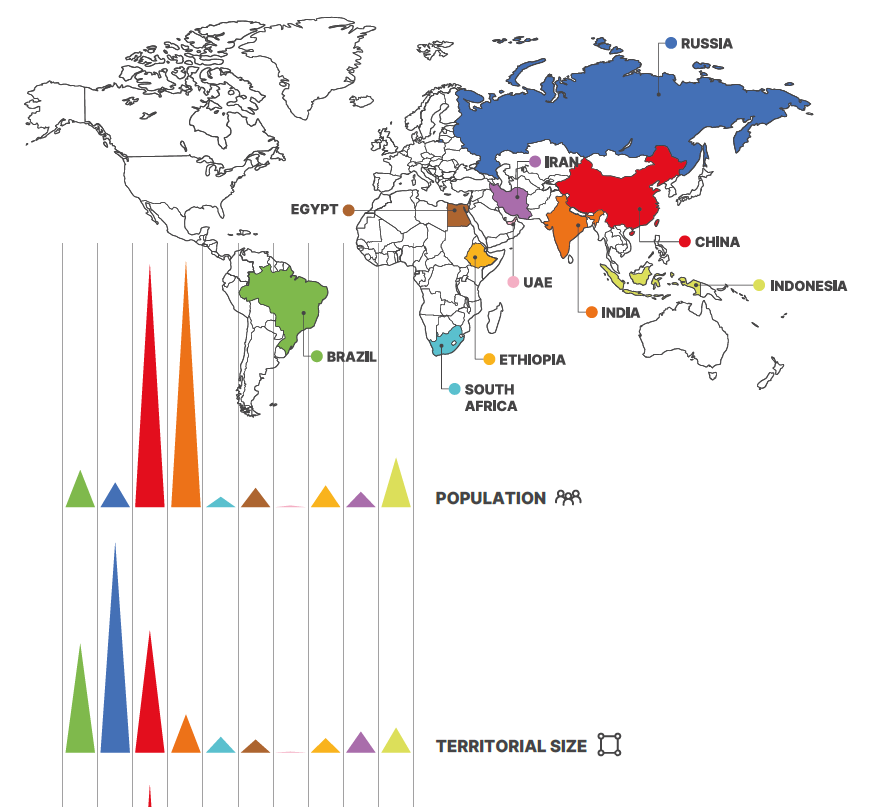
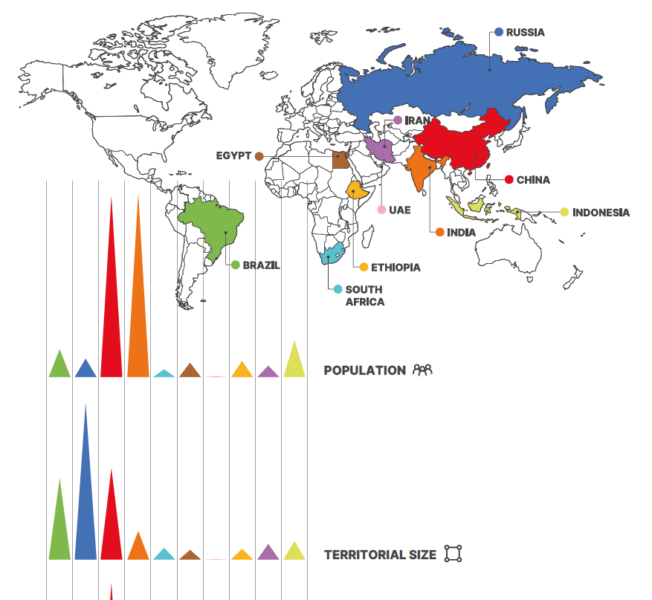
BRICS is a grouping of the largest emerging economies in the world: Brazil, Russia, India, China, South Africa, Egypt, the United ArabEmirates, Ethiopia, Iran and Indonesia. Its main purpose is to promo-te transformation of the global governance system established after World War II through the reform of traditional financial institutions such as the International Monetary Fund (IMF) and the World Bank. Additionally, it aims to contribute to the construction of a multipolar order that reflects the power distribution of the 21st century.
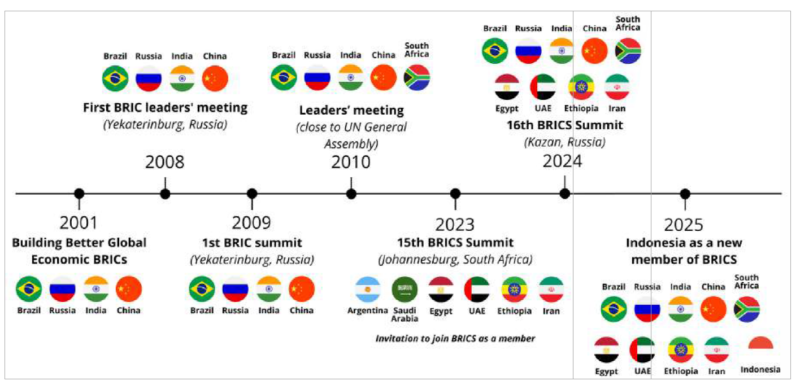
Since 2009, the grouping has held annual meetings, chaired by one of its member countries. The first BRIC Summit – still without South Africa – took place in 2009 in Yekaterinburg, Russia. Starting January 1, 2025, Brazil will assume the rotating presidency of BRICS, under the motto “Strengthening Global South Cooperation for More Inclusive and Sustainable Governance” (Vieira, 2024).
🧩 The Transition from BRIC to BRICS+
The original BRIC – Brazil, Russia, India, and China – was formed around shared economic aspirations. But its transformation into BRICS, and more recently BRICS+, signals a deeper geopolitical ambition: to reform the post-World War II global governance structure, and to challenge the hegemony of the West-dominated IMF, World Bank, and even the U.N. Security Council.
As pointed out by Stunkel (2013), O’Neill did not consider political aspects and projec-ted a group based exclusively on economic indicators. Due to the institutional nature of Goldman Sachs (an investment bank), the text aimed to alert long-term investors to economies that could present more vigorous growth compared to more developed econo-mies, according to the projections (Ramalho, 2017). Despite starting as an announcement, the acronym soon gained international promi-nence (Lima, 2013), as the heads of state and government of Brazil, India, and Russia be-gan to refer to themselves as BRIC members (Stunkel, 2013).
It was in this context that in July 2006 the le-aders of the BRIC countries met for the first time in St. Petersburg, Russia, on the side-lines of the G8 Summit – a group of countries considered the most industrialized and in-fluential in the world, comprising the United States, Japan, Germany, United Kingdom, France, Italy, Canada, and Russia (the latter until 2014, the year of Crimea’s annexation).
In September of the same year, the foreign ministers of the BRIC countries met on the si-delines of the United Nations General Assem-bly, still informally.
In 2008, Russia organized a meeting with the foreign ministers of Brazil, India, and Chi-na, who emphasized the prospects for BRIC dialogue based on mutual trust and respect, common interests, and similar approaches to urgent global development issues (BRIC, 2008). According to Reis (2013), this meeting marked the point where BRIC ceased to be an acronym designating four emerging countries in the global economy and transformed into a political-diplomatic entity. The year 2009 was marked by the first BRIC summit, when the heads of state Lula da Silva (Brazil), Di-mitry Medvedev (Russia), Manmohan Singh (India), and Hu Jintao (China) met in Yekate-rinburg, Russia. On that occasion, the coun-tries agreed to promote intra-BRIC dialogue and cooperation in an incremental, proactive, pragmatic, open, and transparent manner, ai-ming to build a harmonious world of lasting peace and common prosperity (BRIC, 2009).
It was only at the BRIC foreign ministers’ me-eting, held on the sidelines of the UN Gene-ral Assembly in September 2010, that it was decided to incorporate South Africa. The state was invited to participate in the grou-ping’s third summit in 2011, held in Sanya, China, giving rise to BRICS. Since then, the group has continued to hold annual summits, establishing itself as an alternative political–diplomatic mechanism to traditional postwar institutions, composed only of countries that self-represent as developing.
After more than 10 years (2023) with the same format, during the XV BRICS Summit in Johannesburg, South Africa, the bloc took a new step in its expansion, inviting six coun-tries: Saudi Arabia, Argentina, Egypt, the Uni-ted Arab Emirates, Ethiopia, and Iran. Also in 2023, Javier Milei, newly elected president of Argentina, declined the invitation and Saudi Arabia has not yet formalized its accession.1 Except for this one, the other four countries became part of what is now known as BRICS+ on January 1, 2024.
According to Herrero (2024), China played a central role in the group’s expansion. Besides China, Russia also supported the expansion
to protect itself from isolation and Western sanctions resulting from its military invasion of Ukraine in 2022. Regardless of the moti-vation at play, the addition of new members makes BRICS more representative of develo-ping countries and strengthens their voices on the global stage.
During the XVI BRICS Summit in 2024, in Ka-zan, Russia, the creation of a new category of country membership in the group’s struc-ture was announced. In the Kazan Declara-tion (BRICS, 2024), the final document of the Summit, the group confirmed the establish-ment of the “BRICS Partner Countries” cate-gory: countries that can join the group but with limited participation and no voting rights. The invitations were made by Russia, con-sulting whether the countries really wanted to join the grouping as Partners. Since Janu-ary 2025, under the Brazilian presidency, the grouping has officially included the following partner countries: Belarus, Bolivia, Kazakhs-tan, Cuba, Malaysia, Nigeria, Thailand, Ugan-da and Uzbekistan.
At the beginning of January 2025, under the Brazilian presidency, Itamaraty confirmed In-donesia’s formal entry into the grouping as a full member. The Southeast Asian country’s candidacy had been approved by the other members in August 2023, in the context of the process of expanding BRICS’ member-ship. However, due to presidential elections in 2024, Indonesia formally informed the group of its interest in joining BRICS only after the formation of a new government.
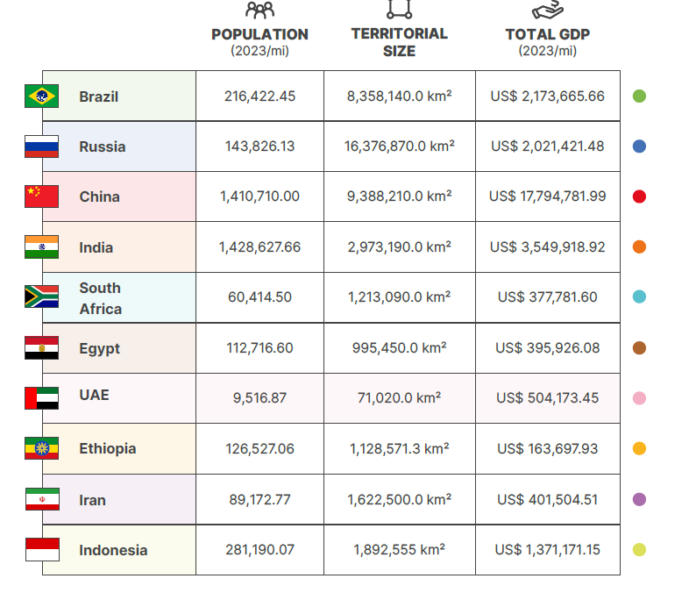
The expansion in 2023—bringing in Ethiopia, Egypt, the UAE, Iran, and others—was not merely a numbers game. It was, in the words of Chinese President Xi Jinping, “a response to the lagging reform of global governance and a step towards a multipolar world order.” The bloc now represents over 45% of the world’s population and nearly 36% of global GDP, forming a powerful counterweight to the G7.
💬 Leaders Speak: Unity in Diversity
“We want to reaffirm the bloc’s vocation in the fight for a multipolar world and less asymmetrical relations between countries,”
— President Luiz Inácio Lula da Silva, Brazil
“BRICS should be a vanguard for advancing global governance reform,”
— President Xi Jinping, China
“Our strength lies in our belief in diversity and multipolarity,”
— Prime Minister Narendra Modi, India
These voices, though ideologically and culturally distinct, are harmonizing under one banner: an urgent call for inclusivity, sovereignty, and rebalanced power in international decision-making.
💰 Economic Tools of Influence: The New Development Bank
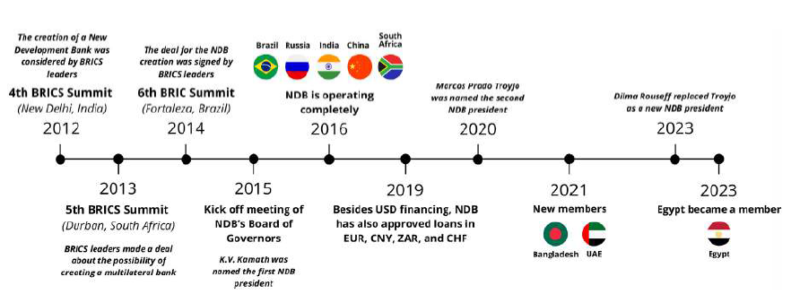
Created in 2014, the New Development Bank (NDB) has become the financial engine of the BRICS vision. With over 40% of its loans now directed to energy transition and sustainability projects, NDB stands as a viable alternative to Western-dominated finance systems.
Under the presidency of former Brazilian President Dilma Rousseff, the bank extended $1.115 billion in climate resilience and recovery funds to Brazil’s Rio Grande do Sul state. With members such as Bangladesh, UAE, and Uruguay (some not even BRICS members), the NDB reflects BRICS’ fluid and inclusive institutional architecture.
📊 BRICS By the Numbers
- 50% of intra-BRICS trade value (2020) is driven by China
- US$ 334 billion total intra-BRICS trade by 2020 (up from US$ 17 billion in 2000)
- $181.9 billion in intra-BRICS foreign direct investment led by China
- Over 70% of BRICS energy-transition projects are aimed at decarbonization
These figures highlight China’s outsized economic influence, but also the bloc’s growing internal interdependence and capacity to challenge Western institutions on their own terms.
🌍 Africa at the Core of BRICS+
The inclusion of Ethiopia and Egypt solidifies Africa’s strategic presence in the group. For Ethiopia, BRICS+ opens access to development financing, global policy influence, and stronger diplomatic partnerships without dependency on traditional Bretton Woods systems.
“Africa is no longer a peripheral player. Through BRICS, we are part of defining the rules, not just following them,”
— [Ethiopian Media Delegate, interview with ANC]
But economic disparity remains stark. Ethiopia’s GDP ($163 billion) pales in comparison to China’s ($17.7 trillion). Still, the symbolism of inclusion carries weight in challenging Western narratives of African marginalization.
🗳️ A Political Alternative to Western Hegemony?
Critics argue that BRICS+ is a fragmented alliance lacking a unified agenda. Differences in governance systems, human rights policies, and economic strategies abound. Yet, recent BRICS voting patterns at the UN on issues like Palestine, Ukraine, and Syria show strategic alignment on sovereignty and anti-Western intervention.
“The bloc reflects a common critical reading of global power distribution,”
— Valdemar Carneiro Leão, Brazilian Diplomat & BRICS Scholar
BRICS countries now use civil society forums, business councils, and even women’s alliances to influence soft power dimensions—something G7 and NATO never achieved at this scale in the Global South.
🚀 Looking Ahead to Brazil 2025
With Brazil presiding over BRICS and having just concluded its G20 leadership, Lula’s government seeks to synchronize both platforms. Key priorities for 2025 include:
- Facilitating trade using local currencies
- AI governance for sustainable development
- Global health cooperation post-COVID
- Financing climate action ahead of COP 30 (Belem 2025)
- Institutional strengthening of the BRICS framework
This roadmap reflects BRICS’ strategic shift from reactive coalition to proactive global designer.
📌 Conclusion: The BRICS Moment Is Now
What was once an acronym is now a geopolitical force, challenging long-standing norms, advocating for equity, and giving voice to the marginalized Global South. With new members, new priorities, and growing legitimacy, BRICS+ is no longer asking for a seat at the table—it’s helping build a new one.
As Brazil prepares to host the 2025 Summit, one thing is clear: the world is watching, and BRICS is determined to reshape it.








