




WRI exposes Africa’s ocean implementation gap as COP31 turns attention to marine protection, climate finance and the future of responsible technology
By Ayele Addis Ambelu
ANTALYA, Türkiye — The world’s oceans are a frontline in the fight against climate change. However, at COP31 a major question is emerging: are governments prepared to turn their ocean commitments into real action?
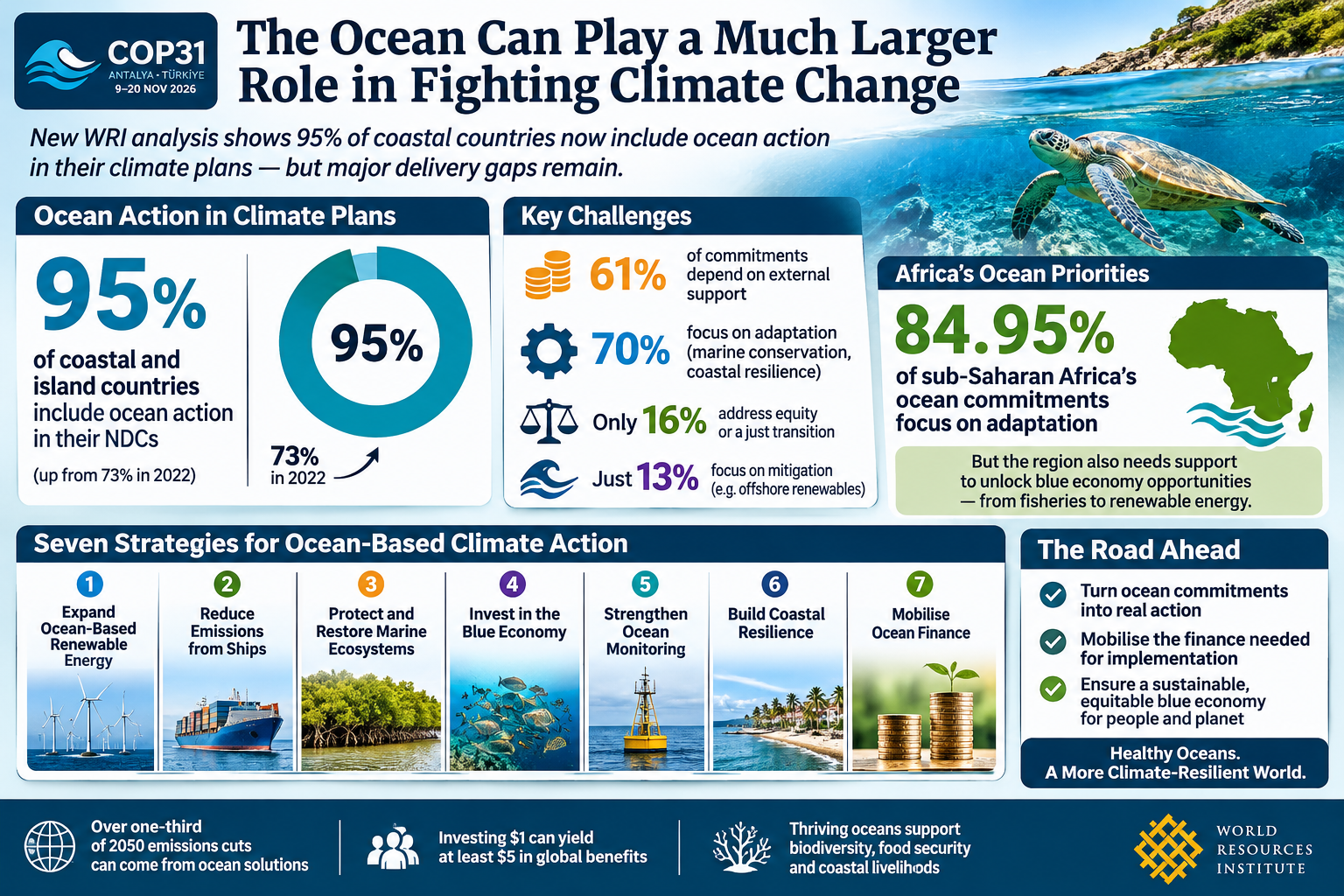
A new WRI analysis on 16 November shows 95% of coastal and island nations include ocean climate action in their NDCs. This is up from 73% in 2022. The study examined 108 national climate plans. It identified 1,281 ocean-related commitments, demonstrating a significant rise in international recognition of the ocean’s role in climate policy.
Yet behind this progress lies a substantial implementation challenge. More than 60% of the commitments depend at least partly on external support. Additionally, countries still face shortages of finance, institutional capacity, technology, and policy frameworks. They also lack sufficient technical expertise and monitoring systems.
Findings reveal a growing contradiction in global climate action. Governments recognize the ocean in climate strategies, but many lack resources and capacity to deliver promises.
As COP31 enters its second week in Antalya, the gap between ambition and implementation is growing. It is becoming one of the most important questions for the future of ocean protection and the sustainable blue economy.
THE OCEAN’S CLIMATE POTENTIAL: A SOLUTION STILL UNDERFINANCED
The ocean is not simply a victim of climate change. It is also one of the planet’s most important potential sources of climate solutions.
Research commissioned by the High Level Panel for a Sustainable Ocean Economy shows ocean-based solutions could deliver more than one-third of needed emissions reductions by 2050. This would help keep the 1.5°C target within reach.
These solutions include offshore renewable energy. Additionally, mangroves and seagrass ecosystems are restored. They cover sustainable fisheries and aquaculture, low-carbon maritime transport, and protecting marine biodiversity.
The economic and environmental benefits could be substantial. Healthy coastal ecosystems can protect communities from storms and coastal erosion, support fisheries, preserve biodiversity and strengthen food security. Sustainable ocean industries can also create jobs and new economic opportunities.
However, the investment gap remains a serious obstacle. The WRI analysis suggests that countries need more than project funding alone. They require stronger public institutions, reliable scientific data, technical expertise, clear regulations and effective monitoring systems to make ocean commitments achievable and investment-ready.
This raises an urgent question for COP31: if ocean-based solutions can make such a significant contribution to climate action, why does their implementation continue to face such serious financial and institutional barriers?
AFRICA’S OCEAN PRIORITIES: ADAPTATION WITHOUT ENOUGH IMPLEMENTATION SUPPORT
For Africa, the WRI findings reveal a particularly important regional challenge.
In sub-Saharan Africa, 84.95% of ocean-related climate commitments focus on adaptation. Coastal-zone management and fisheries are among the leading priorities, reflecting the region’s need to reduce disaster risks, protect food security and sustain the livelihoods of coastal communities.
Mangrove protection, disaster-risk reduction and improved governance also feature prominently in the region’s conservation commitments.
This emphasis reflects the realities facing African coastal countries, where rising sea levels, coastal erosion, extreme weather, marine ecosystem degradation and pressure on fisheries threaten communities and economic activities.
But the regional picture also raises a question about whether Africa’s ocean economy is receiving sufficient attention as an opportunity for low-carbon industrial development.
The WRI analysis finds that only around 13% of all ocean commitments focus on sectors with major mitigation potential, including offshore renewable energy, low-carbon aquatic food systems and the transition away from offshore oil and gas.
The imbalance matters. Africa needs coastal protection and adaptation, but it also needs opportunities to develop sustainable fisheries, modernise maritime transport, expand renewable energy and build industries that generate employment without destroying marine ecosystems.
The challenge is therefore not to replace adaptation with mitigation. It is to connect both priorities through policies and investment that protect communities while creating sustainable economic opportunities.
THE EQUITY QUESTION: WHO BENEFITS FROM THE BLUE ECONOMY?
One of the most concerning findings in the WRI analysis is that only around 16% of ocean actions explicitly address equity or a just transition.
This raises questions about who participates in decisions concerning marine resources, who receives the benefits of new investment and who bears the costs of environmental damage.
Small-scale fishing communities, coastal women, young people and workers whose livelihoods depend on marine ecosystems must not become marginal participants in the transition to a blue economy.
A sustainable ocean economy should not be measured only by investment volumes, export earnings or the expansion of marine industries. It should also be judged by whether local communities have secure livelihoods, access to resources, meaningful participation and a fair share of economic benefits.
For African countries, this is especially important as they seek to attract investment in coastal infrastructure, fisheries, aquaculture, marine tourism and renewable energy.
Without effective safeguards and community participation, the expansion of the blue economy risks reproducing existing inequalities under the language of climate action.
COP31’S BLUE NDC TASKFORCE: CAN IT TURN COMMITMENTS INTO RESULTS?
The WRI findings arrive as COP31 prepares to give greater attention to ocean action through its Ocean, Seas, Nature and Land Use thematic day on 17 November.
A key development is the planned launch of the Blue NDC Taskforce, which aims to connect governments with delivery partners, technical experts and project-preparation support to help countries implement their ocean-related climate commitments.
The initiative could address some of the barriers identified in the WRI study, particularly the need for stronger institutional capacity, technical expertise and project development.
However, the taskforce’s real contribution will depend on what happens after the announcement.
Will it help countries secure actual financing? Will it support projects identified by African governments? Will local fishing communities and coastal businesses participate in project design? And will progress be measured through publicly available results?
The distinction between technical assistance and direct financial support will also be important. Connecting countries with project preparation and delivery partners is valuable, but it does not automatically guarantee that projects will receive the grants, concessional loans or investment they need.
COP31 must therefore demonstrate how the new initiative will move from coordination to measurable implementation.
AI AND CLIMATE ACTION: TECHNOLOGY’S PROMISE AND ITS DANGEROUS EDGES
While ocean action highlights the gap between climate commitments and implementation, another important debate at COP31 is emerging around artificial intelligence and its environmental consequences.
Speaking at the High-Level Green Digital Action Roundtable on 16 November, UN Climate Change Executive Secretary Simon Stiell warned that AI and other frontier technologies represent both enormous opportunities and serious risks.
“AI and other frontier technologies are a double-edged sword. The task ahead is to blunt their dangerous edges, sharpen their catalytic ones, and put these technologies responsibly to work,” he said.
His warning comes as demand from data centres places increasing pressure on electricity systems. Where this demand is met through fossil-fuel power, AI infrastructure can contribute to additional emissions. Stiell also warned that the environmental costs of data centres must not simply be passed on to households and businesses.
He called on technology companies to disclose their energy and water consumption, invest in efficiency and power data centres with renewable energy.
His message is particularly relevant to developing countries, where access to finance, computing capacity and reliable data remains unequal.
“The energy transition already risks moving at two speeds. AI must help to close that divide,” Stiell said.
The challenge is to ensure that AI becomes a practical tool for climate resilience rather than another source of environmental pressure and technological inequality.
TANZANIA’S CLIMAID: AN AFRICAN EXAMPLE OF AI FOR CLIMATE RESILIENCE
One encouraging development is the recognition of African innovation through the 2026 AI for Climate Action Award.
Upendo Ernest Lyimo of Tanzania won the award for CLIMAID, an AI-powered platform that combines climate data, satellite observations and local vulnerability information to support early warning, climate-risk assessment and adaptation planning.
The project illustrates how locally developed technologies can help communities and decision-makers respond to climate risks.
For countries facing floods, droughts and other climate-related hazards, tools that combine scientific information with local vulnerability data can strengthen preparedness and planning.
Stiell highlighted the award as evidence that developing countries must help shape the future of AI and share its benefits.
The recognition also raises a wider African question: how can governments, universities, technology companies and climate-finance institutions support locally developed innovations so they can move beyond individual projects and reach more communities?
The experience of CLIMAID offers a useful contrast with the broader technological divide. Rather than treating AI simply as an advanced industrial product, it demonstrates its potential as a practical instrument for adaptation and public benefit.
THE BIGGER COP31 QUESTION: FROM ANNOUNCEMENTS TO ACCOUNTABILITY
The ocean and AI discussions reveal a common challenge at COP31: climate solutions cannot succeed through announcements alone.
Ocean commitments need finance, institutions, scientific monitoring, technology and community participation. AI climate solutions need reliable data, affordable computing capacity, clean electricity, environmental safeguards and investment in local innovation.
Both debates also expose inequalities between countries with strong technological and financial capacity and those that remain dependent on external support.
For Africa, the priority is to ensure that international climate initiatives respond to national development needs and deliver practical benefits. That means securing support for coastal resilience, fisheries, marine conservation, renewable energy, climate research and locally developed technology.
The 95% figure reported by WRI demonstrates that ocean action has become widely recognised in national climate planning. But the 61% figure for conditional or partly conditional commitments shows how much remains dependent on external support.
The measure of COP31’s success will not be how many new initiatives are announced in Antalya. It will be whether countries can secure the resources and partnerships needed to implement their plans, protect vulnerable communities and build sustainable economic opportunities.
The ocean is already part of the world’s climate strategy. The unanswered question is whether the world is prepared to invest in making that strategy work.
KEY FIGURES AT A GLANCE
| Finding | Evidence |
|---|---|
| Coastal and island NDCs including ocean action | 95% |
| NDCs analysed by WRI | 108 |
| Ocean commitments analysed | 1,281 |
| Commitments dependent at least partly on external support | 61% |
| Ocean commitments focused on adaptation | 69.9% |
| Ocean actions explicitly addressing equity | Around 16% |
| Sub-Saharan African commitments focused on adaptation | 84.95% |
| Potential share of 2050 emissions cuts from ocean solutions | More than one-third |
Source: World Resources Institute, The State of Ocean-Based Climate Action in 2025–26 Nationally Determined Contributions; WRI analysis released 16 November 2026.
This story was produced as part of the COP31 Climate Change Media Partnership, a journalism fellowship organized by Internews’ Earth Journalism Network, Informed Earth and the Stanley Center for Peace and Security.
This story was produced as part of the COP31 Climate Change Media Partnership, a fellowship for journalists covering the UN climate talks.








