





ANTALYA, Türkiye | Saturday, 14 November 2026
By Ayele Addis Ambelu
COP31 is moving from leaders’ speeches into the harder work of negotiating what governments will actually agree to do. The past 24 hours have produced three important signals: the Australian negotiating presidency has published a first summary of proposals for a possible political decision; the United Kingdom, Norway and Canada have announced a climate-investment initiative with a headline target of US$10 billion; and outgoing UN Secretary-General António Guterres has delivered a final warning about fossil-fuel influence and the consequences of delayed action.
But none of these developments yet amounts to a new binding COP31 agreement. We still have unresolved central questions: whether the political text will commit governments to stronger action on fossil fuels.
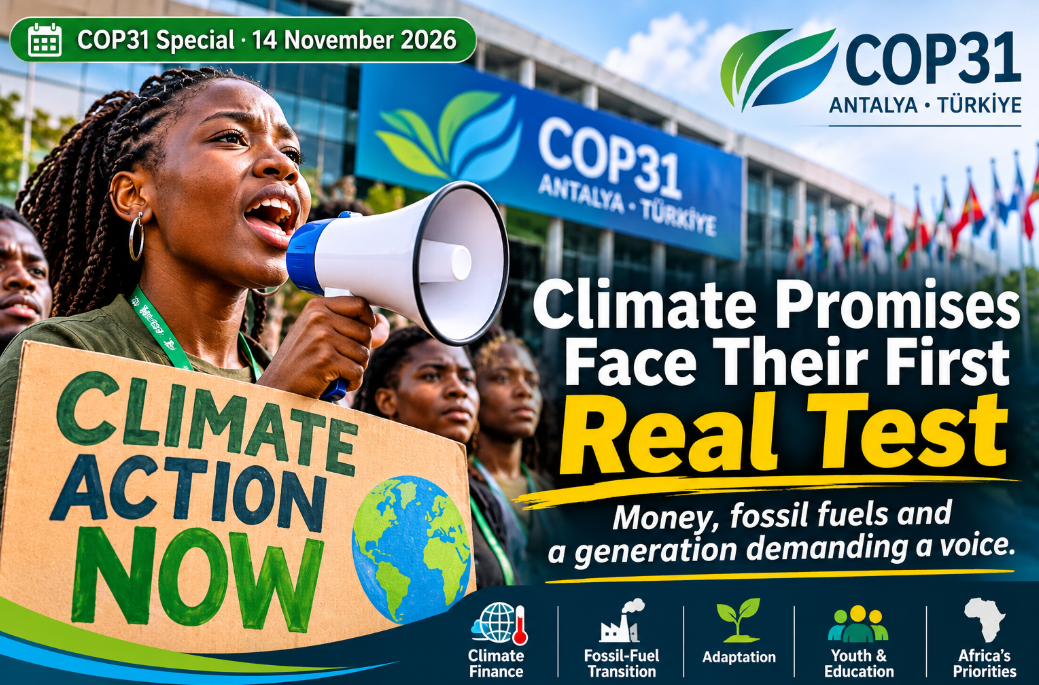
Today’s official theme, Children, Youth, Education and Skills, brings those questions into sharper focus.
The proposed COP31 political decision moves forward — but consensus remains distant
Negotiations unresolved
On 13 November, the COP31 negotiating presidency issued the document Summary of Reflections Expressed by Parties During Consultations on the Proposed Cover Decision. It is an important step towards a possible political decision at the end of the conference.
During consultations on 10 and 11 November, participants expressed views, and the document informally summarizes them. It is not a negotiated text, does not represent consensus, and does not indicate how many countries support each position. UNFCCC
The document reveals the breadth of the political disagreement. Issues raised by Parties include:
- Whether the final decision should explicitly address the likelihood of overshooting the 1.5°C temperature goal, and how to minimise the magnitude and duration of that overshoot.
- Whether to include language on the transition away from fossil fuels in energy systems and the phase-out of inefficient fossil-fuel subsidies.
- Whether developed countries should deliver their climate-finance obligations, including predictable, grant-based, and concessional finance.
- We should determine whether global electrification should reach 35% by 2035 and whether we should explicitly link that expansion to renewable energy.
- Whether the final text should address unilateral climate-related trade measures, strengthen ocean-climate cooperation, and recognise the role of children, youth and Indigenous Peoples.
The next procedural milestone is close: countries have until late Saturday, 14 November, to submit further views. The Guardian reports that the political text’s first draft is expected early next week. The Guardian+1
Why this matters: The cover decision could provide the political direction for the second week. But the language eventually agreed will depend on whether governments can bridge differences over fossil fuels, historical responsibility, finance and national development choices.
For journalists, distinguish between a proposal in the reflection note and a commitment that Parties accept. Those are not the same thing.
Guterres’ farewell warning puts fossil-fuel influence and electrification at the centre of the debate
Major political signal
On Friday, 13 November, António Guterres gave what many called his climate-summit press conference in his role as UN Secretary-General. He called for immediate and drastic reductions in greenhouse-gas emissions and warned that climate impacts are worsening hunger, displacement, poverty and instability.
One of his strongest statements was:
“You cannot build peace on a burning planet.”
He also called on wealthy countries to honour their previous climate-finance promises and contribute more. Referring to the adaptation-finance gap, he said:
Even tripling adaptation finance would cover less than 30 percent of what is needed.
The Associated Press reported both quotations. AP News
The electrification question
Türkiye is promoting a proposed global goal to increase electricity’s share of total energy consumption from approximately 21% to 35% by 2035.
The proposal could accelerate the electrification of transport, buildings, heating and industry. But an important issue remains: the proposed target does not require the additional electricity to come from renewable sources.
The Climate TRACE finds emissions reductions around 14% when electrification uses clean energy, about 7% with fossil fuels. These are estimates reported by AP, not agreed COP31 outcomes.
Brazil’s previously presented transition roadmap provides a contrasting policy direction. It identifies measures such as stopping construction of new fossil-fuel power plants and reducing fossil-fuel subsidies. The roadmap is an implementation proposal, not a binding decision adopted by COP31.
The editorial issue: Electrification is not automatically decarbonisation. The quality of the power supply matters. If electricity demand grows and fossil-fuel generation remains locked in, we will substantially weaken the climate benefits.
Guterres also warned about the disproportionate influence of fossil-fuel interests in climate policymaking. A new civil-society analysis, discussed below, reinforces that warning.
The government announces a US$10 billion climate initiative but the adaptation-finance gap remains enormous.
New financing initiative
On 13 November, development-finance institutions from the United Kingdom, Norway and Canada announced a joint initiative intended to direct US$10 billion towards climate projects in emerging markets by 2030.
The partners are:
- British International Investment;
- Norway’s Norfund;
- FinDev Canada.
Under a memorandum of understanding, the institutions will share investment pipelines, coordinate due diligence and cooperate on climate reporting. The initiative aims to support renewable energy, electricity grids, energy storage, sustainable fuels, and industrial decarbonisation.
But the US$10 billion target includes private capital the institutions expect to attract. The figure should not be reported as US$10 billion in new public grants or as money already disbursed. The announcement does not, by itself, specify how much will reach African countries or on what financial terms.
The wider climate-finance picture
The latest joint reporting by multilateral development banks shows that in 2025:
| Finance indicator | Reported amount |
|---|---|
| MDB climate finance for low- and middle-income economies | US$103 billion |
| Of this, adaptation finance | US$35 billion |
| Private finance mobilised in these economies | US$35 billion |
The report includes the US$35 billion adaptation figure in the US$103 billion total. They report private finance mobilised separately. These aggregate figures do not tell us how much was disbursed to African governments or communities, or how much was provided as grants rather than loans.
The gap is particularly stark in adaptation. UNEP’s Adaptation Gap Report 2026 estimates that developing countries will need around US$305 billion annually by 2035. International public adaptation finance from developed to developing countries reached only US$28.2–31.7 billion in 2024.
Even if the COP30 aspiration to triple international public adaptation finance by 2035 is achieved, UNEP estimates it would cover only 20–29% of developing countries’ needs. UNEP – UN Environment Programme
Loss and damage remains another major financing challenge. However, UNEP reports that the first funding round generated requests worth US$2.8 billion, exceeding the initial envelope of US$342 million. This indicates substantial unmet demand, although it does not establish the full global loss-and-damage financing gap. UNEP – UN Environment Programme
The central distinction for reporting: financing targets, institutional commitments, private capital expected to be mobilised, approved projects and money actually reaching affected communities are different measures. Moreover, COP31’s finance announcements should be assessed against all of them.
Africa’s negotiating priorities: a finance-work-programme opening, but no settled adaptation-finance baseline
African negotiators have secured some important negotiating space, but their central demand for clarity on adaptation finance remains unresolved.
Additionally, the African Group of Negotiators (AGN) secured the inclusion of the Climate Finance Work Programme in the COP31 agenda. AGN Chair Nana Dr Antwi-Boasiako Amoah told the According to the Ghana News Agency, the outcome provides an opportunity to discuss guidance for the Green Climate Fund. that the outcome also provides an opportunity to discuss guidance for the Green Climate Fund ahead of its next funding round. The group also secured a route for countries to contribute to future discussions on climate and trade. Additionally, Ghana News Agency, 12 November 2026. Ghana News Agency
However, the AGN’s effort to secure a separate formal agenda item on tripling adaptation finance did not succeed. The issue can still be pursued through other negotiating tracks, including the Climate Finance Work Programme and the Global Goal on Adaptation.
Therefore, the group seeks a clear baseline and a measurable financing trajectory. Without an agreed baseline, governments will struggle to establish whether adaptation finance is genuinely increasing and whether the tripling aspiration is being fulfilled.
The AGN’s just-transition position is also significant. African countries have stressed that a fair transition must address food security, industrialisation, economic diversification, financing and the barriers created by unilateral trade measures. A transition defined only through decarbonisation targets, without resources for development, risks overlooking the economic realities of many African countries. African Climate Wire
The Presidency’s 13 November reflection note records calls for grant-based and concessional finance, stronger replenishment of the Green Climate Fund and other climate funds, simpler access procedures, and a way to track progress on adaptation finance. These remain proposals and negotiating positions, not agreed commitments.
Why this matters for Africa: The test is no longer simply whether adaptation finance is mentioned in the final text. It is whether the text identifies a baseline, a timetable, an accountable process and financial terms that do not deepen the debt burdens of vulnerable countries.
Today’s theme has a direct connection to the climate crisis facing children across Eastern and Southern Africa.
A UNICEF and Dalberg report published in April 2026 estimates that climate-related disruptions affected 130 million children across the region between 2005 and 2024. The report estimates US$1.3 billion in direct damage to education systems and up to US$140 billion in future earnings losses. It warns that projected losses could rise to US$380 billion by 2050 as climate impacts intensify.
The report includes country analysis from Ethiopia, Kenya, Mozambique, Somalia and Zambia. In Ethiopia, UNICEF reports that rising temperatures and more frequent heatwaves affect an estimated 83% of children and are already disrupting school attendance, concentration and learning outcomes. Education receives less than 1.5% of global climate finance, according to the report.
This makes today’s discussion about education more than a question of curriculum. It is also about protecting school buildings from floods and heat, keeping children learning during climate emergencies, ensuring access to electricity and water, and financing education systems that can withstand climate shocks.
The accountability test: Will the commitments made at COP31 translate into climate-resilient schools, funded vocational training, green employment pathways and meaningful participation for young people and women?
Implications for Africa, Ethiopia and East Africa
The latest developments point to six priorities for African reporting and negotiation monitoring.
1. Track the real value of finance. The US$10 billion initiative has no announced Africa allocation and includes expected private capital. African governments and journalists should seek country-level information on grants, loans, guarantees, interest rates, disbursement schedules and local benefits.
2. Demand a measurable adaptation-finance baseline. The AGN’s call for a baseline is essential. Without it, the promise to triple adaptation finance cannot be properly tracked or held accountable.
3. Keep the transition tied to clean power. The proposed 35% electrification goal should be assessed against the source of electricity, affordability, grid access, storage and the risk of new fossil-fuel dependence. For Ethiopia and East Africa, reliable renewable electricity and transmission infrastructure are central to the development benefits of electrification.
4. Put education into adaptation and loss-and-damage finance. UNICEF’s evidence on school disruption in Ethiopia, Kenya and neighbouring countries provides a strong case for climate-resilient education to be reflected in National Adaptation Plans, national budgets and climate-fund proposals.
5. Defend African economic interests in climate-trade negotiations. The AGN’s concerns about unilateral trade measures deserve scrutiny. Journalists should investigate how carbon-related import rules may affect African exporters, manufacturers, farmers and mineral supply chains.
6. Examine who has access to decision-making. The polluter-influence report should prompt questions about transparency, conflict-of-interest safeguards and the representation of affected communities, not just the number of people registered at the summit.
This story was produced as part of the COP31 Climate Change Media Partnership, a journalism fellowship organized by Internews’ Earth Journalism Network, Informed Earth and the Stanley Center for Peace and Security.
This story was produced as part of the COP31 Climate Change Media Partnership, a fellowship for journalists covering the UN climate talks.








