How trade, food security, investment, infrastructure and technology are reshaping an old relationship and why Africa wants the partnership measured in factories, jobs, skills, value addition and market access.
By Ayele Addis Ambelu, (africaunionmedia@gmail.com) : Journalist | Global Analyst | Africa Union Media Fellow
THE RUSSIA-AFRICA: THE RELATIONSHIP IS MOVING FROM DIPLOMACY TO DEALS
The Russia–Africa relationship is increasingly visible outside presidential meeting rooms. It can be traced through a coffee shipment leaving Ethiopia, fertilizer entering an African agricultural market, machinery being discussed for local production, engineers working on a nuclear power project in Egypt, and officials in Addis Ababa debating how trade and investment can fit Africa’s industrial ambitions.
The numbers are beginning to tell the same story.
Russia–Africa trade turnover was reported at $27.7 billion for 2025 by Irina Abramova, director of the Institute for African Studies of the Russian Academy of Sciences. Russian Foreign Minister Sergey Lavrov, writing before the December 2025 Russia–Africa Partnership Forum ministerial conference, separately said trade with Africa had exceeded $27 billion in the previous year. The figures come from different Russian officials and reporting points, so they should not be treated as interchangeable series. What they do show is the scale of a relationship that Moscow wants to expand and African governments increasingly want to make more commercially useful.
In October 2025, Russian President Vladimir Putin put the market logic plainly. Speaking at the Valdai Discussion Club, he said Russia wanted to “focus primarily on the rapidly growing markets of Africa and South Asia” and to integrate into that development trend, including through work in African markets. [S1]
That sentence matters because it describes the relationship in economic rather than purely diplomatic terms. Africa is a market, a source of commodities, a destination for capital and technology, and a continent whose future consumption and production patterns will influence global commerce.
But Africa is also asking a harder question: what kind of partnership will the growth produce?
South African President Cyril Ramaphosa gave one answer at the 2023 Russia–Africa Summit in St Petersburg: “We seek reciprocal trade and investment.” He argued that African goods, products and services should compete on an equal footing in the global economy and welcomed cooperation that could build value chains and manufacturing capacity.
That distinction between growing trade and transformative trade is at the centre of the new economic frontier.
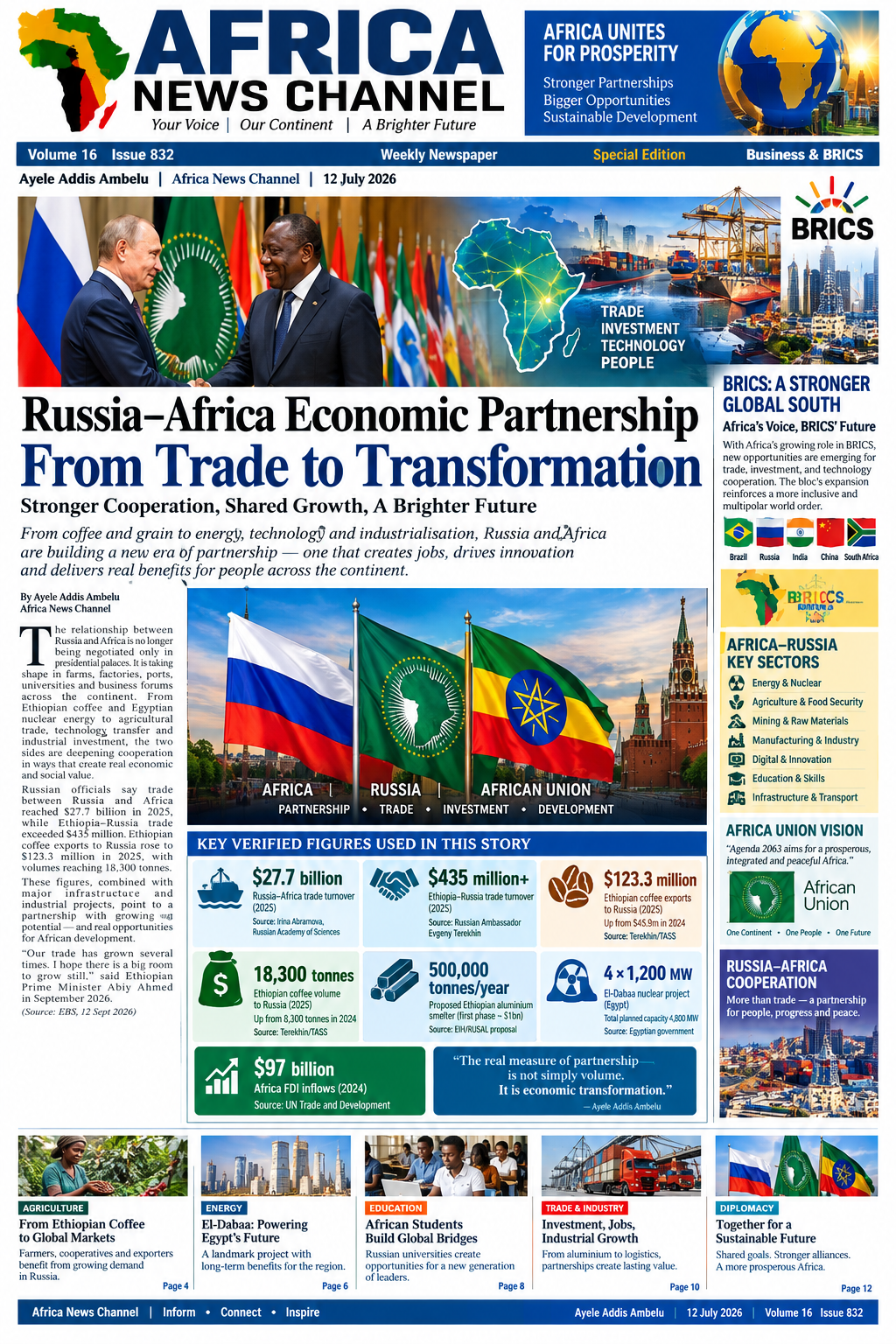
| $27.7bn RUSSIA–AFRICA TRADE 2025 | Reported by Irina Abramova, Russian Academy of Sciences | $435m+ ETHIOPIA–RUSSIA TRADE 2025 | Russian Ambassador Evgeny Terekhin |
| $123.3m ETHIOPIAN COFFEE EXPORTS 2025 | Up from $45.9m in 2024; Terekhin/TASS | 18,300 t ETHIOPIAN COFFEE VOLUME 2025 | Up from 8,300 tonnes in 2024 |
| 500,000 t/yr PROPOSED ALUMINIUM CAPACITY Ethiopia | EIH/RUSAL proposal; first phase about $1bn | 4 × 1,200 MW EL-DABAA NUCLEAR PROJECT Egypt | Total planned capacity: 4,800 MW |
| $97bn AFRICA FDI INFLOWS 2024 | UN Trade and Development |
THE NUMBER IS GROWING, BUT THE COMPOSITION MATTERS
Russia’s trade relationship with Africa has expanded, but its structure remains uneven.
Russian Foreign Ministry officials have acknowledged that a large share of Russia’s African trade is concentrated in North Africa. That geography is important because it means the headline continental figure does not automatically describe the experience of sub-Saharan economies. Egypt, Algeria, Morocco and Tunisia have long-standing commercial links with Russia, while countries farther south are building or rebuilding market connections from a smaller base.
The December 2025 Russia–Africa Partnership Forum ministerial statement recognized the need to increase and diversify trade and investment and called for partnerships involving manufacturing and industrial capabilities, transport and logistics infrastructure, energy, fertilizers, metallurgy, digitalisation, pharmaceuticals, medical equipment, professional training and technology transfer.
The African Union’s own high-level consultations with Russia in Addis Ababa on 7 July 2026 made a similar connection. The AU and Russia identified infrastructure, energy, industrial development, transport connectivity and technological advancement as areas for cooperation. They also agreed that future economic cooperation should align with Agenda 2063, the African Continental Free Trade Area and Africa’s industrialisation and economic-transformation agenda.
The significance is easy to miss.
A trade relationship can grow while the underlying economic structure remains unchanged. A country can export more coffee without processing more coffee. It can import more machinery without developing the technicians to maintain it. It can attract a large investment without building a domestic supplier network. It can receive a power plant without creating enough local expertise to sustain the technology ecosystem around it.
For African economies, therefore, the central question is not simply how much trade increases. It is how much value remains in Africa.
That is why the African Union’s emphasis on industrialisation and AfCFTA is important. The continental market is intended to make it easier for African producers to move beyond fragmented national markets and participate in regional value chains.
Russia’s interest in African markets and Africa’s interest in Russian technology, inputs, capital and consumers can meet at that point — if commercial relationships move beyond buying and selling toward production, processing, skills and investment.
ETHIOPIA: A FAST-GROWING BILATERAL RELATIONSHIP
Ethiopia offers one of the clearest recent examples of the acceleration.
According to Russia’s Ambassador to Ethiopia, Evgeny Terekhin, bilateral trade turnover in 2025 nearly tripled from the previous year and exceeded $435 million. He linked part of the increase to major investment projects and identified Russian fertilizers, agricultural machinery and energy equipment alongside Ethiopian coffee, flowers and textiles as important drivers.
The figure remains modest compared with Ethiopia’s largest global trading relationships. Its significance is therefore less about absolute size than about the speed and changing composition of the relationship.
In the first half of 2025, Terekhin said bilateral trade had already risen to $191.2 million, more than double the level of the corresponding period a year earlier.
Then came the September 2026 meeting between Ethiopian Prime Minister Abiy Ahmed and Russian President Vladimir Putin on the sidelines of the BRICS Summit in New Delhi.
In the published transcript, Abiy said: “Our trade has grown several times. I hope there is a big room to grow still.” He also thanked Russia for cooperation in trade, investment and scholarships and referred to the bilateral relationship in defense, trade, investment and education.
That is the strongest version of the quotation currently supported by the public transcript. The earlier wording in the original draft describing Russia as a “true friend of Africa” and a “balance power” has been removed from this final article because it was not independently verified in the published transcript. If the author’s audio contains that statement, it should be checked against the recording before any future publication.
Abiy’s documented remark captures the central economic issue: the relationship has grown, but the ceiling is still undefined.
COFFEE: WHEN A BILATERAL RELATIONSHIP REACHES THE FARM
Few products make the economics of the relationship easier to understand than Ethiopian coffee.
According to figures cited by Ambassador Terekhin in February 2026, Ethiopian coffee exports to Russia rose from $45.9 million in 2024 to $123.3 million in 2025. Physical shipments increased from approximately 8,300 tonnes to 18,300 tonnes.
Terekhin described Ethiopian coffee from Sidamo and Harar as well known in Russia and valued for its flavour profile. He also stressed that Russia was not yet among the world’s largest buyers of Ethiopian coffee, suggesting that the expansion had taken place from a relatively limited base.
That detail changes the interpretation of the headline.
A 2.6-fold increase is significant. But percentage growth from a small market does not mean the market has become one of Ethiopia’s dominant destinations. It means that demand and commercial links are developing and that the opportunity can be tested further.
The Russian coffee industry has also signalled interest. Ramaz Chanturia, director general of the Russian Association of Tea and Coffee Producers, described Ethiopia as “one of our reliable suppliers and partners” and said that marketing and direct business connections could help strengthen the relationship.
For Ethiopia, however, the larger opportunity is not simply to sell more green beans.
The value chain includes farmers, cooperatives, washing stations, exporters, logistics providers, banks, insurers, importers, roasters, cafés and consumers. Each stage captures part of the final value.
If more Ethiopian coffee is processed, branded and packaged before export, the economic effect can extend beyond the farm gate. If Ethiopian exporters build stronger direct relationships with Russian roasters and distributors, the commercial chain can become more predictable. If logistics and payment systems become easier, smaller producers may find it easier to participate.
In other words, coffee is not only an export story. It is a test of whether trade can become value creation.
FROM COFFEE TO INDUSTRY: THE RUSAL–ETHIOPIA QUESTION
The most consequential part of the Ethiopia–Russia economic story may eventually be industrial rather than agricultural.
In November 2025, Ethiopian Investment Holdings signed a memorandum of understanding with RUSAL concerning plans for a large aluminium smelter in Ethiopia. EIH says the proposed facility would have annual production capacity of 500,000 metric tonnes and that the first phase is valued at about $1 billion. The project is expected to take three to four years to develop if it proceeds.
The project is not a completed factory. It is a project under development, with feasibility and site-related work forming part of the process. That distinction matters in responsible reporting.
Its potential significance, however, is substantial. Aluminium production could create demand for engineering, construction, maintenance, logistics and technical services. It could support local supplier networks and reduce some reliance on imported aluminium products. But those benefits are possibilities, not automatic outcomes.
The decisive question will be localisation.
How many Ethiopian workers will be trained? How many local firms will enter the supply chain? How much technical knowledge will remain in the country? What environmental and energy requirements will be involved? What market will absorb the output? What financing structure will ultimately be used?
Those questions are not obstacles to partnership. They are the questions that determine whether partnership produces durable economic value.
Terekhin has associated the recent rise in bilateral trade with major investment projects, including the RUSAL–EIH aluminium initiative.
At the same time, Russian companies have been exploring other forms of industrial presence. In March 2026, KAMAZ and Ethiopia’s Ministry of Transport discussed the possibility of localising production of the Russian vehicle manufacturer in Ethiopia. The Russian embassy said the parties discussed trade, economic cooperation and the possibility of local production.
If these discussions develop into manufacturing, the relationship would begin to look different from a conventional commodity-trade model.
Localisation turns an imported product into a potential industrial ecosystem.
RUSSIA’S EXPORTS: FERTILIZER, MACHINERY AND ENERGY
The economic relationship is not a one-way export corridor from Africa to Russia.
Russian exports to African markets include grain, fertilizers, machinery and energy-related products. In Ethiopia, fertilizers have become particularly important.
This has direct relevance for a country whose agricultural economy depends heavily on imported agricultural inputs. Fertilizer availability affects farmers’ production decisions, yields and costs. Agricultural machinery can affect productivity, but only when it is affordable, maintainable and supported by technical skills and spare parts.
That last condition is easy to overlook.
Technology transfer is not achieved merely by shipping equipment across a border. It requires training, maintenance systems, local technical institutions, financing and long-term access to components and knowledge.
Ethiopia and Russia have discussed agricultural cooperation with precisely these issues in mind. In March 2026, Ethiopia’s Agriculture Minister Addisu Arega met a Russian delegation led by Deputy Agriculture Minister Maxim Markovich. ENA reported that the talks covered agricultural inputs, coffee, oil crops and horticulture, mechanisation, agrochemicals, trade, knowledge and technology transfer.
The relationship therefore has two connected sides.
Russia can supply inputs and industrial equipment.
Ethiopia can supply agricultural and other products while developing its own productive capacity.
The economic benefit becomes deeper when those two sides are connected through local skills and investment.
FOOD SECURITY: A TRADE CHANNEL WITH A HUMAN CONSEQUENCE
Grain is where the commercial relationship intersects directly with food security.
Russian officials reported that 5.7 million tonnes of wheat out of 10 million tonnes exported by Russia in the first five months of 2025 went to African countries. Those figures are Russian official figures and should be treated as such; they demonstrate the scale of the trade channel but do not, by themselves, establish the outcome for African food security.
Russia has also highlighted fertilizer supplies and humanitarian deliveries.
Lavrov said in December 2025 that Russia wanted reliable mechanisms for mutual payments in national currencies and reported increased use of the rouble in Russia–Africa trade. He also said Russia had supplied or donated agricultural products and fertilizers and was interested in cooperation in agriculture, irrigation and related technologies.
For African governments, the importance of agricultural imports is practical. Grain prices affect household budgets. Fertilizer prices affect farmers. Shipping and insurance affect landed costs. Payment systems affect whether a contract can actually be completed.
The commercial relationship therefore depends on more than political agreement.
It depends on logistics, finance, insurance, customs, ports and predictable contracts.
That is why the next stage of Africa–Russia trade may be less about announcing new intentions and more about solving the practical bottlenecks that determine whether businesses can trade repeatedly.
THE PAYMENT AND LOGISTICS TEST
Every international trade relationship eventually encounters the same basic questions: How is the transaction financed? In which currency is it settled? Which bank processes it? How does the shipment move? Who insures it? How long does delivery take? What happens when regulations change?
Russia and African partners have been exploring alternatives to conventional payment arrangements.
Lavrov said in December 2025 that Russia wanted “steadfast and reliable mechanisms for mutual payments in national currencies.” He reported that the share of rouble transactions in mutual trade with African partners had increased and said central banks had established direct links. He also referred to Russia’s A7 international financial platform.
Such mechanisms can be commercially useful if they reduce friction. But the test for an African exporter is straightforward: Is the payment method reliable, affordable, compliant with applicable rules and usable by ordinary businesses?
Currency risk also matters.
A payment system does not remove the underlying economic risks of exchange-rate movements. Nor does it automatically solve shipping delays, insurance constraints or the challenge of finding buyers.
This is why logistics and finance deserve to be treated as economic infrastructure.
The Africa–Russia relationship can grow faster if companies can identify counterparties, obtain trade finance, move goods predictably, insure shipments and receive payment without excessive transaction costs.
The African Continental Free Trade Area adds another dimension. If African producers can use continental markets to scale before exporting farther afield, partnerships with external markets can become more commercially sustainable.
Russia’s market opportunity, therefore, may intersect with Africa’s regional integration project rather than substitute for it.
EGYPT: WHEN ENERGY PARTNERSHIP BECOMES TECHNOLOGY PARTNERSHIP
Egypt shows how a bilateral relationship can move into a much larger industrial and technological scale.
The El-Dabaa Nuclear Power Plant is being built on Egypt’s Mediterranean coast with Russian assistance. The project comprises four VVER-1200 reactors, each with a planned capacity of about 1,200 megawatts, for a total of 4,800 megawatts.
By September 2026, Egyptian and Russian officials were reviewing preparations for nuclear fuel delivery and coordination between the teams working on the plant. Egyptian officials also discussed training programmes for personnel who will operate the facility.
The economic significance is broader than electricity generation.
A nuclear project requires engineers, technicians, regulators, construction workers, suppliers, logistics systems, maintenance specialists and scientific institutions. The long-term value therefore depends partly on how much expertise is developed around the project.
Egyptian officials have also discussed cooperation on small modular reactor technologies and advanced nuclear applications.
For Africa, the El-Dabaa experience raises a larger question: can large foreign-financed infrastructure projects help build domestic technological capabilities?
The answer depends on the details of implementation — training, local procurement, safety institutions, research partnerships, maintenance capability and the ability of domestic firms to enter related supply chains.
That is the same economic question appearing in Ethiopia’s proposed aluminium project, KAMAZ localisation discussions and agricultural mechanisation.
Different sectors. Same test: how much capability is built locally?
THE AFRICAN POSITION: RECIPROCITY, VALUE CHAINS AND A CONTINENTAL MARKET
Africa’s economic position in this relationship is not simply a request for more foreign investment.
At the 2023 Russia–Africa Summit, Ramaphosa explicitly called for reciprocal trade and investment and for African goods, products and services to compete on an equal footing. He also called for cooperation that develops value chains and manufacturing capacity and said the Russia–Africa Action Plan should align with AU Agenda 2063.
Three years later, the African Union’s July 2026 consultations with Russia used similar language.
The AU and Russia agreed on the importance of expanding economic cooperation and increasing mutually beneficial trade and investment flows. They encouraged closer engagement between African and Russian public and private institutions and linked future cooperation to Agenda 2063, AfCFTA and Africa’s industrialisation and economic transformation.
That framework gives African governments a way to measure the relationship.
Does trade diversify African exports?
Does investment build productive capacity?
Does technology transfer?
Does local employment increase?
Do African firms enter supply chains?
Does the partnership help African products reach Russian consumers?
And does Africa capture more value from what it produces?
Those questions are more demanding than counting memoranda of understanding. They are also more useful to businesses and households.
Africa’s investment landscape is already competitive. UN Trade and Development reported that foreign investment inflows to Africa reached a record $97 billion in 2024, up 75 percent, although a major Egypt project accounted for much of the exceptional increase; excluding that deal, inflows still rose to about $62 billion.
Russia is therefore entering a continent where governments are seeking capital from multiple sources.
That competition can create room for African governments to negotiate around national development priorities.
The objective is not to choose one external partner over another. It is to build partnerships that fit African strategies and produce measurable economic outcomes.
THE RUSSIAN MARKET LOGIC — AND AFRICA’S BARGAINING SPACE
Russia’s own public statements make clear that African markets are strategically important to Moscow.
Putin has described Africa and South Asia as rapidly growing markets in which Russia wants to participate.
Lavrov has described trade, investment, agricultural cooperation, energy, professional training and technology as important areas of Russia–Africa cooperation.
Russian policy documents and officials also emphasize sovereignty, mutual respect and long-term partnership. Those are Russian positions and should be understood as such.
For African governments, the relevant response is not to accept or reject the language at face value, but to translate it into contracts and measurable outcomes.
A partnership based on mutual benefit should be visible in the numbers.
It should be visible in employment.
It should be visible in skills.
It should be visible in African exports.
It should be visible in local companies joining supply chains.
And it should be visible in the ability of African producers to negotiate from a stronger commercial position.
That is where Africa’s bargaining space lies.
The continent’s market is large and increasingly integrated. UN Trade and Development’s investment figures show that global investors already see Africa as a significant destination.
Russia’s interest is one part of that wider competition for markets, resources, infrastructure and investment.
For African countries, the strategic question is therefore not whether Russia is important in the abstract. It is whether specific projects and commercial relationships deliver against specific national and continental priorities.
ETHIOPIA’S OPENING: FROM TRADE GROWTH TO INDUSTRIAL CAPABILITY
Ethiopia’s case brings the continental debate down to a national level.
The country’s coffee exports to Russia have expanded rapidly. Bilateral trade has increased. Fertilizer and machinery supplies are growing. Discussions about aluminium production and vehicle localisation are underway. Energy cooperation has also entered the bilateral agenda.
The next step is to connect those separate activities.
Coffee can connect to food processing, packaging, logistics and branding.
Fertilizer can connect to agricultural productivity and agro-processing.
Machinery can connect to local maintenance and engineering.
Vehicle imports can connect to assembly, servicing and parts.
Aluminium can connect to manufacturing.
Energy can connect to industrialisation.
That is what an economic partnership looks like when the pieces begin to form a value chain.
The opportunity is real, but so are the conditions.
Projects need transparent feasibility assessments. Investment needs predictable regulation. Businesses need access to finance and foreign exchange. Infrastructure needs to connect factories to markets. Technical institutions need to train workers. Environmental standards need to be respected. And commercial agreements need to produce results beyond ceremonial announcements.
The most important measure will be what happens after the signing ceremony.
A memorandum is an intention.
A feasibility study is an assessment.
Construction is an investment.
Production is an economic result.
Exports, jobs, skills and local supplier networks are the longer-term test.
WHAT COULD MAKE THE PARTNERSHIP TRANSFORMATIVE?
The evidence points to six practical areas.
First, value addition. African countries can seek more processing and manufacturing rather than relying on the export of unprocessed commodities.
Second, logistics. Better transport connections, ports, warehousing, customs procedures and reliable shipping routes can make the difference between a theoretical market and a workable market.
Third, finance. Businesses need payment channels, trade finance and risk-management mechanisms that are predictable and affordable.
Fourth, technology transfer. Equipment matters, but training, maintenance, research cooperation and local engineering capability matter just as much.
Fifth, market access. African exporters need stronger links with Russian importers, distributors, retailers and industrial buyers. Russian companies need reliable African counterparties.
Sixth, measurement. Governments and businesses need to track whether agreements generate jobs, local procurement, exports, skills and productive capacity.
These are not uniquely Russia–Africa requirements. They are the basic conditions for any international economic partnership that aims to become developmental.
But they are particularly relevant here because both sides increasingly describe the relationship in terms of long-term partnership rather than short-term trade.
THE HUMAN ECONOMY BEHIND THE NUMBERS
International economic stories can become dominated by billions of dollars and tonnes of grain. But every number represents people.
The $123.3 million in Ethiopian coffee exports represents farmers, cooperative members, processors, exporters, truck drivers, customs officials, port workers and Russian buyers.
The fertilizer trade represents farmers deciding what they can afford to plant.
An aluminium plant, if constructed, would represent construction workers, engineers, technicians, suppliers and communities around an industrial site.
El-Dabaa represents a long-term workforce of nuclear specialists, engineers and technicians.
Localised vehicle production would depend on mechanics, engineers, suppliers and logistics workers.
That is why economic diplomacy matters beyond government buildings.
A trade relationship becomes socially meaningful when people can identify the change it creates in their livelihoods.
The challenge for journalism is to keep both levels visible: the presidential meeting and the producer; the billion-dollar project and the technician; the trade statistic and the household.
The strongest evidence of partnership is often found between the two ends of the transaction.
THE REAL MEASURE OF PARTNERSHIP
The evidence now shows a Russia–Africa economic relationship that is expanding across multiple sectors: agriculture, fertilizers, coffee, industrial projects, machinery, energy, infrastructure, finance and technology.
The relationship is institutionalising as well. The African Union and Russia held high-level consultations in Addis Ababa in July 2026 and agreed to continue regular consultations.
But expansion should not be confused with transformation.
The headline trade number can rise without changing the structure of African economies.
The coffee shipment can grow without local processing.
The investment announcement can be large without creating a competitive supplier ecosystem.
The machinery shipment can increase without technology transfer.
The power project can be completed without enough local skills to sustain the wider technology system.
That is why the African emphasis on reciprocal trade, value chains, AfCFTA and industrialisation is so important.
It gives the relationship a measurable development framework.
For Russia, Africa represents a growing market and an expanding field for commercial and technological cooperation.
For Africa, Russia can be a source of agricultural inputs, machinery, energy technologies, investment, market access and technical cooperation.
The relationship becomes more durable when those interests overlap in projects that create productive capacity on African soil.
THE NEXT CHAPTER: FROM VOLUME TO TRANSFORMATION
Return to the coffee bean.
It begins on an Ethiopian farm. It moves through a cooperative or trader, a washing station, a processor, an exporter, a bank, a logistics chain and a port. Eventually it reaches a Russian importer, roaster, café or consumer.
The bean is small.
The economic chain is not.
That chain is where the future of the Africa–Russia relationship will be decided.
The same is true of a bag of fertilizer, a truck, a tonne of aluminium, a megawatt of electricity or a piece of industrial equipment. Each product can be an isolated transaction or the starting point of a larger economic ecosystem.
Africa is not entering this relationship as a passive market. Its governments are negotiating through Agenda 2063, AfCFTA and national industrial strategies. Russia is seeking access to growing African markets and new areas of commercial and technological cooperation.
The opportunity lies in connecting those interests.
The test lies in implementation.
For Ethiopia, the rapid rise in coffee exports and bilateral trade shows what can happen when demand and commercial links accelerate. The proposed aluminium project and discussions over industrial localisation show what could happen if investment moves into production. Egypt’s El-Dabaa project shows the scale of technological cooperation that can emerge from a long-term infrastructure relationship.
None of these examples guarantees an outcome. Each requires financing, regulation, skills, infrastructure, local participation and sustained commercial demand.
But together they point to a new phase.
The real measure of partnership is not simply volume. It is economic transformation.
And the defining question for the next chapter of Africa–Russia relations is therefore not whether trade will grow.
It is whether that growth will leave behind more factories, more African exports, more skilled workers, stronger companies, deeper value chains and greater productive capacity.
The relationship is expanding.
The numbers show it.
The next question is whether the expansion can become transformation.
| Indicator | Figure | Source / period |
| Russia–Africa trade turnover | $27.7 billion | 2025; reported by Irina Abramova, Russian Academy of Sciences |
| Ethiopia–Russia trade turnover | More than $435 million | 2025; Russian Ambassador Evgeny Terekhin |
| Ethiopian coffee exports to Russia | $123.3 million | 2025, up from $45.9m in 2024; Terekhin/TASS |
| Ethiopian coffee volume to Russia | 18,300 tonnes | 2025, up from 8,300 tonnes in 2024 |
| Proposed Ethiopia aluminium smelter | 500,000 tonnes/year | EIH/RUSAL proposal; first phase about $1bn |
| El-Dabaa nuclear project | 4 × 1,200 MW | Egypt; total planned capacity 4,800 MW |
| Africa FDI inflows | $97 billion | 2024; UN Trade and Development |