





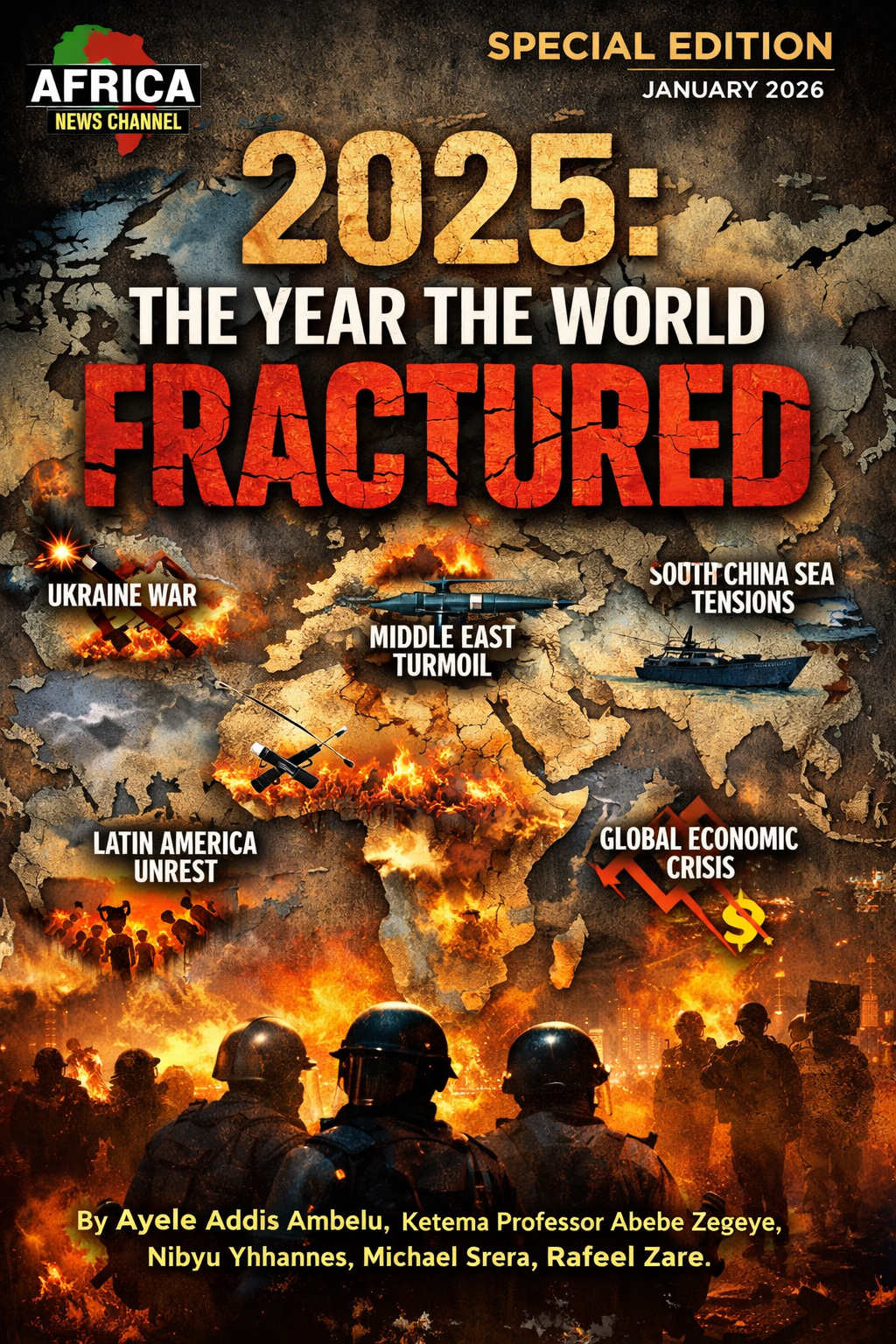
A One-Year Investigative Global Political Assessment Based on the Africa News Channel Special Edition Poster
Over the past 365 days of 2025, the world did not descend into a single catastrophic war; instead, it fractured everywhere at once. The Africa News Channel Special Edition – January 2026 cover captures this reality with brutal clarity: a burning global map marked by conflict points, economic shocks, and collapsing norms. What 2025 revealed, more starkly than any year since the Cold War, is that global instability is no longer regional; it is synchronized.
In Europe, the Ukraine war remained the defining fault line of the continent. Throughout 2025, frontlines hardened rather than shifted, while Western military aid increased even as public fatigue grew. NATO leaders warned repeatedly that “this is no longer only Ukraine’s war, but a test of Europe’s security architecture.” International monitoring bodies reported sustained civilian casualties and infrastructure damage, while Russia deepened strategic ties with non-Western partners, accelerating the erosion of Europe’s post-1991 security order.
Across the Middle East, turmoil intensified rather than resolved. Gaza, southern Lebanon, Syria, and the Red Sea corridor formed what UN analysts called a “continuous arc of instability.” Shipping disruptions in the Red Sea pushed global insurance costs upward, contributing directly to inflation in Africa and Asia. One senior UN official summarized the year bluntly: “2025 proved that ceasefires without political solutions only delay the next explosion.” Civilian displacement across the region reached levels unseen in years, reinforcing the sense that diplomacy had lost its leverage.
In Asia, the South China Sea emerged as the most dangerous geopolitical flashpoint of the year. Close encounters between naval vessels, aggressive air patrols, and competing maritime claims pushed the region to the brink. ASEAN statements grew sharper, while Beijing insisted it was defending sovereignty. A widely cited international security report warned that 2025 would normalize permanent crisis management in East Asia, where miscalculation, not intention, posed the greatest risk of war.
Africa, often treated as the periphery of global politics, stood at the epicenter of multiple overlapping crises. From the Sahel to the Horn of Africa, conflicts were fueled by climate shocks, debt distress, and proxy rivalries. According to international development assessments released in late 2025, more than half of fragile states worldwide were African, while humanitarian funding gaps widened dramatically. African leaders repeatedly warned global forums that the continent was being “strategically engaged but economically abandoned.”
In Latin America, unrest returned as a political constant. Elections across the region triggered protests, contested results, and states of emergency. High inflation, organized crime, and migration pressures converged into what analysts termed a “governability crisis.” One Latin American head of state remarked during a regional summit: “Democracy is surviving, but barely.” The poster’s imagery of mass protests reflects a year when public trust eroded faster than institutions could reform.
Hovering above all regions was the global economic crisis, less visible than war, but equally destructive. IMF and World Bank outlooks throughout 2025 warned of stagnant growth, mounting sovereign debt, and widening inequality. Currency volatility in emerging economies collided with high interest rates in the Global North, creating what economists described as a “two-speed recovery that benefits almost no one.” The economic shockwaves amplified political instability everywhere they landed.
What makes 2025 historically significant is not any single incident, but the collapse of shock. Crises no longer surprised the world; they arrived expected, overlapping, and unresolved. Global leaders spoke of “resilience” and “strategic patience,” yet the data told a harsher story: more conflicts, more displacement, more militarization, and less trust in global institutions than at any point in the past two decades.
As this Special Edition goes to print in January 2026, one conclusion stands uncontested: 2025 was the year the world learned to live inside permanent fracture. The flames on the map are not symbolic, they are structural. And unless global leadership shifts from reaction to reform, the poster may soon read not as a warning, but as a template for the years ahead.
The Shock of 2025: A World on the Edge
In the final weeks of 2025, as diplomats packed their bags and newsrooms slowed for the holidays, the world was jolted awake by a political incident so sudden, so layered, that it shattered the illusion of global stability.
What began as a routine multilateral announcement, buried in bureaucratic language and released minutes before midnight GMT, quickly escalated into the most consequential geopolitical rupture of the decade.
Within hours, currencies plunged. Militaries went on alert. Alliances fractured in real time.
By dawn, it was clear: the post–Cold War global order had finally collapsed.
The Trigger: Power Without Permission
At the center of the crisis was a bold unilateral move by a major global power—one that ignored existing international frameworks, bypassed multilateral consent, and openly challenged institutions once thought untouchable.
The decision redefined:
- Who controls strategic resources
- Who enforces global security
- Who gets to decide what “international law” even means
For smaller and mid-level states, particularly in Africa, the Middle East, and Southeast Asia, the message was chillingly clear:
Global rules apply, until they don’t.
A Domino Effect of Defiance
What followed was not war—but something more dangerous.
- Regional powers announced “strategic autonomy doctrines.”
- Long-standing alliances issued carefully worded condemnations, then quietly hedged their bets.
- The Global South, long sidelined, found itself both courted and coerced.
In Addis Ababa, Nairobi, Brasília, and Jakarta, policymakers asked the same question:
If the rules can be broken at the top, why should we obey them at the bottom?
The End of Neutrality
Perhaps the most dramatic shift was psychological.
2025’s final incident did what pandemics, wars, and climate disasters could not:
It ended neutrality.
Every country was forced to choose:
- Align
- Resist
- Or become strategically irrelevant
Non-alignment, once a proud doctrine, became a liability overnight.
A New World, Unnamed
No treaty was signed.
No declaration announced a new era.
Yet historians will mark this moment as the quiet death of the old system—replaced not by order, but by contested power, fragmented influence, and permanent uncertainty.
As one diplomat reportedly said off-record:
“We didn’t enter a new world order. We entered a world with no order at all.”
Final Analysis: Why This Moment Matters
The last global political incident of 2025 was not about missiles or elections.
It was about permission.
Who has it? Who doesn’t? And who no longer asks.
The world did not explode that night,
But it irreversibly shifted.
And in that shift, the future was rewritten.
by Ayele Addis Ambelu








