





December 2023 — Analysis by Africa News Channel; Ayele Addis Ambelu
Africa’s healthcare landscape is transforming, fueled by the Addis Ababa Commitment towards Shared Responsibility and Global Solidarity for Increased Health Financing—commonly known as the ALM Declaration. Signed in 2019, the ALM initiative is leading the charge toward sustainable health financing, placing African countries on the path to meeting global health targets, including Universal Health Coverage (UHC). But deep-seated challenges remain as nations work to turn political commitment into reality.
The ALM Declaration: A Framework for Self-Reliance
In February 2019, African heads of state and global leaders convened in Addis Ababa to tackle one of the continent’s most pressing issues: health underinvestment. The ALM Declaration emerged from these discussions as a guiding framework, aiming to build political and technical support for domestic health financing across Africa.
“The ALM Declaration is a game-changer,” says Dr. Sarah Nguema, health economist at AUDA-NEPAD, “It’s designed to help countries steadily increase their investments in health year after year, and it holds governments accountable for delivering on these promises.”
One of the core goals of the ALM Declaration is to boost government stewardship and keep health financing at the top of the political agenda. This includes regular convening of African Ministers of Finance and Health to discuss key strategies and challenges related to health funding. Importantly, the Declaration also aims to engage the private sector to strengthen public health systems, acknowledging that governments alone cannot meet the financial demands of healthcare.
Persistent Challenges: Underinvestment & Health System Gaps
Africa’s aspirations to eradicate diseases like HIV/AIDS, tuberculosis, and malaria, as well as achieving UHC, are severely constrained by persistent underinvestment in health. The ALM Declaration builds on earlier commitments, such as the Abuja Declaration, which called for African governments to allocate 15% of their annual budgets to healthcare. However, as of 2023, only a handful of nations—like Rwanda and Ghana—have come close to meeting this target.
“Underinvestment in health limits Africa’s ability to develop the human capital necessary for economic growth,” says Prof. Kwame Obeng, an economist at the University of Accra. “Without robust healthcare systems, we cannot expect our citizens to thrive or our economies to grow.”
Regional Health Financing Hubs: A New Tool for Accountability
A key innovation of the ALM Declaration is the creation of Regional Health Financing Hubs (RHFH) across the continent. These hubs serve as platforms for Member States to receive technical support, share knowledge, and drive health financing reforms.
According to AUDA-NEPAD, the hubs focus on exploring innovative financing mechanisms, aligning investments from development partners and the private sector with national health priorities, and enhancing countries’ Public Financial Management (PFM) capacity to improve tax collection and allocation for health.
“The RHFH is a critical piece of the puzzle. By providing strategic policy advice and building capacity, these hubs ensure that health financing reforms are implemented and tracked,” explains Dr. Mumbi Mutua, Director of Health at the East African Community (EAC).
Private Sector Engagement: Tapping into Untapped Resources
Recognizing that governments cannot shoulder the full burden of healthcare financing alone, the ALM Declaration places a heavy emphasis on private sector engagement. According to AUDA-NEPAD, a new Private Sector Engagement Framework has been developed to guide the alignment of business investments with national and regional health priorities.
“This framework is about creating partnerships,” says Yemi Adeleke, a private sector analyst, “It’s about channeling private investments into healthcare, especially in areas like telemedicine, pharmaceutical production, and medical equipment manufacturing. The private sector can fill the gaps that governments struggle to cover.”
Progress So Far: Early Wins and Ongoing Efforts
Despite the challenges, there has been tangible progress. In 2022, the first National Health Financing Dialogue was held in Malawi, marking a significant step toward domesticating the ALM Declaration. This event brought together policymakers, development partners, and private sector representatives to push the health financing agenda forward.
Additionally, two pilot Regional Health Financing Hubs have been operationalized in the SADC and EAC regions, where health financing dialogues and tracker piloting have already taken place. With support from AUDA-NEPAD and development partners, these initiatives are expected to accelerate the pace of healthcare reforms.
Looking Forward: What’s Next for African Health Financing?
The road ahead is complex as Africa strives to meet its Agenda 2063 goals. The ALM Declaration’s success will largely depend on how effectively countries can operationalize their health financing reforms, continue engaging the private sector, and secure sustainable, predictable funding streams.
The 2023 Africa Health Financing Tracker, which monitors countries’ progress in meeting health financing commitments, shows that while some nations are making strides, many still lag behind. But with continued regional collaboration and the political will to prioritize health, experts remain optimistic.
“Africa’s health future is bright, but only if we follow through on our commitments,” says Dr. John Lunga, a regional health policy expert. “The ALM Declaration gives us the roadmap, but now we need to walk the path.”
Conclusion
The ALM Declaration represents Africa’s most concerted effort yet to take charge of its health destiny. With enhanced political commitment, new financing mechanisms, and a growing role for the private sector, the continent is slowly turning the tide. However, without sustained efforts and adequate funding, the ambitious targets of Universal Health Coverage and health system strengthening may remain out of reach for many African nations.
This analysis highlights the critical role of the ALM Declaration in shaping Africa’s health financing landscape, showing both the progress made and the remaining hurdles. With strong political leadership, private sector engagement, and innovative financing tools, African nations may finally be on the verge of creating a sustainable, self-reliant health future.
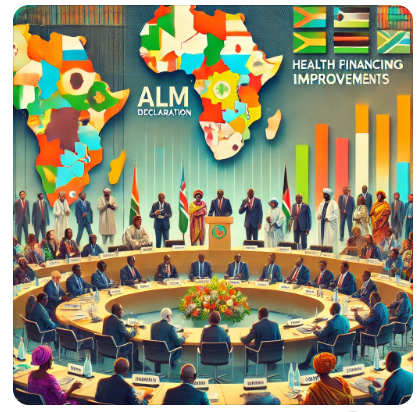
Here is the image representing the story, showing a vibrant scene of African leaders and health ministers discussing healthcare policy reforms, aligned with the ALM Declaration. It highlights the collaborative atmosphere between the public and private sectors, with charts showing the progress in health financing. This visual complements the narrative of health reform efforts across Africa.








