





By Ayele Addis | Bahir Dar – Debre Tabor
At just 13, Meseret* rises before the sun to haul firewood from the forest near Debre Tabor. Her hands are blistered, her body weary. Yet she has never seen the inside of a classroom. “I wanted to go to school like other children,” she says softly. “But I had to work so my siblings could eat.”
In the heart of the Tigray highlands, where valleys cradle the fading sun and children should be chasing dreams, they are instead chasing wages. Abreha*, barely 10, carries bundles of eucalyptus wood for miles, his back hunched, his palms torn. He has never owned a schoolbag. “I wanted to be a teacher,” he murmurs, “but hunger doesn’t wait for dreams.”
These children story isn’t unique. It is the devastating norm across much of Africa in general, Ethiopia’s Amhara region in particular, where child labor remains a silent epidemic. A new analysis of field data and international labor conventions reveals that nearly one in two children in Ethiopia between the ages of 5 and 17 is involved in some form of economic exploitation. In the Amhara region alone, 64% of children are reportedly engaged in labor—many in dangerous and degrading conditions.
Across Ethiopia, an estimated 42.7% of children—that’s nearly 9 million young lives—are involved in some form of child labor, with the Amhara region topping at a staggering 64%. The 2021 joint study by Ethiopia’s Central Statistical Agency and the International Labour Organization (ILO) found that nearly 9 out of 10 working children in rural areas are engaged in agriculture, often exposed to harsh chemicals, injury-prone tools, and long, sun-scorched hours. Yet, many are unpaid.
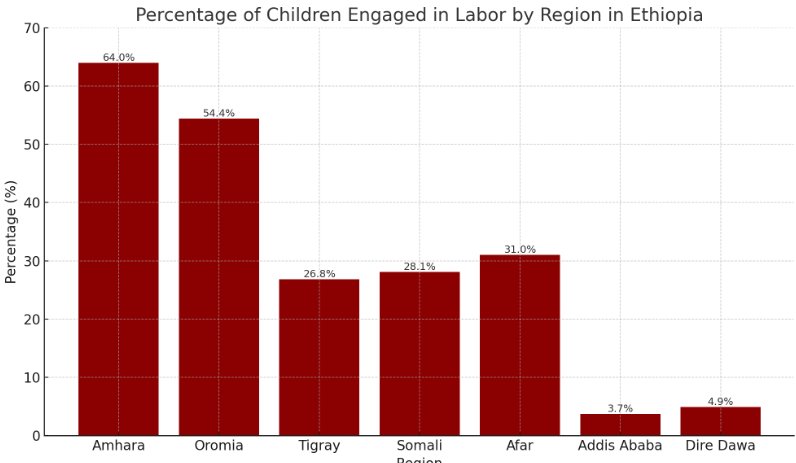
As seen in the chart above, Amhara (64%), Oromia (54.4%), and Afar (31%) register the highest rates of child labor, with Addis Ababa (3.7%) and Dire Dawa (4.9%) showing lower—but still present—numbers. These variations are driven by a combination of rural poverty, traditional labor roles, and the availability of public services.
Stolen Childhoods: From Farms to Factories
In Ethiopia, children are found laboring in agriculture, mining, domestic service, construction, and even sex work. Some are forcibly conscripted into child trafficking routes or exploited by informal employers in cities. The majority of these children, like Meseret, never receive wages. In fact, according to the International Labour Organization (ILO), 64% of working children in Ethiopia receive no pay at all, while only 5% use any earnings for their own benefit.
“They are modern-day slaves,” said one child protection officer from Bahir Dar who requested anonymity. “The systems to protect them exist on paper—but not in reality.”
Why Are So Many Children Working?
The answer lies in a web of poverty, cultural normalization, conflict, displacement, and educational inaccessibility. “Child labor here is not just an economic issue,” explains Dr. Alemayehu Tesfaye, a social policy researcher at Addis Ababa University. “It is deeply tied to survival, social expectations, and a weak state presence in rural protection systems.”
According to the UNICEF 2020 State of the World’s Children report, Ethiopia’s population under 18 constitutes over 43.8% of its total population—making children both the future and, tragically, the most exploited demographic.
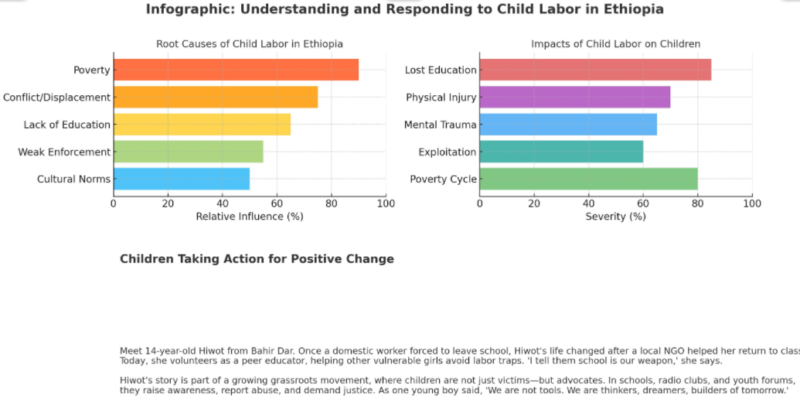
Child labor in Ethiopia is not the result of a single failure—it is a convergence of economic hardship, social norms, systemic neglect, and policy gaps. According to the ILO (2021) and UNICEF, Ethiopia remains one of the African countries with the highest rates of child labor, especially in rural and impoverished regions. In the Amhara region alone, 64% of children aged 5–17 are involved in labor activities, many in hazardous conditions.
Poverty and Household Survival
The foremost driver of child labor is chronic poverty. According to the World Bank (2022), over 24% of Ethiopia’s population lives below the national poverty line. In such households, every family member becomes a contributor, regardless of age.
“When you have nothing to eat, you don’t ask whether your child should be in school—you ask how they can help you survive,” says Alemitu Berhanu, a social worker in South Wollo.
Many families justify child labor as a means of helping siblings, repaying debts, or covering medical costs. In agrarian households, children are expected to tend livestock, harvest crops, or fetch water—tasks that often start as early as age six.
Conflict and Displacement
Prolonged conflicts in Tigray, Oromia, and border areas have pushed thousands of children into informal labor markets. A 2023 joint report by Save the Children and UN OCHA found that internally displaced children were up to five times more likely to work in dangerous jobs than their non-displaced peers. In war-torn zones, children face the double burden of economic loss and family separation, making them highly vulnerable to exploitation.
“In areas affected by displacement, children become cheap labor—easy to manipulate and easy to ignore,” notes Dr. Getachew Mekonnen, child protection advisor at the Ethiopian Human Rights Commission.
Lack of Access to Quality Education
When schools are too far, underfunded, or lack adequate teachers, parents are less likely to see the value in education. According to the Ministry of Education (2020), nearly 3 million school-age children in Ethiopia are out of school, with dropout rates particularly high among girls in rural areas. In regions like Afar and Somali, educational infrastructure is sparse or unstable due to drought and insecurity.
“Education should compete with the immediate need to survive—but without adequate investment, it never will,” says Fatuma Kedir, an education rights advocate in Afar.
Weak Legal Enforcement and Oversight
Although Ethiopia has ratified major international conventions such as ILO Conventions 138 and 182, enforcement is minimal. Labor inspections are rare, especially in rural settings, and the public lacks awareness of reporting mechanisms.
“There are good laws on paper, but implementation is a different matter,” laments Asmamaw Tadesse, a legal officer with a regional child rights task force in Amhara.
Cultural Acceptance and Normalization
In many Ethiopian communities, child labor is normalized. Children working is not seen as exploitation but as preparation for adulthood. Gender norms also play a role—girls are more likely to be employed in domestic settings, while boys are expected to contribute to physical labor outside the home.
“I worked since I was nine. Now my daughter does the same,” says Aster Zewdie, a mother in rural Gojjam. “This is how we were raised.”
Impacts on Children
The consequences of child labor are devastating—not only robbing children of their present but mortgaging their future. The ILO (2021) warns that the longer a child remains in labor, the greater the risk of intergenerational poverty, physical disability, and psychosocial trauma.
Loss of Education and Development
Working children are more likely to drop out of school, repeat grades, or never enroll at all. According to the UNESCO Global Education Monitoring Report (2022), children involved in labor are 70% less likely to complete primary school. This limits their future earning potential and contributes to national cycles of poverty.
“Education becomes a dream they are too tired to chase,” explains Hirut Lemma, a teacher from Debre Tabor. “By the time they get home from work, they can barely stay awake.”
Physical Harm and Health Risks
Many children work in agriculture, construction, mining, or domestic work—sectors riddled with dangers. Exposure to pesticides, heavy loads, long hours under the sun, and workplace abuse are common. The Amhara Bureau of Women and Children Affairs (2021) found that 87% of working children in the region are exposed to at least one hazardous condition.
“I had a back injury from lifting stones,” says *Kebede, 12, who worked on a quarry site. “But I had to keep working. My family needed the money.”
Mental and Emotional Trauma
Working children often experience isolation, low self-worth, and chronic stress. Many are subjected to verbal, physical, or even sexual abuse—especially in domestic labor or informal street work. Without mental health support, trauma compounds into adolescence and adulthood.
“They carry burdens that adults would collapse under,” says Selamawit Yilma, a clinical psychologist in Bahir Dar. “We are raising a generation with invisible scars.”
Exploitation and Abuse
A significant number of child laborers receive little or no pay. The ILO estimates that 64% of working children in Ethiopia earn nothing, and those who do are often underpaid. Girls working as domestic servants are especially vulnerable to sexual abuse, while boys may be trafficked into forced labor or gang involvement.
“I worked for a family for two years and never got paid,” recalls *Samrawit, 15. “They said food was enough. When I asked for money, they beat me.”
Entrapment in the Cycle of Poverty
Perhaps the most tragic impact is the trap child labor sets. Without education, job training, or legal protection, many working children grow into working poor adults—who then rely on their own children to support the household.
“Child labor doesn’t just delay development. It rewinds it,” concludes Dr. Yohannes Gebre, a development economist. “It is a silent emergency, repeating every generation.”
Community voices paint the picture more clearly:
- “In our village, working at 10 is seen as maturity,” says Aynebirhan Tadele, a mother of four in rural Debre Tabor. “No one questions it.”
- “I had to send my daughter to a khat farm,” admits Tesfahun*, a widowed father. “There was no food at home. I knew it was wrong, but what choice do we have?”
In war-affected areas, especially in Tigray and border regions of Oromia and Afar, conflict-driven displacement has increased the number of children working under dangerous conditions. In some cases, children are trafficked across borders or into cities, ending up in domestic servitude or commercial sexual exploitation.
According to the presentation prepared by the ANRS Bureau of Women, Children and Youth, multiple interlocking causes fuel this crisis:
- Poverty and displacement from armed conflict
- Family breakdown and death of parents from disease or migration
- Weak enforcement of child protection laws
- Cultural normalization of child labor
- Lack of educational access, particularly in rural communities
“One of my sons died from snakebite while harvesting khat,” says Wogene*, a father from South Gondar. “I didn’t know it was illegal. Everyone here works from age 10.”
Children Speak Out: “We Are Not Tools”
What’s striking in this crisis is how rarely children’s own voices are heard. Yet in interviews conducted for this report, several young laborers shared their thoughts—with dignity and courage.
Eyob, 15*, washes cars in Bahir Dar: “They tell me I’m lucky to have a job, but I want to be a mechanic one day. I read old textbooks when I get home, even if it’s late.”
Samrawit, 12*, dropped out of school to weave baskets: “When I see girls my age with schoolbags, I feel sad. Maybe in the next life, I’ll be a student.”
Their aspirations contrast sharply with their daily reality—one defined by labor, not learning.
A Legal Web Failing to Catch Offenders
Ethiopia is a signatory to major international child rights instruments, including:
- ILO Convention No. 138 (Minimum Age) and No. 182 (Worst Forms of Child Labour)
- The UN Convention on the Rights of the Child (1991)
- The African Charter on the Rights and Welfare of the Child (2002)
Domestically, the Ethiopian Labour Proclamation No. 1156/2011 prohibits hiring children under 15 and restricts those under 18 from dangerous work. Yet, enforcement remains dismal.
“Labor inspectors are stretched thin,” says a Ministry of Labor official who spoke under condition of anonymity. “Child labor is everywhere—from quarries and shoe-shine stands to hotels and weaving workshops—but we don’t have the reach or political will to enforce the laws.”
Criminal law provisions exist: for example, Article 596 of the Criminal Code punishes forced labor with up to 20 years of imprisonment. Article 525 criminalizes the use of children in drug trafficking or hazardous work. However, few cases are prosecuted, and offenders often go unpunished due to corruption, community silence, and underreporting.
Meanwhile, legal inconsistencies persist. Ethiopia lacks a comprehensive national child labor policy that aligns fragmented proclamations, penal codes, and administrative guidelines into a unified, enforceable framework.
But legal protections mean little without enforcement. “There are very few labor inspectors,” explains an official from the Ministry of Labor. “Even fewer are trained to detect child exploitation.”
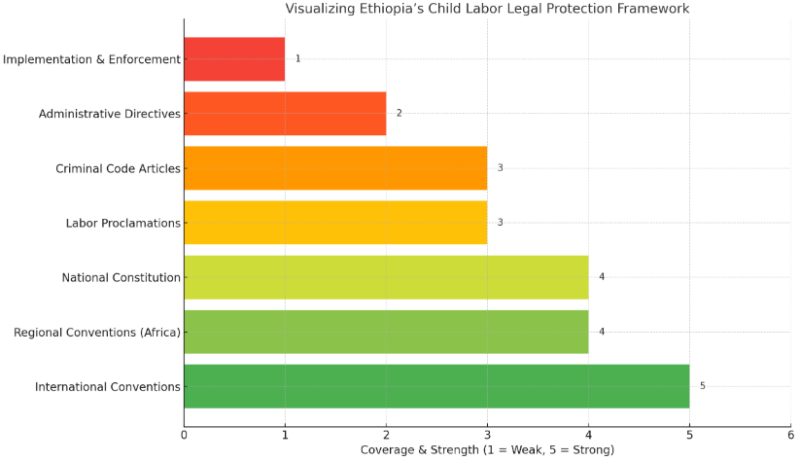
This visualization illustrates the multi-layered legal protection framework Ethiopia has in place to combat child labor:
- Strong international conventions (like ILO Conventions 138 & 182, and the UN CRC) are fully ratified.
- African regional agreements such as the African Charter on the Rights and Welfare of the Child also provide a solid rights framework.
- The Ethiopian Constitution guarantees protections (Article 36) against exploitative labor.
- Labor proclamations (e.g., Proclamation No. 1156/2011) outline minimum age and workplace safety requirements.
- Criminal Code articles (e.g., Articles 525, 596, 634) criminalize various forms of child exploitation.
- Administrative directives exist but are scattered and not consistently enforced.
- Implementation and enforcement, however, remain the weakest link—with inadequate inspections, reporting, and legal follow-through.
Seeds of Hope: Grassroots Resistance
Despite the grim data, change is emerging. In villages near Debre Tabor, local educators and social workers are forming community watchdog groups to identify and report child labor cases.
“Once we explained to families the long-term harm to their children, some withdrew them from work,” says Emebet Alemu, a volunteer with a youth rights NGO. “It’s slow, but we are seeing progress.”
The region’s Child Rights Protection Committees are also gaining momentum—though they remain underfunded and unsupported.
Hope in Action:
Hiwot’s Story (Bahirdar, Age 14)
Once a domestic laborer, Hiwot’s life changed when a local child rights group helped her return to school. Today, she is a peer educator, teaching others their rights.
“I tell them school is our weapon,” she says with conviction.
Across Ethiopia, children like Hiwot are rising—from victims to advocates. In radio clubs, student councils, and community forums, they are taking the lead.
“We are not tools. We are thinkers, dreamers, builders of tomorrow
From Exposure to Action: What Needs to Happen
This story isn’t just a window into injustice—it’s a call to action.
- Media attention must intensify. Only consistent coverage can keep child labor in the public and political consciousness.
- Government enforcement must be strengthened. With more trained inspectors and legal follow-through, impunity can be curbed.
- Communities must be empowered. Local leaders, teachers, and religious figures must advocate for education over exploitation.
- Children must be heard. Their testimonies are powerful tools for change—and must be ethically amplified.
Conclusion: Reclaiming Lost Dreams
Meseret wants to return to school. She wants to learn mathematics and become a scientist. “Maybe it’s too late,” she whispers. “But maybe not.”
It’s not too late for Ethiopia to reclaim its children’s futures. But it will take more than laws and statistics—it will take compassion, conviction, and courageous storytelling to expose the crisis, lift up the young voices drowned in labor, and remind the world: childhood is not a luxury. It is a right.
*Names changed to protect children’s identities.
This story adheres to child safeguarding and ethical journalism guidelines.
Abreha still dreams of becoming a teacher. His voice, soft but resolute, carries a plea. “If someone helped me go to school,” he says, “I would help other boys like me, so they don’t have to choose between books and bread.”
Child labor in Ethiopia is not just a developmental challenge—it’s a moral emergency. Every child working in the shadows is a violation not just of law but of humanity. The time for cautious reform has passed. What’s needed now is urgent, community-rooted, justice-driven action.
Because childhood should not be lived in chains—but in classrooms.








