






By Awot Haileslasie, Addis Ababa, Skylight Hotel – November 25, 2024
The 2nd Ordinary Session of the Organization for Southern Cooperation (OSC) General Assembly commenced today, bringing together Member States and Associate Members to spearhead a transformative “Third Way of Development” by and for the Greater South. Over four days, from November 25 to 28, global leaders, diplomats, and experts will engage in deliberations to foster equitable multilateralism and advance sustainable progress rooted in solidarity and equity.
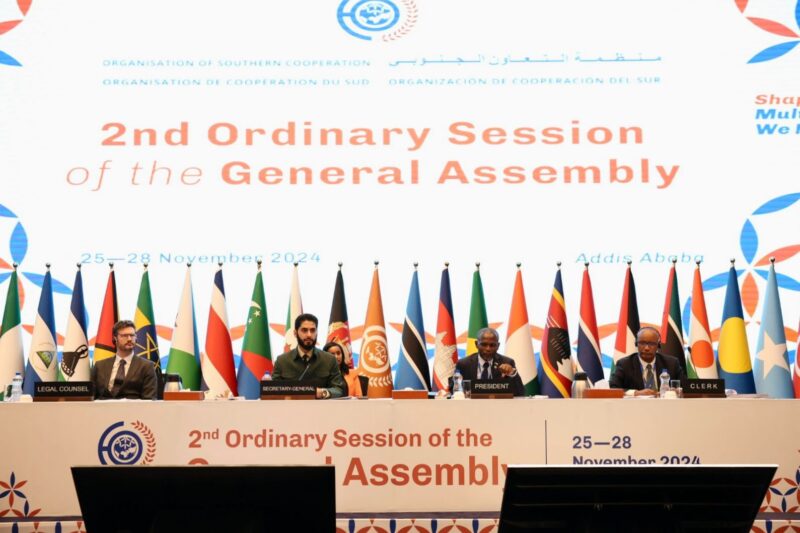
Secretary-General Manssour Bin Mussallam underscored the pivotal role of education in driving sustainable development and fostering cooperation among OSC member states. In his remarks, he highlighted the organization’s commitment to modernizing education systems through intensive investment and strategic initiatives aimed at enhancing human capital across the Global South.
“Education is the cornerstone of transformation,” he stated, emphasizing the necessity of bridging knowledge gaps to empower nations and communities. To achieve this, the OSC has implemented a range of capacity-building programs tailored to the diverse conditions and priorities of its member states.
Among the flagship achievements shared during the session was the securing of 400 scholarships for students from member states. These scholarships, aimed at expanding access to quality education and fostering cross-border knowledge sharing, reflect the OSC’s vision of education as a universal right and a catalyst for progress. The initiative is designed to build a skilled workforce equipped to address the pressing challenges of development, technological advancement, and global competition.
Beyond scholarships, the Secretary-General highlighted the OSC’s focus on creating sustainable frameworks for teacher training, curriculum development, and the integration of digital learning tools. These efforts aim to modernize educational systems and equip young people with the skills needed for a rapidly evolving global economy.
“The success of these programs lies in their inclusivity and adaptability,” he said. “By tailoring capacity-building efforts to the unique needs of each member state, we ensure that no nation is left behind in our shared mission for progress.”
Strengthening Collaboration and Integration
The session further emphasized the OSC’s commitment to fostering collaboration among its members. Secretary-General Bin Mussallam called for stronger partnerships within and beyond the Global South to address systemic barriers to education and development.
Through strategic initiatives, the OSC seeks to promote regional integration, facilitating the exchange of best practices and resources. Programs such as joint research initiatives, technology sharing, and student exchange networks are being actively explored to deepen cooperation and enhance the collective strength of member nations.
“The challenges we face are global, but solutions must be locally driven and regionally supported,” the Secretary-General remarked. “By working together, we can ensure that education systems in the Global South are not only resilient but also engines of innovation and growth.”
A Holistic Vision for Human Development
The Secretary-General’s address reflected a holistic approach to human development, recognizing the interconnectedness of education, technology, and economic growth. He reiterated the OSC’s resolve to leverage emerging technologies to revolutionize learning and ensure equitable access to education.
The initiatives discussed at the session exemplify the OSC’s mission to empower its members through strategic investment in people. As part of this vision, the organization is committed to addressing inequalities in educational opportunities and bridging gaps in skills and resources among member states.
This renewed focus on education serves as a foundation for the OSC’s broader objectives, reinforcing its commitment to building a united and prosperous Global South. The initiatives discussed during the session are expected to lay the groundwork for transformative change, enabling member nations to achieve their full potential.
“The empowerment of our people is not just a goal; it is the pathway to our collective future,” the Secretary-General concluded. “Through education, we unlock the potential of the Global South to lead the way in creating a more equitable and sustainable world.”
A Platform for Change
In his opening address, H.E. Dr. Gideon Timothews, Ethiopia’s Minister of Foreign Affairs, emphasized the OSC’s potential to redefine international cooperation for the benefit of the Global South. “Our interests lie in promoting peace and sustainable development. The OSC serves as a critical platform for addressing the challenges faced by our countries while fostering partnerships that advance equity,” he remarked, underlining Ethiopia’s commitment to the organization’s vision.
The session, hosted in Ethiopia’s capital, is a testament to the nation’s growing role in supporting regional and global initiatives. Dr. Timothews highlighted Ethiopia’s dedication to supporting OSC’s operations and facilitating collaboration among its member states.
Voices from Across the Global South
Speakers from various nations echoed the urgent need for a unified approach to development. Hon. John Mulimba, Uganda’s representative, called for a concerted effort to eliminate global inequalities and support the implementation of the “Pact for the Future.”
“The future we want must be free from oppression and inequality,” he said. “We need to deliberately offer opportunities for the Global South to catch up and ensure effective execution of OSC’s agenda.”
H.E. Daniel Owassa of the Republic of the Congo stressed the importance of visibility and commitment, stating, “Enhancing the visibility of our organization is key to achieving results and making meaningful impacts.”
Somalia’s representative, Mr. Mohamed Omar Osman, described the OSC as “not just a framework for collaboration but a shared dream.” He urged members to “nurture and pursue this vision with unwavering commitment.”
Empowering Youth and Building Human Capital
A notable highlight was the focus on the role of young people in shaping the Global South’s future. Peter Kwasi Kodjie, Secretary-General of the All-Africa Students Union (AASU), praised the OSC for its innovative programs addressing education, technology, and artificial intelligence (AI).
“This generation faces unprecedented challenges and opportunities, including AI and globalization,” he noted. “OSC’s initiatives like GreSIS and GresFET ensure that young people are central to remodeling the New World Order.”
Dr. Ali Kore of the African Curriculum Association (ACA) emphasized the need for inclusive and transformative education, calling for reforms in curriculum development to empower future generations.
Achievements and Commitments
Secretary-General Manssour Bin Mussallam presented key achievements, including the securing of 400 scholarships for member states to enhance educational opportunities. He emphasized the importance of investing in human capital and implementing tailored capacity-building programs to meet the unique needs of each member nation.
“The OSC is committed to fostering integration and strategic support for its members,” he stated. “Through education and knowledge sharing, we aim to create a foundation for sustainable development.”
As discussions continue, the session underscores the critical role of partnerships and technological innovation in addressing the Global South’s challenges. Leaders from across the region called for unity and action.
Mr. Leonce Kwizera of Burundi reiterated his country’s commitment: “Together, we can overcome obstacles and build a brighter, more equitable future for all.”
The OSC’s 2nd Ordinary Session represents a significant milestone in global governance, signaling the Global South’s determination to assert its voice in shaping a fair and inclusive world order. By the end of the session, actionable strategies are expected to emerge, driving forward the shared vision of the Greater South.








