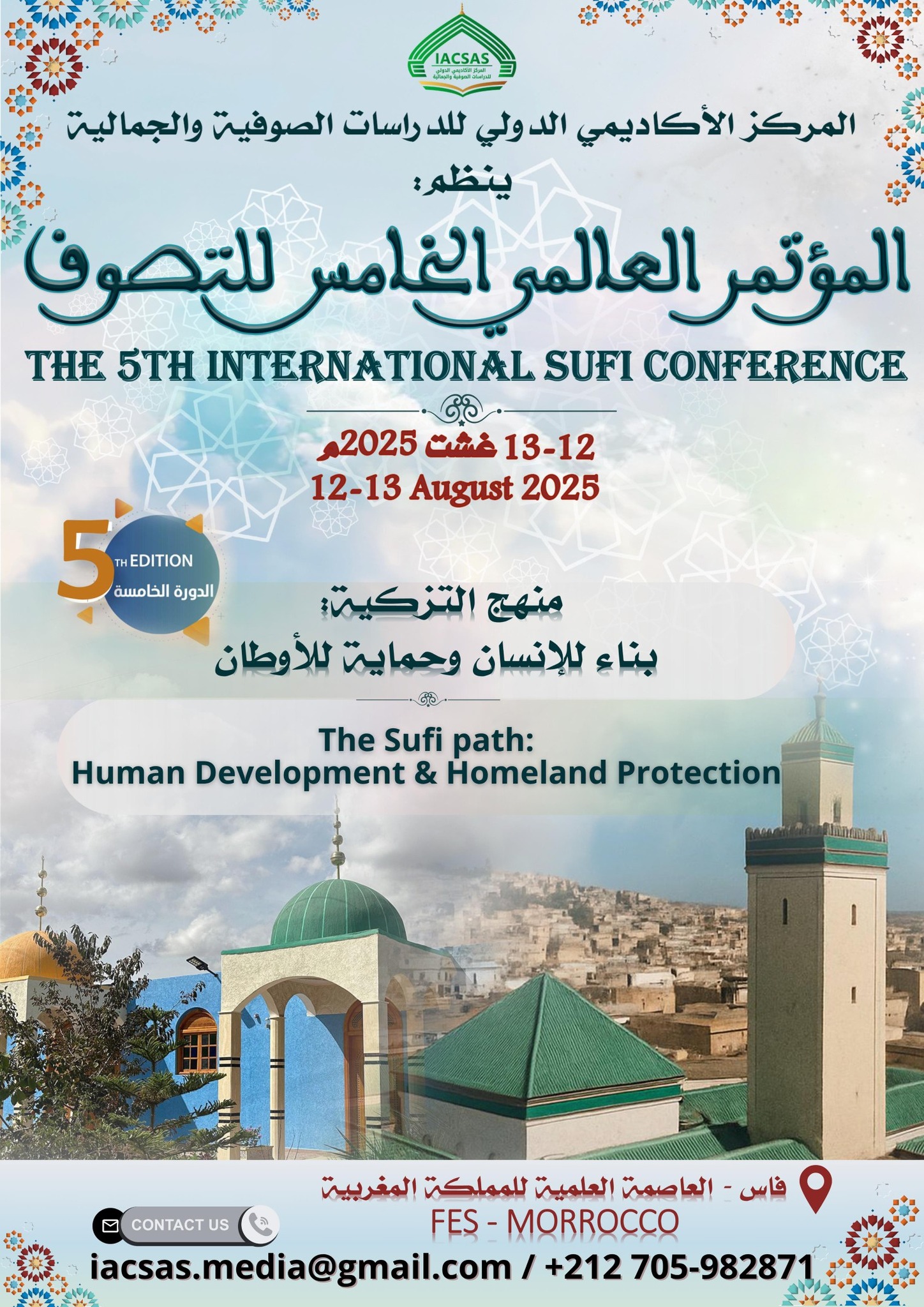
FEZ, MOROCCO — In a world increasingly battered by ideological extremism, spiritual emptiness, and fractured identities, the 5th World Sufism Congress emerges like a luminous torch from the sacred city of Fez, Morocco. Under the theme “The Sufi Path: Human Development & Homeland Protection”, this landmark gathering—organized by the International Academic Center of Sufi and Aesthetic Studies (IACSAS)—seeks nothing less than a civilizational awakening through the revival of Sufism’s ethical and spiritual legacy.
Held on August 12–13, 2025, this year’s edition convenes a distinguished roster of sheikhs, scholars, and thought leaders from across Africa, the Middle East, Europe, Asia, and the Americas. At its heart lies a radical, yet timeless proposition: to rebuild humanity from within, purify the soul, and restore harmony between the individual, society, and the Divine.
🔥 Why This Congress Matters Now
From war-torn regions to climate catastrophe, today’s global crises are not merely political or environmental—they are existential and spiritual. This is the premise put forth by Dr. Aziz El Kobaiti Idrissi Al Hassani, the visionary president of IACSAS and the Congress’s intellectual architect. Speaking to reporters, he declared:
“Humanity is destroying itself, its homeland, and its environment. We are in urgent need of Sufism to reconstruct the individual through the purification of the heart, mind, and soul. This is the path to true homeland protection—through human elevation, not militarization.”
Sufism, often misunderstood as a purely mystical or esoteric tradition, is redefined at this Congress as a pragmatic tool for reform, diplomacy, education, and nation-building. Rooted in Morocco’s unique religious trinity—Maliki jurisprudence, Ash’ari theology, and Junaydi Sufism—it is held up as a spiritual infrastructure capable of shielding societies from ideological decay and civilizational collapse.
🇲🇦 Moroccan Sufism: The Middle Path in a Divided World
Moroccan Sufism, with its centuries-long legacy of moderation, tolerance, and integration, was repeatedly emphasized as a bulwark against extremism. Under the reign of His Majesty King Mohammed VI, who is both a constitutional monarch and Amir Al-Mu’minin (Commander of the Faithful), Sufi institutions have flourished. They’ve become instruments of soft power and internal cohesion in a region otherwise rife with fragmentation.
“There is no enemy in the heart of a true Sufi,” Dr. El Kobaiti stated. “Our only enemy is the ego. Moroccan Sufism teaches us: Don’t hate a Jew or Christian; hate the ego between your flanks.”
This moral clarity is why Moroccan zawiyas (Sufi lodges) are attracting seekers from around the globe. Many non-Muslims are reportedly embracing Islam through Moroccan Sufi channels—not out of proselytism, but from witnessing a model of Islam that preaches peace, embodies ethics, and invites introspection.
🌍 Global Representation, Unified Message
This Congress is not merely academic. It is a geopolitical statement in spiritual garb. Delegates from over 30 countries, including Nigeria, Egypt, Turkey, Jordan, Pakistan, the U.S., and the U.K., have gathered in Fez to echo one call: that the spiritual purification of individuals is the prerequisite to global peace.
Participants include:
- Sheikh Qaribullah Al-Qadiri (Nigeria)
- Dr. Mohamed Alf Sissay (Senegal)
- Sheikh Riad Bazou (Lebanon)
- Sheikh Ahmed Al-Dabbagh (U.K.)
- Sheikh Aziz Abidin (U.S.)
- And leading Moroccan voices like Dr. Hakima El Hajar and Dr. Abdellah Boussouf
National borders do not limit these voices. They are united by a shared belief in Sufism as the spiritual cement of civilization.
💫 A Congress of Light Amid Global Darkness
At a time when political polarization, nihilism, and moral confusion reign supreme, the Congress proposes a radical return to balance, mercy, and divine-centered ethics. It is not retreating into mysticism; it is re-entering the public arena with the tools of the heart—education, ethics, and aesthetics.
Workshops, lectures, and spiritual performances (Samaa and Madih) will breathe life into these ideals, especially for youth. Programs offered by IACSAS also include weekly lessons in Tazkiya (soul purification), retreats, and courses aimed at cultivating ethical leadership.
“Our goal is to re-open the human heart to the divine light, to restore the sacred balance between body and spirit,” said Dr. El Kobaiti. “This is not a dream. This is a mission.”
🎓 About IACSAS
The International Academic Center for Sufi and Aesthetic Studies (IACSAS), headquartered in Fez, is a pioneering institution dedicated to reviving the intellectual, ethical, and spiritual dimensions of Sufism. It is known for its partnerships with major international universities and its scholarly engagement through publications, conferences, and field research. Under the leadership of Dr. El Kobaiti—who holds a Fulbright-backed doctorate in Islamic Studies and has lectured globally—IACSAS is at the forefront of re-integrating Sufism into contemporary discourse.
📢 Final Word
The World Sufism Congress 2025 is not just a spiritual retreat—it is a moral uprising. From Fez to the world, it offers a transcendent message rooted in tradition yet facing forward. It’s a declaration that the human soul still matters, and that the answers to modern chaos might just lie in ancient wisdom.
“This is not the end of times,” a scholar remarked. “It is the beginning of remembrance.”
World Sufism Congress 2025 – 5th Edition
Organized by
The International Academic Center of Sufi and Aesthetic Studies (IACSAS)
On August 12–13, 2025- Fez, Kingdom of Morocco
under the theme:
The sufi Path:
Human Development & Homeland Protection
Sufism is an essential pillar of “Moroccan religiosity,” combining Maliki jurisprudence, Ash’ari doctrine, and the Sufism of Junayd. It’s not merely an appearance or attire, but a way of life based on an individual’s observation of their Lord – “If you do not see Him, He sees you.” This approach has unified the voice of Moroccans, rallied their ranks, and ended their divisions throughout the ages. They have thus distinguished themselves by the unity of doctrine, rite, and behavior.
Over the years, Sufism has enjoyed constant attention and support from the Alaouite Sultans who have successively ruled the Sharifian Kingdom of Morocco. This interest has been particularly evident under the reign of His Majesty the Commander of the Faithful, King Mohammed VI, may God assist him. He has granted great importance to Sufism, solidifying its role as a cornerstone of Moroccan identity in reform, the education and purification of souls, and the achievement of spiritual security for those who follow its path and adhere to it as an educational and behavioral method. This is why His Majesty has supported Sufi institutions, both through his participation in and patronage of Sufi events.
Moroccan Sufism boasts a rich history and a light that has extended to the East, and even beyond to the West. It is a light that illuminates the path of the Muslim. This is a Sufism of ethics, not merely one of illumination; a Sufism that isn’t limited to religious science and research, but one that extends to the practical and behavioral dimension.
This spiritual path, therefore, is not content with merely a religious and doctrinal presence; it also plays a role as a social, political, and diplomatic tool, consequently, Moroccan Sufism does not neglect its part in the building of nations, which rests upon the construction of the human being. This individual, entrusted with the trust of this existence and bearing the divine deposit in this universe, is charged, by duty and honor, with the responsibility of populating the Earth and ensuring divine vicegerency (khilāfa) in the visible world, so as to be a source of mercy, compassion, and life.
Yet, it’s undeniable that most of the woes of the contemporary world originate from humanity itself. The very being who was supposed to be a source of peace and benevolence has often become a source of harm to themselves, their family, their homeland, and their vital environment. This is contrary to what Allah intended for His servants: to be a source of mercy and goodness in the universe, by the divine law inscribed in creation and guided by prophetic models.
Humanity can only achieve the purpose of its existence by resting on a solid foundation. This can only be realized through an education rooted in the noble virtues of the knowers of Allah the Most High (Al-Arifin)—those who have reached the highest degrees of soul purification, drawing from the outer and inner attributes of the Messenger of Allah, peace and blessings be upon him, the supreme example of the accomplished human model: “And indeed, you are of a tremendous moral character.”
This is why the organizers of the fifth edition of the World Sufism Congress, scheduled for this year 2025, have chosen a theme adapted to current challenges: “The sufi Path: Human Development & Homeland Protection. This theme is based on the commitment of Sufi masters, who have always been the most dedicated to achieving this divine edification by focusing on the purification approach (Tazkiya). This aims to reconstruct man internally, so that he becomes an adequate receptacle for divine knowledge and a means to once again enjoy divine creation and its magnificence.
Indeed, one of the essential pillars upon which Sufi masters rely to build the human being is the purification of the mind and heart, as well as the mastery of the soul. This mastery is achieved by freeing the soul from its obscure attributes such as pride, arrogance, hatred, resentment, envy, and greed, until it becomes benevolent, serene, upright, and peaceful. The human being is an edifice composed of spirit, body, mind, heart, and soul.
The true criterion for evaluating an individual, and the human community in its civilizing endeavors, lies in its spirituality and enlightenment. From this perspective, Sufism plays a crucial role in preventing deviant ideas and fallacious manifestations. It strives to immerse hearts in an educational and aesthetic dimension, enabling an understanding of the world without excess, without violence, without fanaticism, in the image of the Prophet, peace and blessings be upon him, who was sent as a mercy to the universe.
Islam’s approach is inherently reformative, aiming to repel evils and restore benefits. This is what Sufism promotes through its educational and purifying dimension, calling for moderation and balance without excess or negligence. It urges human beings to draw from intellectual, legal, and scientific treasures, just as they need to draw from the spiritual treasure that strengthens their determination, refines their personality, and rectifies their behavior and actions.
Today more than ever, as a community, we need a spiritual awakening and a renaissance founded on faith. This impulse must be capable of restoring the sacred balance between word and deed, spirit and body. It must also be able to reopen the human heart to the infinite horizons of the spirit and its divine lights, and to revive within it the strength of spiritual unveiling and taste (dhawq), so that it may attain the fullness of its noble human nature. This spiritual awakening can only take place within a moral educational framework, guaranteeing immunity and protection against any deviance and aberration. It constitutes an essential moral infrastructure for coherent social construction, fostering the most conducive spiritual conditions for establishing civilizational security.
Notable Participation at the Fifth Session of the World Sufism Congress
The fifth edition of the World Sufism Congress will feature extensive and distinguished participation from eminent personalities, sheikhs, and academics across the globe. This is in addition to the organizing body, the “International Academic Center for Sufi and Aesthetic Studies,” based in the Kingdom of Morocco.
From Morocco:
- His Eminence Sheikh Dr. Aziz EL KOBAITI IDRISSI AL HASSANI (President of the International Academic Center for Sufi and Aesthetic Studies)
- Dr. Hakima El Hajar
- Dr. Abdellah Boussouf
From Other African Countries:
- Sheikh Qaribullah Al-Qadiri (Nigeria)
- Dr. Abd Al-Rahman Abd Al-Hakim (Nigeria)
- Dr. Abd Al-Hadi Ahmed Abd Al-Karim (Chad)
- Dr. Nour Al-Din Aman (Ethiopia)
- Dr. Mohamed Alf Sissay (Senegal)
- Dr. Ammar Mirghani Hussein Mohamed (Sudan)
- Sheikh Mohamed Chehoumi (Libya)
- Dr. Mohamed Helmy Abdel Wahab (Egypt)
From the Middle East and Asia:
- Sheikh Aoun Mouin Al-Qadoumi (Jordan)
- Sheikh Riad Bazou (Lebanon)
- Sheikh Mohamed Al-Maghrebi (Lebanon)
- Dr. Farida Ben Zayed Boutamjet (Oman)
- Dr. Molla Younes Emre Aydın (Turkey)
- Sheikh Mohamed Mutiullah Al-Nahrakarizi (Pakistan)
From the United Kingdom:
- Sheikh Ahmed Al-Dabbagh (from the “Prophetic Path” institution)
From the United States of America:
- Sheikh Aziz Abidin
Guests from Iraq, Bangladesh, Indonesia, and of course, Morocco (the organizing country), will also be in attendance.
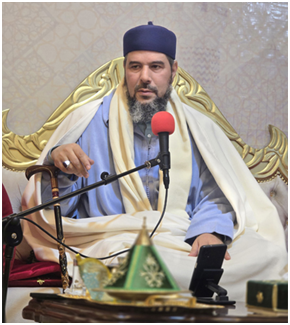
Interview with Dr. Aziz EL KOBAITI IDRISSI AL HASSANI, President of the International Academic Center of Sufi and Aesthetic Studies (IACSAS) in Fes and President of the World Sufism Congress
1. Why did you choose ” The sufi Path: “HumanDevelopment & Homeland Protection”, as a theme for the 5th edition of the congress?
Simply put, in our contemporary reality, what we observe around us highlights a critical need for this approach. Humanity has come to destroy itself, its homeland, and its environment. Therefore, we have an urgent need, now more than ever, for the science of Sufism to support reform and construction.
Its educational and civilizational role is essential to repair and restore what has been undermined in the current generation, and to prepare promising future generations, equipped with knowledge, experience, and a balanced education for both personality and a pure soul.
From this perspective, the science of Sufism is capable of reconciling reform and edification, provided its proponents know how to combine the sciences of jurisprudence (Sharīʿa) with the science of truth (Ḥaqīqa), and authenticity with modernity. It also reconciles adherence to the noble objectives of the Sharīʿa with the utilization of contemporary technologies and inventions. Thus, Sufism can renew the call for adherence to virtuous behaviors in public life and offer humanity a path aboard a universal ark of salvation, carrying the mission of the community of the just middle, which strives for the dignity, freedom, and elevation of humankind.”
2. Regarding the “nation of the just middle,” how do you see Moroccan Sufism contributing to this notion, particularly in rejecting violence and extremism, and do you seek to unify efforts in this field?
Moroccan Sufism is, first and foremost, a Sufism of ethics, not merely of pure illumination. It has not confined itself solely to the religious dimension, nor has it retreated into itself. On the contrary, it has extended to the practical and behavioral dimension, opening up to and accepting others.
This is precisely what His Majesty the Commander of the Faithful, King Mohammed VI, has consistently called for: moderation and the just middle in matters of religion. That is also why His Majesty has supported Sufism, which is renowned for its peaceful and tolerant values. In Sufism, there is no enemy: the Sufi is one whose heart is purified for God, whose actions are pure for God, and whose dignity is pure for God. Such a person loves and harmonizes with all people.
Through this congress, as you can see for yourselves with the gathering of various Sufi orders from multiple countries and nationalities, we are committed to following the High Directives of the Commander of the Faithful. These directives aim to bring together the different Sufi brotherhoods and unify their efforts in service of society.
This unity has always been and remains one of the reasons why Moroccans enjoy security, peace, unity, and harmony. These constants and religious specificities of Moroccans have constituted essential foundations that Moroccans have adopted and agreed upon for centuries. Among their fruits, they have bequeathed to Moroccan society an identity that distinguishes it from other Islamic societies.”
3. Despite current global tensions, we observe that the number of foreigners visiting Moroccan Sufi zawiyas to declare their conversion to Islam or to learn more about our religion and approach is increasing, rather than decreasing. How do you explain this?
“The path of Sufism in Morocco does not believe in extremism or excess in matters of religion. It follows the way of the Noble Prophet, peace and blessings be upon him and his family: ‘The believer is like the ear of corn; it bends sometimes and straightens sometimes.’ It also adopts the path of mercy for which he was sent, as the Almighty said: ‘And We have not sent you except as a mercy to the worlds’ (Surah Al-Anbiya, 107), and in Surah Al-A’raf: ‘Say: O mankind! Indeed, I am the Messenger of Allah to you all, to Whom belongs the dominion of the heavens and the earth…’ (Surah Al-A’raf, 158).
For centuries, the motto of Moroccan Sufi heritage has been: ‘Do not hate a Jew or a Christian, but hate your ego that is between your flanks.’ This means: do not hate any human being for their humanity, and read in them the wisdom of the Creator in His creations.
This is why many foreigners, eager to learn about Islam and convert to it, turn to Moroccan zawiyas and Moroccan Sufism. Even at our conference, we have never closed the doors to those who seek knowledge and spiritual enrichment through the path of saints and gnostics. We do not require any specific religion, race, or nationality; everyone is welcome here.”
Information about The International Academic Center of Sufi and Aesthetic Studies (IACSAS)
The International Academic Center of Sufi and Aesthetic Studies (IACSAS) is an institution based in Morocco, specifically in Fes. It is presided over by Dr. Aziz EL KOBAITI IDRISSI AL HASSANI, and plays a central role in the study and promotion of Sufism, notably through the organization of international conferences.
IACSAS is dedicated to the study of Sufism across its various dimensions: spiritual, ethical, behavioral, cognitive, and intellectual. Its main objective is to highlight the role of Sufism in the edification of the human being and the development of societies.
The Center is particularly active in promoting a Sufism of moderation and tolerance, thus opposing extremism and violence. It emphasizes the peaceful and humanistic values of Sufism, in line with the “middle path” vision advocated by Morocco.
The International Academic Center for Sufi and Aesthetic Studies (IACSAS) aims to restore the importance of spiritual and behavioral education. This education is rooted in Ash’ari doctrine, Maliki jurisprudence, and Sufi practice, all under the aegis of the Command of the Faithful. The Center also works to train researchers and students in Sufi and aesthetic thought, through a variety of academic, educational, and spiritual activities.
IACSAS regularly organizes a range of significant events, including:
- International conferences: notably the prestigious World Sufism Congress of Fes.
- Academic seminars: to deepen discussions on Sufism and Islamic thought.
- Spiritual retreats: including therapeutic and educational retreats for soul purification.
- Scientific councils: fostering the exchange of knowledge among scholars and researchers.
- Educational courses: specifically designed for children and youth to familiarize them with the values of Sufism.
- Weekly lessons: dedicated to the science of purification (Tazkiya) and conduct.
- Samaa and Madih troupes: to revive spiritual and artistic heritage.
- Targeted activities: aimed at children and youth.
The Center has established strong partnerships with international universities and institutes. It has also represented Morocco at major international conferences in Indonesia, Malaysia, and Europe. IACSAS has hosted scientific delegations from countries such as the United States, France, and India, and has received visitors from over 30 different countries, testifying to its global influence and recognition.
For more information, please visit: https://www.fezconference.com/
Dr. Aziz EL KOBAITI IDRISSI AL HASSANI: A Leading Figure in Islamic Studies and Sufism
Born on January 18, 1976, Dr. Aziz EL KOBAITI IDRISSI AL HASSANI is a prominent Moroccan academic, widely recognized for his significant contributions to Islamic studies, with a particular specialization in Sufism. He currently serves as a professor at Al Quaraouiyine University in Fes, and his professional journey is marked by numerous parallel activities that demonstrate his profound commitment to research, knowledge dissemination, and interfaith dialogue.
A Leader in Sufism and Islamic Studies
Dr. Aziz EL KOBAITI IDRISSI AL HASSANI holds the prestigious position of President of the International Academic Center for Sufi and Aesthetic Studies (IACSAS) in Fes.
He has also assumed other important leadership roles, including former president of the Al Firdaws Association for International Correspondence and DX World in Fes, and Director of the World Sufism Congress in Fes. His influence extends internationally, as he is a member of the Authority of Muslims of the Caucasus in Baku, Azerbaijan, President of the Sufi Affairs Office of the World Sufi Union in Jakarta, Indonesia, and President of the World Testimony Council in Kuala Lumpur, Malaysia. He also holds the position of Secretary General of the World Sufi Parliament in Dhaka, Bangladesh.
An Academic Career of Excellence
His brilliant academic record attests to his scholarly excellence. He holds a Doctorate in Islamic Studies (Islamic Thought) with “Very Honorable” distinction from Sidi Mohamed Ben Abdellah University, Faculty of Letters and Human Sciences, Dhar El Mehraz in Fes, obtained in 2012. Previously, in 2007, he earned an Advanced Diploma of Higher Studies (DESA) in Arabic Literature and Thought from the same university, ranking first in his entire graduating class with “Very Good, First in Class” honors.
Dr. EL KOBAITI IDRISSI has been awarded prestigious scholarships that have enriched his research career. He received a full Fulbright International Scholarship to conduct his doctoral research at the University of Chicago in the United States, from July 2008 to March 2012. In 2009, he obtained a “Jean Monnet Action” scholarship from the European Union to attend international summer seminars organized by the Universities of Rome and Siena in Italy. He also secured a postdoctoral scholarship to conduct field research on Islamic thought in the United States in July 2014. In recognition of his contributions, he received the Award for Excellence in Islamic Studies for the year 2017, presented by the Moroccan-American Commission for Educational and Cultural Exchange, recognizing him as “best researcher in Islamic studies in the English language.”
Publications and Engagements
His extensive list of works showcases his prolific output. He is the author of several printed and published books, including “Islamic Sufism in the United States (Doctoral Thesis)” (2013), “Gnostic Paths in the Secrets of the Prophetic Sira” (2024), “Perfect Conquests in the Qualities of the Prophet” (2024), and “Divine Gifts in the Knowledge of Sunni Doctrine” (2024). His writings cover a wide range of topics related to Sufism, Islamic spirituality, and the global influence of Moroccan Sufism.
In addition to his books, Dr. EL KOBAITI IDRISSI has published numerous articles in specialized Moroccan and international journals and edited volumes. He has also participated in many international seminars and conferences, and has delivered lectures on diverse subjects such as Sufism, interfaith dialogue, Islamic movements, and the role of scholars in correcting deviant thought.
Dr. EL KOBAITI IDRISSI is also a frequent guest in the media, having appeared on television programs on national and international channels such as Al Jazeera, Medi1 TV, and the Indonesian International Channel. He addresses crucial topics like extremism, the Moroccan model of peaceful coexistence, and the errors of Islamic movements. His commitment to interfaith dialogue is evident in his participation in meetings of religious leaders, emphasizing the importance of building trust through dialogue.
The works and contributions of Dr. Aziz EL KOBAITI IDRISSI AL HASSANI establish him as a leading intellectual figure, and his works continue to enrich the understanding of Islamic studies and Sufism across the world.
Press Contacts
MTG Communication & Pr
Bouchra CHAKIR 0634948101
Saida CHAOU 0680380009