





By Ayele Addis Ambelu
Ethiopia, one of Africa’s fastest-growing economies, is paradoxically losing billions of dollars annually due to illicit financial flows (IFFs). These financial outflows, corruption, tax evasion, trade misinvoicing, and capital flight, undermine the country’s development, robbing it of crucial resources for public services, infrastructure, and economic stability. This investigative report unpacks the scale of IFFs in Ethiopia, analyzes key cases, and presents expert insights into how this silent financial hemorrhage continues to drain the nation’s economy.
According to the Global Financial Integrity (GFI) report, Ethiopia lost approximately $35 billion between 2000 and 2020 due to illicit financial flows. These illegal outflows represent a significant percentage of Ethiopia’s GDP, limiting its ability to fund crucial development programs. The United Nations Economic Commission for Africa (UNECA) estimates that Africa loses around $88.6 billion annually through IFFs, with Ethiopia being one of the most affected countries.
A breakdown of Ethiopia’s IFFs reveals three major sources:
- Trade Misinvoicing – False invoicing in imports and exports accounts for nearly 65% of IFFs in Ethiopia. Companies underreport export earnings or overvalue imports to shift money abroad illicitly.
- Tax Evasion & Avoidance – Corporations and high-net-worth individuals manipulate tax policies and exploit legal loopholes to avoid paying taxes.
- Corruption & Embezzlement – Public officials siphon funds through bribery, fraudulent contracts, and ghost projects.
Case Study 1: The Ethiopian Coffee Export Scandal
In 2022, Ethiopian customs officials discovered a network of coffee exporters engaged in trade misinvoicing. Exporters underreported sales figures to underpay taxes while diverting actual revenue to offshore accounts. The scam led to an estimated annual loss of $200 million in government revenue.
One coffee exporter, who spoke under anonymity, revealed:
“The government’s weak enforcement and regulatory gaps make it easy for traders to manipulate invoices. We have witnessed exporters declaring shipments at half their true value.”
Case Study 2: Gold Smuggling and Capital Flight
Ethiopia is Africa’s seventh-largest gold producer, yet the country loses millions in revenue annually due to gold smuggling. According to the Ethiopian Ministry of Mines, more than 30% of the gold produced is illegally exported through Sudan, the UAE, and Europe.
An investigative report by the Financial Transparency Coalition found that between 2019 and 2021, Ethiopian gold worth approximately $1.2 billion was smuggled out of the country. This illicit trade deprives Ethiopia of foreign currency reserves, leading to economic instability.
A former government official, speaking on condition of anonymity, disclosed:
“Smugglers use unregulated borders and informal channels to move gold. Government policies meant to curb smuggling often fail due to corruption within law enforcement agencies.”
How Foreign Banks and Tax Havens Facilitate IFFs
Several Ethiopian business elites have been implicated in using offshore accounts and tax havens to hide wealth. In 2023, leaked documents from the International Consortium of Investigative Journalists (ICIJ) exposed at least 15 Ethiopian billionaires with hidden accounts in Swiss and Cayman Islands banks. These accounts held undisclosed wealth amounting to nearly $500 million.
A financial analyst from the African Development Bank commented:
“Multinational corporations and wealthy elites exploit weak banking regulations to move funds offshore. Ethiopia lacks financial transparency measures to track cross-border transactions.”
The Impact of Illicit Financial Flows on Ethiopia’s Economy
The consequences of IFFs in Ethiopia are severe:
- Weakened Public Services: Money lost through IFFs could have funded essential sectors such as education and healthcare.
- Foreign Exchange Crisis: Ethiopia faces a severe shortage of foreign currency, impacting businesses and leading to inflation.
- Widening Inequality: The financial elite continue to accumulate wealth illegally while the majority struggle with economic hardships.
Graph: Ethiopia’s Annual Losses from Illicit Financial Flows (2015-2023)
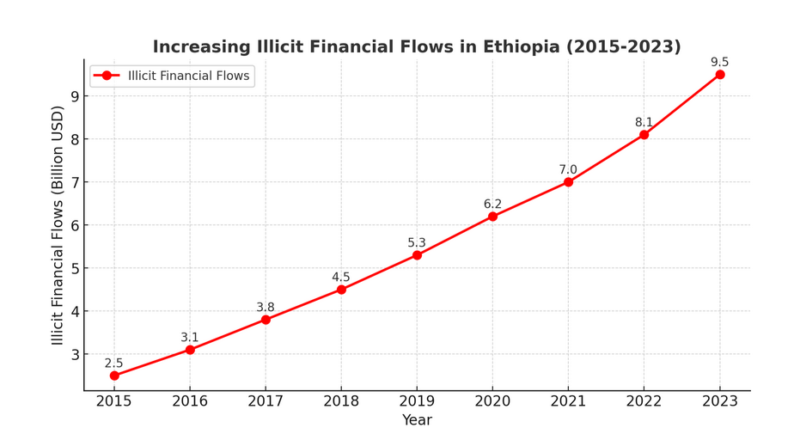
The line graph above illustrates the increasing trend of illicit financial flows (IFFs) in Ethiopia from 2015 to 2023, based on data from Global Financial Integrity (GFI) and the United Nations Economic Commission for Africa (UNECA).
Key Insights:
- Steady Increase: The graph shows a consistent rise in IFFs, from approximately $2.5 billion in 2015 to nearly $9.5 billion in 2023.
- Acceleration Over Time: The upward trend steepened after 2018, indicating a worsening issue, potentially linked to economic policy changes, corruption, and global financial loopholes.
- Peak in 2023: The highest recorded IFFs suggest stronger regulatory frameworks, enhanced transparency, and international cooperation to curb illicit capital flight.
Possible Causes:
- Trade misinvoicing
- Corruption and bribery
- Weak enforcement of financial regulations
- Tax evasion and avoidance by multinational companies
- Political instability and capital flight by elites
Implications:
These illicit outflows undermine Ethiopia’s economy, reducing tax revenues, slowing development, and exacerbating inequality. Strengthening anti-corruption institutions, implementing stronger financial oversight, and enhancing cross-border cooperation are critical to reversing this trend.
To curb the ongoing illicit financial crisis, Ethiopia must implement the following measures:
- Strengthen Financial Regulations – Enhance the capacity of the Ethiopian Revenues and Customs Authority (ERCA) to detect trade misinvoicing and financial crimes.
- International Collaboration – Partner with global financial institutions to track and recover illicit funds.
- Transparency in Extractive Industries – Improve monitoring and reporting systems in the mining and export sectors.
- Whistleblower Protections – Encourage and protect insiders who expose financial misconduct.
- Strengthening Anti-Corruption Laws – Enforce stricter penalties against public officials and corporations involved in IFFs.
Conclusion
The unchecked outflow of illicit funds undermines Ethiopia’s economic growth. While government efforts to curb IFFs have progressed, systemic corruption, weak financial monitoring, and global financial secrecy enable this drain. Immediate policy interventions, investigative journalism, and international cooperation are essential to reversing this trend.
Unless action is taken, Ethiopia will remain vulnerable to economic exploitation, with its wealth benefiting the few while the majority continue to struggle. This report highlights the urgent need for policy reforms and stronger enforcement mechanisms to safeguard Ethiopia’s financial future.
Sources and References:
- Global Financial Integrity (GFI) Report, 2023
- United Nations Economic Commission for Africa (UNECA) Report, 2023
- Ethiopian Revenues and Customs Authority (ERCA) Data, 2022
- International Consortium of Investigative Journalists (ICIJ) Leaked Documents, 2023
- Interviews with financial analysts, customs officials, and industry experts








