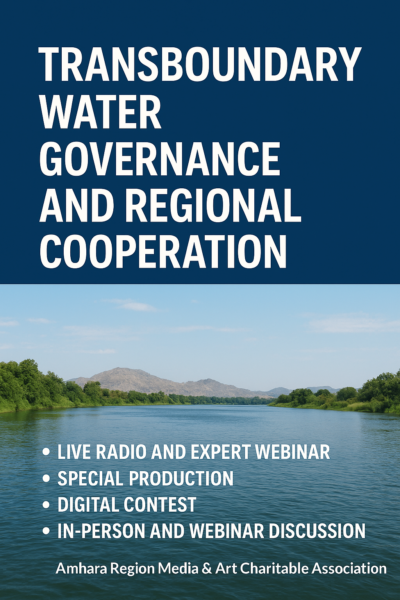
Presented by Amhara Region Media and Art Charitable Association (ARMACA)
Supported by the Pulitzer Center on Crisis Reporting
1. Where the River Meets the Policy Table
“Water does not recognize borders, but people do.”
With that line, the moderator opened ARMACA’s third flagship broadcast, inspired by the Nile Basin Initiative’s webinar on Transboundary Water Governance and Regional Economic Cooperation.
Across Ethiopia and Amhara’s FM frequencies, the familiar hum of the Blue Nile faded beneath her words. The program, part of ARMACA’s Hydropower and Humanity series with the Pulitzer Center, sought to unpack one question that haunts both policymakers and farmers:
How can nations turn the Nile from a source of conflict into a platform for cooperation?
Pulitzer’s “Hydropower” story had already framed the dilemma starkly:
“Two large dams, the GERD and the High Aswan Dam (HAD), in two countries, Ethiopia and Egypt, will coexist on a single river, the Nile, with no specific agreement yet on water sharing or reservoir operations.”
It’s a haunting truth, one that echoes through policy corridors from Addis to Cairo. But for ARMACA’s listeners, the question was less about treaties and more about life itself.
“The Nile is our breath,” said Mulu Asnakew, a fisherman from the shores of Lake Tana, in a recorded segment played mid-program. “If it dries, our lives dry with it.”
2. The Architecture of Cooperation: Expert Voices from the NBI
The webinar-based live radio’s keynote speaker, Dr. Clive Lipchin, director at the Arava Institute for Environmental Studies, began with a challenge:
“Regional water cooperation is not a dream. It’s a necessity. But it must be built on trust, and trust requires institutions that listen, not just decide.”
Dr. Lipchin’s insights, cited from the webinar-based live radio program, anchored the conversation around institutional cooperation, from basin-wide data sharing to climate adaptation mechanisms. He highlighted that the Nile Basin Initiative (NBI), established in 1999, remains “the only inclusive platform that brings together all riparian states.”
But as he pointed out, “inclusivity alone is not enough.”
The NBI’s challenge lies in balancing national sovereignty with collective stewardship, an ongoing tug-of-war at the heart of the hydropower debate.
“It’s like conducting an orchestra where every player wants to lead,” Dr. Lipchin joked. “But the river needs harmony, not solos.”
His words resonated beyond academia. ARMACA’s host paused, then translated into Amharic for the broadcast audience:
“If the Nile is the orchestra, we must all learn to play in tune, Ethiopia, Egypt, Sudan, and beyond.”
3. Water–Food–Energy Nexus: The Hidden Equation
The webinar-based live radio program presentation was given by Dr. Lydia Abebe, an environmental economist who emphasized the water–food–energy nexus—the interdependence between what nations grow, eat, and power.
“You cannot talk about electricity without talking about agriculture,” she said. “You cannot plan irrigation without understanding energy.”
Her statement echoed a passage from Pulitzer’s “Hydropower” piece:
“Ethiopia’s vast majority of citizens survive as subsistence farmers… Electricity, it is hoped, will make their work more efficient and their lives more livable.”
In ARMACA’s radio version, this quote became a bridge between policy theory and human struggle.
Listeners heard the voice of Tesfaye Alemu, a smallholder farmer from South Gojjam, recorded during a community field interview:
“When the lights reach our villages, we can mill grain after sunset, pump water for irrigation, and store medicine for our children. That’s not just energy, it’s life.”
Dr. Lydia continued:
“If regional cooperation ensures energy access through hydropower trade, it can free up water for food and strengthen economies. The Nile Basin’s future lies in coordinated planning, not isolated projects.”
4. The Challenge of Governance: From Paper to Practice
As Pulitzer’s journalist Ann Neumann wrote,
“Ethiopians are left wondering: Where is the infrastructure, domestic and international, to deliver on the dam’s promises?”
That same frustration was echoed in the webinar-based live radio program roundtable. Dr. Gabriel Adeyemi, a governance specialist from the Nile Basin Initiative Secretariat, warned that political will is “often strong on stage but weak in the field.”
“We see grand declarations,” he said, “but cooperation must be measured not in documents signed, but in dams co-managed, in floods prevented, in energy shared.”
ARMACA’s reporter Solomon Mulu, reflecting live from Bahir Dar University’s Hydrology Department, linked this comment to the Ethiopian context:
“The GERD has become a national dream. But if that dream doesn’t connect with Sudan’s irrigation and Egypt’s food security, it will remain a solo act.”
Dr. Gabriel nodded in agreement.
“That is the essence of transboundary governance, making one country’s success another’s opportunity, not another’s fear.”
5. The Economics of Sharing
The webinar-based live radio program session also spotlighted Dr. Grace Anyango, a senior researcher on regional trade and infrastructure. She argued that water cooperation is not just a matter of politics; it is profoundly economic.
“A shared river can generate shared wealth,” she said. “If managed collectively, the Nile could power factories in Ethiopia, irrigate fields in Sudan, and sustain fisheries in Egypt. This is not utopia, it’s simply good economics.”
She cited data showing that regional trade within the Nile Basin remains under 10% of total trade, despite enormous hydropower and agricultural potential.
ARMACA turned that insight into a vivid illustration for listeners:
“Imagine if Ethiopia sells surplus power to Sudan; Sudan sells sesame and sorghum to Egypt; and Egypt offers technology and finance. That is not competition, that is cooperation,” host Tigist narrated.
This framing transformed academic analysis into accessible public dialogue. a hallmark of ARMACA’s collaboration with Pulitzer.
6. Climate Change and the Basin’s Shared Vulnerability
Dr. Samuel Muwonge, a Ugandan hydrologist, presented one of the webinar-based live radio program session’s most urgent warnings:
“Climate change will not respect colonial borders. Floods, droughts, and heat waves are basin-wide realities. If the Nile Basin countries do not cooperate, they will all lose together.”
His statement carried deep weight. ARMACA paired his quote with real stories from flood-affected Amhara communities in Jawi and Achefer.
“The river used to rise like a guest,” said Kebede Getaneh, a local elder interviewed during field reporting. “Now it comes like a thief.”
Pulitzer’s story also echoed this sense of vulnerability:
“Sudan has been forced to choose a side between these two bordering powerhouses while domestic unrest mounts.”
Both the Pulitzer investigation and the NBI experts’ discussions painted the same picture, a river caught between hope and hazard.
7. Community Reflection: Voices from the Basin
As ARMACA’s live webinar transitioned to open microphones, the audience took ownership of the dialogue.
Meselech Desta, a high school teacher from Gondar, said:
“When our children learn about the Nile, they should learn about peace, not politics. Why can’t school lessons teach cooperation?”
Habtamu Abebe, a fisherman, added:
“We share nets in the water, why can’t our countries share the river?”
From Sudan, an online participant named Ahmed Nour called in through the studio line and spoke:
“Media like ARMACA are doing more diplomacy than diplomats.”
These voices reflected what Pulitzer hydropower is reporting had revealed from Cairo: how ordinary citizens carry the weight of political mistrust.
8. Knowledge as Power: The Role of Data and Institutions
Another major theme from the webinar-based live radio program document was data governance, how shared knowledge builds trust.
Dr. Monica Mutoni, a policy analyst with the African Ministers’ Council on Water (AMCOW), said:
“Information asymmetry is the mother of suspicion. Shared data on flows, rainfall, and storage can reduce political friction.”
Her insight mirrors a line from the Pulitzer hydropower story:
“In the absence of transparency, rumors fill the void, and rivers become weapons.”
Dr. Mutoni called for an open Nile Basin Data Portal, managed jointly by the NBI and riparian states, to ensure that decisions are made on evidence, not emotion.
ARMACA’s radio host summarized this beautifully:
“When knowledge flows like water, peace follows its course.”
9. Regional Economic Integration: From Vision to Action
The webinar-based live radio program concluded that transboundary cooperation is the engine of the African Continental Free Trade Area (AfCFTA).
Dr. Grace Anyango again emphasized:
“You cannot have free trade without free water. Infrastructure and environment must be planned together.”
ARMACA connected this to Ethiopia’s new Green Legacy Initiative, showcasing how hydropower revenue could fund climate resilience and reforestation, if regional policies align.
“Hydropower must not only generate electricity,” Prime Minister Abiy Ahmed speech in the African climate change session, “but also regenerate trust.”
10. Pulitzer Reflections: Journalism as Bridgework
Pulitzer’s hydropower story warned how misinformation and media repression deepen divides:
“The Abiy administration has used the same tactic… by silencing media and spreading misinformation.”
ARMACA flipped that script. By hosting these open dialogues, it demonstrated how journalism can counter misinformation, turning the microphone into a peacebuilding tool.
As Dr. Schmeier concluded in the TG3 session:
“Every basin that learned to share information first learned to share stories.”
That sentiment now anchors ARMACA’s transboundary initiative: storytelling as governance, journalism as diplomacy.
11. Reflections and the Way Forward
At the end of the episode, the host closed with a question from a listener in Gondar:
“If the Nile connects us, why are we still divided?”
The studio fell silent for a moment. Then the voice came out from the studio host replied softly:
“Because we forgot that cooperation is also a current, it needs to keep flowing.”
As the outro music blended with the sound of the river, ARMACA’s signature line played:
“Presented by Amhara Region Media and Art Charitable Association, with the support of the Pulitzer Center on Crisis Reporting, where dialogue becomes the bridge between waters.”
#Hashtags for Digital Publication
#TransboundaryNile
#WaterGovernance
#RegionalCooperation
#PulitzerCenter
#ARMACAStories
#NileBasinInitiative
#WaterFoodEnergyNexus
#SharedWatersSharedFutures
#HydropowerAndHumanity
#BlueNileDialogue
#PeaceThroughWater
#NileEconomy
#MediaForCooperation
Produced by:
Amhara Region Media and Art Charitable Association (ARMACA)
With Support from the Pulitzer Center on Crisis Reporting