News Analysis: From Degraded Soil to Dignified Livelihood—A Transformative Journey Led by World Vision and Local Partners in Amhara
Bahir Dar, Ethiopia – July 21, 2025 — A powerful display of partnership, perseverance, and progress unfolded at the Year-2 Semiannual Review Workshop of the Resilience Increased for Smallholders in Ethiopia (RISE) Project. Hosted in Bahir Dar, this event marked a milestone in a groundbreaking $1.59 million initiative funded by the Heineken Africa Foundation and implemented by World Vision Ethiopia. The project has already impacted 13,570 households and over 65,000 individuals in Dera, Fogera, and Farta woredas of South Gondar.
In his heartfelt welcome speech, Mr. Tewodros Abate, World Vision’s Amhara Region Lead, emphasized the human-centered mission: “This is not just about numbers, it’s about lives being rebuilt, children being nourished, and communities standing tall against climate and economic shocks.”
Opening Reflections from Leadership. In his keynote address, Mr. Tewodros Abate, World Vision Lead for Amhara region, highlighted, “The RISE project is a cornerstone of our mission to transform communities from within. It goes beyond food and farming. It’s about resilience, self-reliance, and dignity.”
The gathering, attended by regional and district government officials, farmers, and stakeholders, also featured powerful remarks from Mr. Ataleye Tilahuen, Deputy Head of the Amhara National Regional State Finance Bureau. “Our government is committed to scaling such models that deliver not just hope but measurable results,” he affirmed.
Mr. Ataleye Tilahuen, Deputy Head of the Amhara Regional Finance Bureau, echoed this vision during his opening remark: “This initiative demonstrates what can be achieved through targeted investment and community-driven development. We now see farmers turning degraded land into vibrant farms.”
Seeds of Change: From Barren Hills to Flourishing Farms
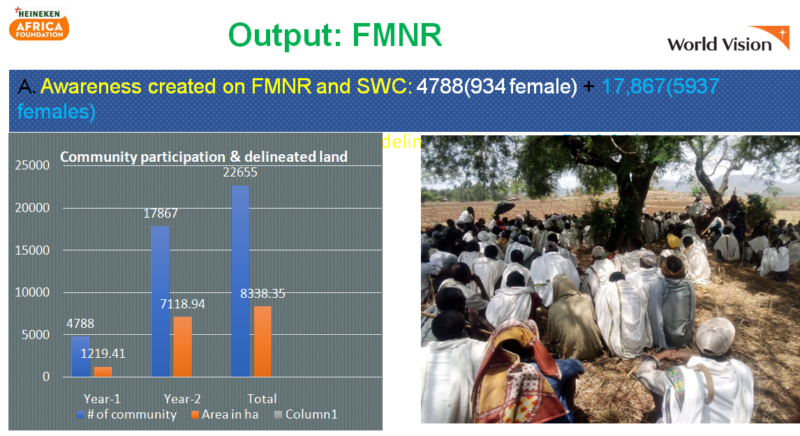
Since its launch, the RISE Project has brought regenerative agriculture and climate-smart practices to the fore. Over 8,338 hectares of degraded communal land were delineated and restored under community-led management. More than 325,000 tree seedlings were nurtured—many already greening once-barren hillsides.
Mr. Ashiber Tafesse, RISE Project Coordinator, highlighted, “By teaching farmers how to regenerate soil with vermicompost and manage landscapes sustainably, we’re planting both trees and transformation.”
On the productivity front, 817 households produced 1,660 quintals of vermicompost, which was applied to 120.5 hectares, thereby boosting fertility and yields. Meanwhile, 497 households engaged in intensive vegetable cultivation on 141.9 hectares, generating 2,331 quintals of produce and over 10.4 million birr in income.
Restoring Landscapes and Community Stewardship The project has successfully restored 8,338 hectares of previously degraded communal land, now under active management by local communities. This included 325,045 regenerated tree seedlings across delineated restoration zones. Awareness creation events engaged over 22,600 people, including 5,000+ women.
Mr. Ashiber Tafesse emphasized, “It’s inspiring to see communities voluntarily organize to protect and regenerate their environment. Ownership is the foundation of sustainability.”
A government expert from Farta woreda added: “The FMNR model has been especially successful here. With over 7,100 hectares rehabilitated, our woreda is now a reference for other districts.”
Nourishing Futures: From Malnutrition to Healthy Homes
One of the most inspiring results comes from RISE’s nutrition interventions. 1,136 malnourished children were supported through community-led rehabilitation sessions. Cooking demonstrations, peer learning, and health messaging empowered caregivers with life-saving knowledge.
Mr. Yidenkachew Wendaferw, from World Vision’s Livelihood Office, stated, “These aren’t just sessions—they’re lifelines. A nourished child means a thriving family and a stronger community.”
Climate-Smart Farming and Agricultural Productivity Over 817 households produced 1,660 quintals of vermicompost, significantly improving soil fertility on 120.5 hectares of farmland. Additionally, 7,242 fruit seedlings and 96 kg of diverse vegetable seeds were distributed, boosting both nutrition and income.
In Fogera, a district agriculture officer said, “Farmers who used vermicompost reported up to a 40% increase in yield. This is a game-changer, especially for vegetables.”
The irrigation component equipped 497 households with 57 motorized pumps, resulting in 2,331 quintals of vegetables harvested from 141.9 hectares of irrigated land and generating 10.4 million birr in sales.
Beekeeping and Forage Production: New Paths to Prosperity. In partnership with local governments, the project distributed 744 modern beehives and supported the construction of 2,018 transitional hives. 345 households also received 6,000 cuttings and 748 kg of forage seed, resulting in 196 tons of forage biomass.
A man in Dera woreda testified, “I never expected to become a beekeeper, but with RISE’s support, I now produce and sell honey. My earnings helped send my younger sister to school.”
Economic Empowerment: The Rise of Women and Youth Entrepreneurs
RISE also catalyzed financial inclusion. 74 village saving groups mobilized over 1.2 million birr in savings, with loans reaching 911 members—the majority being women.
Mr. Azmerawe, representative of the Amhara Finance Bureau, underscored the importance of this shift: “Access to finance means access to choices, and our women and youth are now active agents in their own economic destiny.”
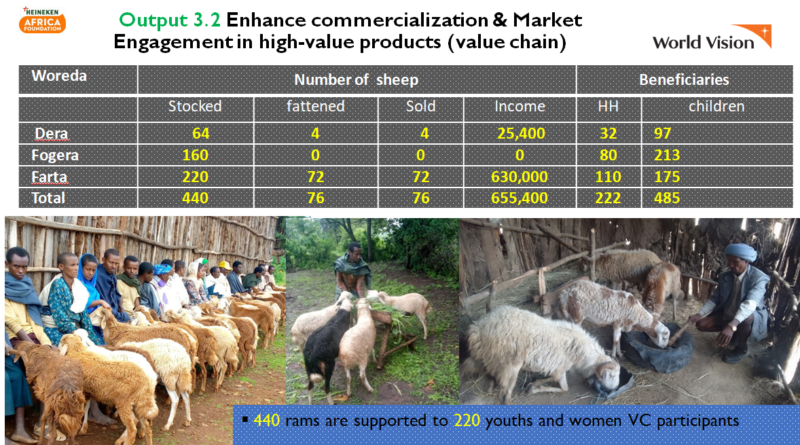
In another bold stride, 282 women and youth entered the livestock and poultry value chains. With 9,300 pullets distributed and 440 sheep supplied as startup assets, entrepreneurial spirit is rising with the morning sun in rural Amhara.
Institutional Reflections: Real Results, Real Challenges
Combating Malnutrition Through Community-led Nutrition Through PD/Hearth sessions, 1,136 malnourished children were supported. Community cooking demonstrations and nutrition education proved effective in combating food insecurity.
Building Local Economies: Financial Inclusion and Agribusiness. The formation of 74 village saving and loan groups (S4Ts) with 1,768 members (1,297 women) led to savings of 1.2 million birr and loans totaling 547,240 birr. Women-led groups were particularly successful.
In Fogera, one group member shared, “I borrowed 3,000 birr to start sheep fattening. Within months, I repaid my loan and had enough to expand.”
The project also empowered 282 women and youth in livestock and poultry businesses, delivering 9,300 pullets and 440 sheep. A youth-led pullet grower group produced 8,000 day-old chicks across four cycles, earning over 1.2 million birr.
Lessons, Challenges, and Forward Motion Despite significant progress, challenges persist. Security concerns, road closures, and fluctuating input prices hindered implementation.
Mr. Azmerawe, of the Finance Bureau, stressed: “We see real entrepreneurship emerging. These are not temporary beneficiaries; they are the next generation of business leaders.” Mr. Azmerawe Quote: A regional official aptly summarized: “RISE is more than a project; it’s a movement. A movement from poverty to prosperity, from crisis to confidence.”
Mr. Ashiber Tafesse, Project Coordinator, stated, “We are seeing remarkable improvements in child nutrition, driven by mothers who now understand and apply local, affordable nutrition practices.”
An administrator of Fogera added, “These sessions changed community attitudes. We no longer wait for clinics; we act at the household level.”
Mr. Abebe Abuye, World Vision’s Regional Program Manager, noted, “We need strong coordination to overcome these systemic challenges. But our progress proves we are on the right track.” Mr. Abebe Abuye, World Vision Ethiopia’s Amhara Region Program Manager, led a thought-provoking discussion on the project’s reflections. While applauding successes, he noted significant barriers: insecurity, road closures, inflation, and input procurement delays.
Mr. Tefera Akalu, from the Environment and Forest Protection Authority, added: “Partnerships must deepen. We must replicate successful practices in other vulnerable areas.” Mr. Tefera Akalu added, “We must work harder to buffer these climate-smart efforts against external shocks. Scaling local solutions must remain our guiding principle.”
Looking Forward: Sustainability Rooted in Local Ownership
The workshop concluded with Mr. Amanuel Tesfahun, World Vision’s Project Coordinator, outlining next steps. These include stronger market linkages, scaling farmer-managed natural regeneration (FMNR), accelerating procurement, and deepening institutional partnerships. Mr. Amanuel Tesfahun summarizes the vision ahead: “The next phase focuses on deeper market integration, broader community ownership, and institutional sustainability. RISE has laid the foundation—now it’s time to build the future.”
Farmers, regional bureaus, and development partners expressed renewed commitment. One farmer participant captured the spirit best: “This project didn’t give us food; it taught us how to feed ourselves.”
RISE is not just a project—it’s a blueprint. A story of how funding from a beverage giant, fieldwork by a global NGO, and the spirit of rural Ethiopia are coming together to rewrite the narrative of resilience and rural prosperity.
Farmers from each woreda shared their stories:
- From Dera woreda, a farmer shared, “Before RISE, our land was dying. Now, with vermicompost training and vegetable seeds, I harvested more than I ever imagined and sold produce worth 64,000 birr.”
- In Fogera woreda, noted, “The poultry training and pullets support helped me start my own business. I never thought I could become a poultry producer. I now supply eggs to nearby markets.”
- From Farta woreda, a farmer added, “The transitional beehive training opened a new source of income for my family. I have produced honey and sold it in local bazaars.”
By Ayele Addis Ambelu (ayeleradio@gmail.com)