Inside the effort to build “zero tolerance” for sexual exploitation, abuse and harassment and turn safeguarding from a donor requirement into an institutional culture
By Ayele Addis
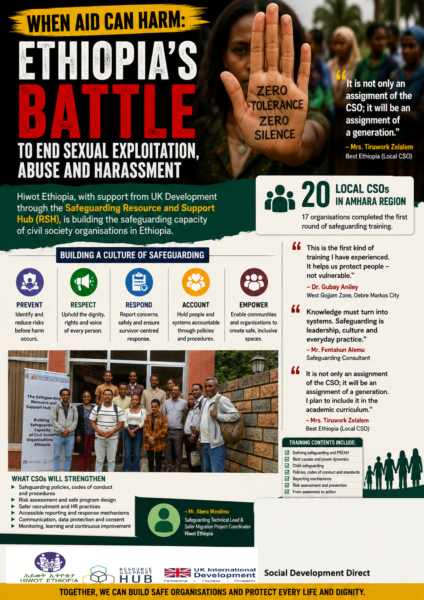
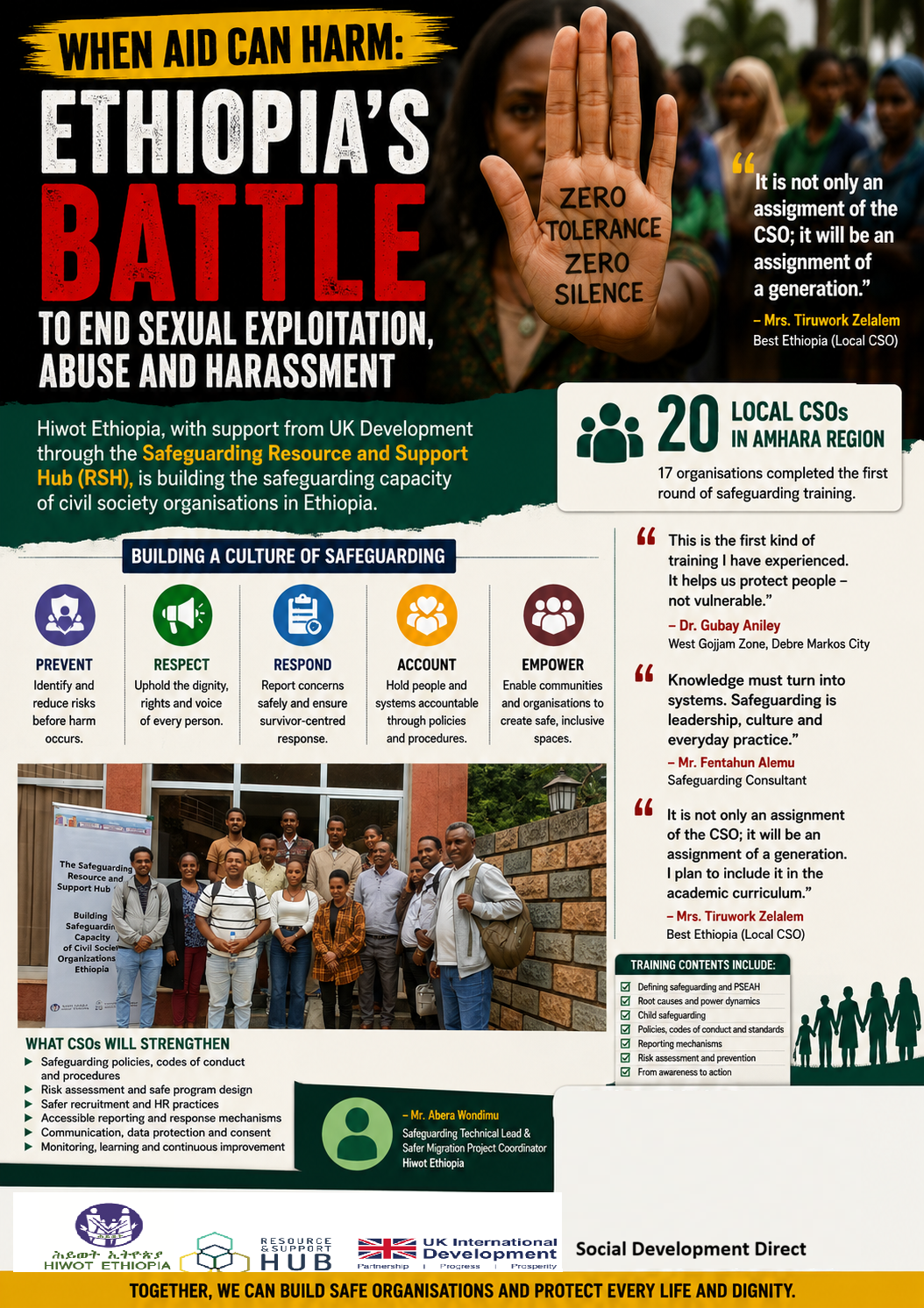
The Safeguarding Resource and Support Hub (RSH- Ethiopia), implemented locally by Hiwot Ethiopia with support from Foreign Commonwealth Development Office (FCDO), is taking its safeguarding work into Ethiopia’s civil society sector with a central proposition: protection cannot be an attachment to a project; it has to be part of the way an organisation operates.
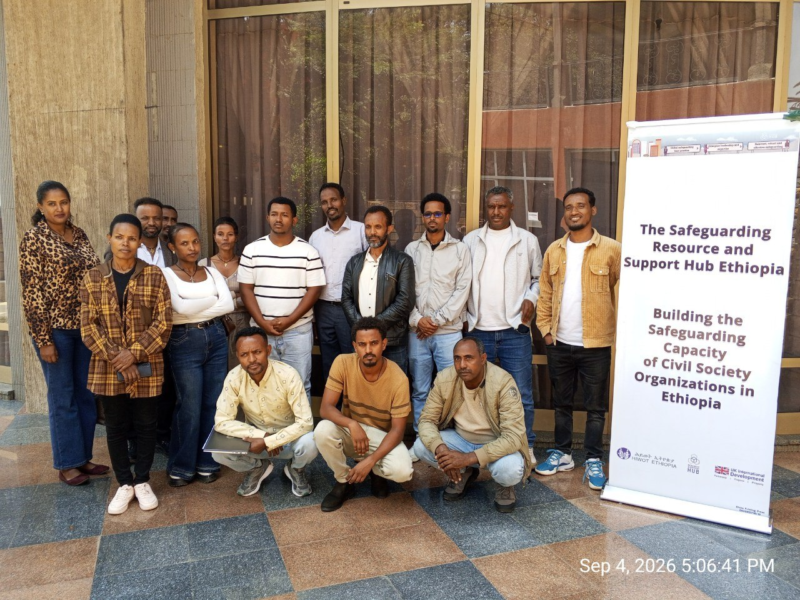
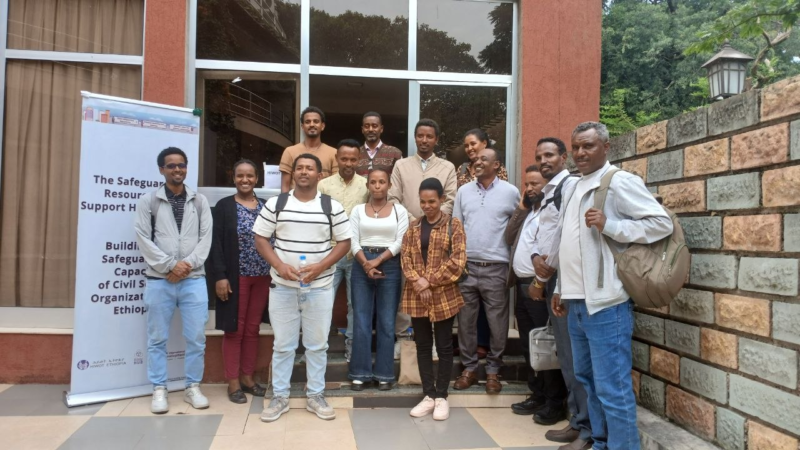
In the Amhara region, the programme is continuing through a capacity-building process targeting 20 local civil society organisations (CSOs). The first round has already brought representatives of 17 organisations into safeguarding training, with further organisations expected to be engaged as the programme develops.
The programme is particularly significant because it seeks to move the discussion beyond awareness. Its objective is to help local organisations understand the risks of sexual exploitation, abuse and harassment (SEAH), assess where those risks exist, establish policies and reporting mechanisms, and integrate safeguarding into project design, implementation, monitoring, human resources, communications and organisational leadership.
The RSH training material defines safeguarding as the ethical measures organisations adopt to protect the safety and wellbeing of people involved in humanitarian and development work. It stresses that organisations have a responsibility both to prevent harm connected to their work and to respond appropriately when harm occurs.
In an office, a training hall or a community project, safeguarding can appear deceptively simple: write a policy, appoint a focal person and tell staff what is prohibited.
But the real test begins when an organisation sends a worker into a community, distributes assistance, recruits volunteers, collects sensitive information, transports programme participants or gives someone access to resources and decision-making power.
That is where the new safeguarding push in Ethiopia is attempting to intervene.
The question behind the programme: Who protects the people being helped?
Development organisations are created to solve social problems. But the same institutions can unintentionally create opportunities for abuse when they control employment, money, services, information, transport, programme participation or access to decision-makers.
This is why the safeguarding programme puts power at the centre of its analysis.
The training contents states bluntly that SEAH involves an abuse of power and that organisations providing assistance and services occupy a position of trust and authority. Survivors can include programme participants, community members, staff and others who come into contact with an organisation.
The implications are profound.
A woman seeking livelihood assistance may depend on a programme officer. A displaced family may depend on an organisation for food or services. A young person may depend on an adult working for an NGO. A temporary employee may fear reporting misconduct by a senior manager.
The problem therefore cannot be reduced to individual morality.
It is also about institutional design.
The RSH training identifies organisational culture, leadership, working practices, human resources, programme design, community conditions, social norms and structural inequalities as factors that can create or reinforce safeguarding risks.
That is why the programme’s message is increasingly becoming: do not wait for abuse to happen before building a safeguarding system.
Abera Wondimu: Safeguarding has to enter the organisation’s DNA
According to Mr. Abera Wondimu, Senior Program Officer & Safeguarding Technical Lead, the purpose of the initiative is not simply to conduct another training workshop.
The ambition, as described by Abera, is to build the institutional capacity of local CSOs so they can recognise safeguarding risks, establish appropriate systems and make protection part of their normal organisational practice.
That distinction matters.
A three-day workshop can raise awareness. It cannot, by itself, transform an organisation.
The training itself makes this point explicitly: “Policies alone do not prevent harm.” Effective safeguarding requires moving from written commitments to systems and everyday behaviour.
For Hiwot Ethiopia, the intended pathway is therefore broader: training, technical support, organisational assessment, mentoring, policy development, codes of conduct, reporting systems, risk assessment and follow-up.
Hiwot Ethiopia’s own published safeguarding experience shows that this model is not entirely new. The organisation says it previously worked with more than 20 civil society organisations through safeguarding training, mentoring and coaching, including support on safe programming, safe recruitment, case management and policy development.
Mr. Abera also says that its safeguarding support has included helping CSOs develop contextual policies and procedures, implement them in daily operations, establish case-management systems and conduct risk assessments.
Why now? Ethiopia’s difficult operating environment
The programme’s organisers point to the wider pressures facing organisations and communities in Ethiopia including the consequences of conflict, displacement, vulnerability and economic pressure as part of the rationale for strengthening safeguarding.
Those pressures matter because vulnerability can increase when people depend heavily on institutions or individuals controlling scarce resources.
The RSH training does not treat vulnerability as a fixed characteristic. Instead, it connects vulnerability to power and intersectionality including gender, age, disability, ethnicity, migration status, employment status, education and other factors that can combine to shape people’s access to power and protection.
This is particularly important in humanitarian and development programming.
When an organisation enters a community with money, services, information or opportunities, it changes the local power relationship.
The question is therefore not simply:
“Do we have a safeguarding policy?”
It is:
“Where does our programme create power and what safeguards exist around that power?”
From Addis Ababa to Amhara: localisation becomes the next test
The Ethiopia safeguarding initiative is part of a much larger international effort.
The UK-funded RSH was established to help organisations in the aid sector strengthen their safeguarding policies and practices against sexual exploitation, abuse and harassment, with particular attention to less-resourced civil society organisations. The programme developed global, regional and national hubs.
The Ethiopia hub has since moved toward local ownership.
A recent FCDO evaluation says the Ethiopia Hub was established in 2019 and focused on strengthening local CSOs’ capacity to develop and implement safeguarding policies, respond to SEAH incidents and create safer environments. It also describes the subsequent transition of leadership to Hiwot Ethiopia.
That transition is more than an administrative change.
It represents an important experiment in whether safeguarding knowledge can become locally owned rather than permanently dependent on international organisations.
The FCDO evaluation notes that Hiwot Ethiopia was selected to assume leadership following an assessment of its organisational and technical capacity and previous safeguarding experience.
The Amhara experiment: 20 organisations, one institutional challenge
The next phase in Amhara is designed around 20 local CSOs.
In the first round, 17 organisations participated in the training, according to programme information provided for this story.
The significance of the number is not simply how many people sat in a training room.
The real question is what happens when those representatives return to their organisations.
Will they revise their safeguarding policies?
Will organisations appoint and support safeguarding focal persons?
Will staff understand how to report concerns?
Will communities know where to report?
Will safeguarding risks be included in project budgets?
Will recruitment procedures include safeguarding?
Will programme managers conduct risk assessments before activities begin?
And will organisational leaders actually act when allegations arise?
Those are the measures that will determine whether the programme succeeds.
The training framework itself identifies seven broad risk areas: the external environment; governance, culture and leadership; human resources; programmes; reporting and response; communications and information management; and third-party engagement.
Dr Gubay Aniley: “This is the first kind of training”
For Dr. Gubay Aniley of West Gojjam Zone, Debre Markos City, the value of the programme is its practical orientation.
In his testimony, he described the training as a new experience and said it could help organisations protect people who may be vulnerable to abuse.
His observation points to one of the central benefits of the programme: safeguarding is often discussed in broad language, but organisations need the ability to translate principles into everyday decisions.
The training therefore moves from definitions to practice.
Participants examine how power operates, how abuse can occur, how children may be exposed to risk, how reporting mechanisms should work and how organisations can design safer programmes.
The training explicitly asks participants to consider who is most at risk, who holds power and how different identities and social conditions intersect.
For local CSOs, that can turn safeguarding from an abstract international standard into something that can be examined in their own offices and communities.
Fentahun Alemu: The consultant’s challenge turn knowledge into systems
Mr. Fentahun Alemu, a safeguarding consultant, also emphasises the need to move beyond training.
That challenge is perhaps the hardest part of the programme.
Safeguarding becomes meaningful only when it changes behaviour.
The RSH training identifies leadership, communication, policies, prevention, reporting, response and monitoring as interconnected components of an effective safeguarding system.
A policy that sits inside a computer file cannot protect a beneficiary.
A reporting mechanism that nobody knows about cannot protect a survivor.
A safeguarding focal person without authority or resources cannot carry the whole system.
And a leadership team that does not enforce its own code of conduct can destroy confidence in the entire mechanism.
That is why the programme emphasises organisational culture.
The training describes a safe culture as one in which leadership visibly supports safeguarding, people can speak up without fear of retaliation, expectations are clear, concerns are taken seriously and organisations continuously learn and improve.
Tiruwork Zelalem: “Not only an assignment of CSOs: it is an assignment of a generation”
Perhaps the most far-reaching vision comes from Mrs. Tiruwork Zelalem of Best Ethiopia, a local CSO participant.
Her message, according to the testimony provided for this story, is that safeguarding should not be treated merely as an organisational assignment.
“It is not only an assignment of the CSO; it will be an assignment of a generation.”
That argument takes the programme beyond compliance.
Mrs. Tiruwork is considering how safeguarding principles could eventually be incorporated into the academic curriculum of her institution, allowing the ideas to reach future professionals before they enter civil society organisations.
If that happens, safeguarding could gradually shift from a specialised NGO concept into a broader professional ethic.
Teachers, health workers, social workers, journalists, development professionals, community workers and administrators could encounter the principles before they assume positions of authority.
That would be a much deeper form of localisation.
What exactly are CSOs being asked to change?
The answer is almost everything.
1. Recruitment
The programme promotes safer recruitment from job descriptions and advertisements through interviews, references, vetting, contracts and orientation.
The logic is straightforward: safeguarding begins before someone receives organisational authority.
2. Codes of conduct
A code of conduct translates organisational values into expected behaviour.
It should apply not only to permanent employees but also volunteers, consultants, board members, partners and suppliers.
3. Reporting
The programme encourages multiple, accessible reporting pathways and clear explanations of what happens after a concern is raised. Confidentiality and survivor support are central to the process.
4. Programme design
Safeguarding is supposed to begin during programme planning—not after an incident.
The training identifies programme start-up, planning and design, implementation and closure as stages where safeguarding risks need to be considered.
5. Human resources
Safeguarding responsibilities should continue through the employee lifecycle—from recruitment and onboarding to supervision, performance management and exit.
6. Communications
The programme warns organisations to obtain informed consent before using photographs, stories or videos; protect privacy; avoid stereotypes and victim-blaming; and represent people with dignity.
7. Monitoring and evaluation
Even research and monitoring activities can create safeguarding risks.
The training therefore calls for risk assessment, informed consent, privacy, secure data handling, safe recruitment of data collectors and procedures for responding to disclosures.
The hidden danger: when a project itself creates risk
One of the strongest ideas in the training is that safeguarding problems do not necessarily originate from “bad people.”
They can be produced by bad systems.
Consider a food distribution.
If one staff member controls the beneficiary list, there is power.
If the complaint mechanism is inaccessible, there is risk.
If beneficiaries believe reporting will cause them to lose assistance, there is another layer of risk.
If workers are not trained to recognise abuse, the system can become blind to warning signs.
The training therefore asks organisations to examine risk before harm occurs.
Its risk-assessment model follows four steps: identify and assess the risk; mitigate and manage it; monitor and adapt; and revisit the assessment.
The programme’s assessment tool goes further by rating risk according to likelihood × impact, allowing organisations to prioritise scarce resources.
This is crucial for smaller Ethiopian CSOs that may not have large compliance departments or specialist safeguarding staff.
Why local CSOs matter
The international safeguarding system has increasingly recognised that local organisations need locally relevant support.
A UK cross-sector report found that organisations continue to face difficulties providing safeguarding support that fits local contexts, languages and capacities. It also identified continued demand for in-country advice and stressed the importance of sustaining national hubs such as the Ethiopia hub.
The RSH model was deliberately designed to support smaller, less-resourced organisations.
Its online platform provides safeguarding resources, e-learning, webinars and access to safeguarding consultants, while national hubs provide context-specific support.
This is particularly important because a small local CSO may have strong community legitimacy but limited institutional resources.
The answer cannot simply be to impose the same compliance system used by a large international NGO.
Safeguarding must be accessible, contextualised and practical.
The training itself says good safeguarding policies should use clear language, be practical, survivor-centred, context-specific, accessible and regularly reviewed—and warns against simply copying another organisation’s policy.
From zero tolerance to zero silence
The phrase “zero tolerance” is powerful, but it can also become empty language.
A genuinely zero-tolerance organisation needs more than a statement on a wall.
It needs:
- a functioning reporting system;
- trained staff;
- clear disciplinary procedures;
- confidential and accessible channels;
- survivor-centred responses;
- responsible leadership;
- risk assessments;
- safe recruitment;
- community participation;
- protection of sensitive information;
- monitoring and learning.
The RSH training repeatedly returns to this distinction.
Its objective is not merely to respond after abuse. It is to prevent harm before it happens, reduce organisational risks and create systems through which concerns can be raised safely.
That is the difference between zero tolerance on paper and zero tolerance in practice.
A generational opportunity for Amhara’s civil society
The Amhara programme now faces its most important phase.
The first 17 organisations have received the training. The wider programme is planned to reach 20 local CSOs. But the measure of success will not be the number of certificates issued.
It will be whether the organisations change.
Whether a programme manager asks about safeguarding during project design.
Whether an HR officer considers safeguarding during recruitment.
Whether a board allocates resources.
Whether a volunteer knows how to report.
Whether a community member understands their rights.
Whether a survivor believes that reporting will be taken seriously.
And whether leaders act when the person accused is powerful.
That is why the programme’s most important product may not be a policy document at all.
It may be a change in institutional behaviour.
The bigger picture: Ethiopia’s safeguarding architecture is becoming locally owned
The story of the Ethiopia RSH is also part of a wider evolution.
The original UK-funded RSH model was established to strengthen safeguarding in the international aid sector. Its Ethiopia hub has now moved toward national ownership under Hiwot Ethiopia.
Hiwot Ethiopia reports that earlier safeguarding work helped CSOs establish policies, focal persons, reporting systems, safeguarding budgets and case-management structures.
That experience gives the Amhara initiative an important foundation.
But localisation also creates a new responsibility.
Once international technical assistance becomes locally led, Ethiopian institutions and CSOs must determine how safeguarding survives beyond individual projects and donor cycles.
The question becomes:
Can safeguarding become part of Ethiopia’s institutional culture?
The verdict will come after the training
The training room is only the beginning.
The real safeguarding test starts when participants return to their offices.
The RSH material itself captures this challenge in one of its final reflections:
“Change doesn’t happen because we attended a training. It happens because we take the first step when we get back.”
For the 20 CSOs targeted in Amhara, that first step could mean rewriting a policy, establishing a reporting channel, training volunteers, assessing a programme’s risks, changing recruitment practices or simply creating an environment where someone can safely say: “Something is wrong.”
For Hiwot Ethiopia, the challenge is to accompany them beyond the training room.
For local CSOs, the challenge is to turn safeguarding from a requirement into a habit.
And for communities, especially people who depend on organisations for assistance, services and opportunities, the hoped-for outcome is much more fundamental: help should never come at the price of dignity, safety or silence.
That is ultimately what the safeguarding agenda is asking Ethiopia’s civil society sector to build, not simply organisations that comply with safeguarding standards, but organisations that people can safely trust.