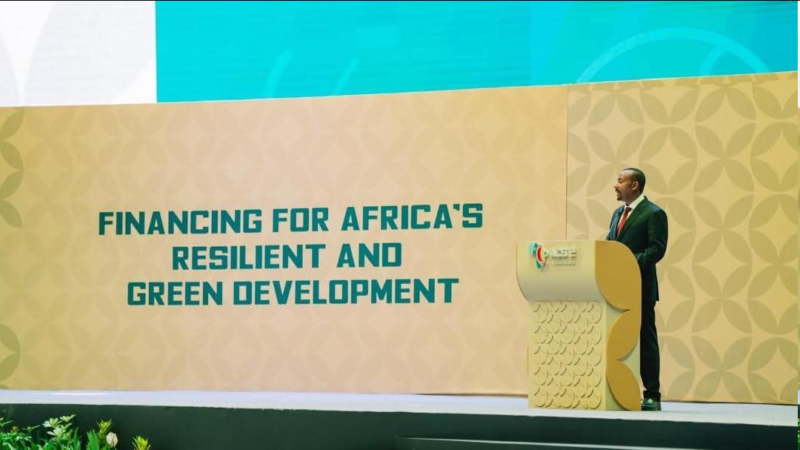
Africa Closes Climate Summit With Multi-Billion-Dollar Green Investment and Insurance Commitments
By Ayele Addis Ambelu
Addis Ababa, Sept 11, 2025 (ANC) — The Second Africa Climate Summit (ACS2) concluded Thursday in Addis Ababa with African leaders adopting the Addis Ababa Declaration, a landmark agreement positioning the continent as a driver of climate solutions backed by billions in new financing and climate insurance mechanisms.
Hosted by Ethiopia in partnership with the African Union, ACS2 drew more than 25,000 participants under the theme “Accelerating Global Climate Solutions: Financing for Africa’s Resilient and Green Development.”
$50 Billion Compact for African Solutions
Ethiopian Prime Minister Abiy Ahmed announced the creation of the Africa Climate Innovation Compact (ACIC) and the African Climate Facility (ACF). Together, the initiatives aim to mobilize $50 billion annually in catalytic finance to deliver 1,000 African-designed solutions in energy, agriculture, water, transport, and resilience by 2030.
“We ask our partners not to fund us because we are impacted, but to invest with us because we are visionary,” Abiy said, underscoring Africa’s shift from aid-dependence to investment-led growth.
Climate Insurance at the Center
The Declaration emphasized the urgent need to expand climate risk insurance and resilience financing, citing the billions Africa loses annually to droughts, floods, and extreme weather. Leaders demanded that adaptation finance be provided as grants, not loans that add to Africa’s debt burden.
“Adaptation finance is not charity—it is a legal obligation,” the Declaration stated. “Climate insurance is essential for Africa’s survival and prosperity.”
The Africa Adaptation Acceleration Program (AAAP) 2.0 was launched, targeting $50 billion by 2030 to climate-proof food systems, infrastructure, and urban zones.
Major Financial Commitments
A series of major pledges were unveiled at ACS2:
- The African Development Bank (AfDB), Afreximbank, Africa50, and Africa Finance Corporation signed a cooperation framework to operationalize the Africa Green Industrialisation Initiative (AGII), with $100 billion mobilized for renewable energy and green industries.
- Italy reaffirmed its pledge of $4.2 billion through the Italian Climate Fund, with 70% allocated to Africa, and signed an MoU with Ethiopia.
- Denmark announced $79 million to support agricultural transformation.
- The European Investment Bank (EIB) signed technical assistance agreements with three Ethiopian banks as part of its €100 billion global green investment plan by 2027.
- The Climate Justice Impact Fund for Africa (CJIFA) reported disbursing 64 grants in 17 African countries for grassroots solutions.
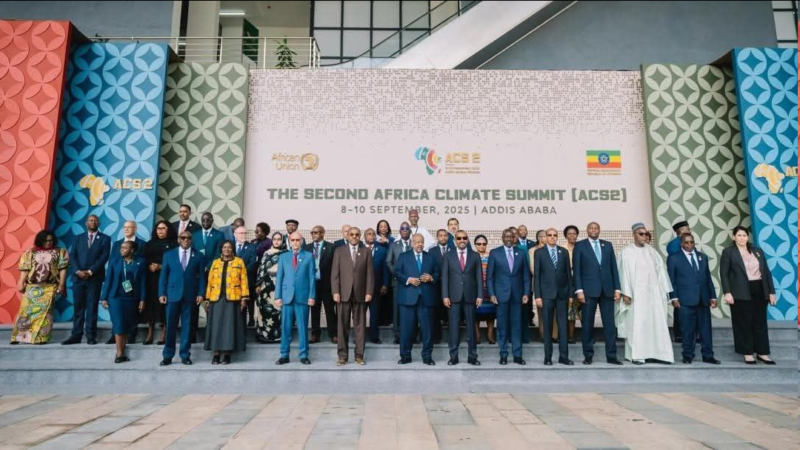
Leaders also called for Africa’s share of global renewable energy investment—currently just 2%—to rise to 20% by 2030.
Green Minerals and Industrialisation
Another focus was the Green Minerals Strategy, aimed at ensuring Africa’s vast cobalt, lithium, and rare earth resources drive local industrialization and job creation, rather than being exported raw to fuel global clean tech supply chains.
AfDB President Akinwumi Adesina stressed the linkage between resilience and industrialization: “We must insure our people against risks, but also insure our economies by adding value at home. Green growth and green insurance are two sides of the same coin.”
Road to COP30
The adoption of the Addis Ababa Declaration sets the stage for Africa’s engagement at COP30 in Belém, Brazil, where leaders aim to speak with one voice on climate finance and justice.
UN research estimates Africa requires $250 billion annually by 2030 to meet its climate goals, yet currently receives less than 12% of that amount. Leaders argued that ACS2 marks a turning point in mobilizing finance on Africa’s terms.
Closing the summit, Abiy Ahmed warned of urgency: “We are the first African generation with the means to heal what was broken, and the last with the time to do it. This is not charity. It is the most strategic investment humanity can make.”
A Unified Voice
The summit drew over 43 private sector exhibitions and 240 side events, underscoring Africa’s growing role in global climate solutions. For the first time, African governments, financiers, and grassroots leaders appeared aligned on both narrative and strategy.
With the Addis Ababa Declaration, Africa positioned itself not as a climate victim but as a renewable energy powerhouse and insurance innovator, demanding fair finance and delivering homegrown solutions.
As one delegate from Senegal remarked: “This is the moment Africa shifted from asking for climate justice to designing the climate economy.”
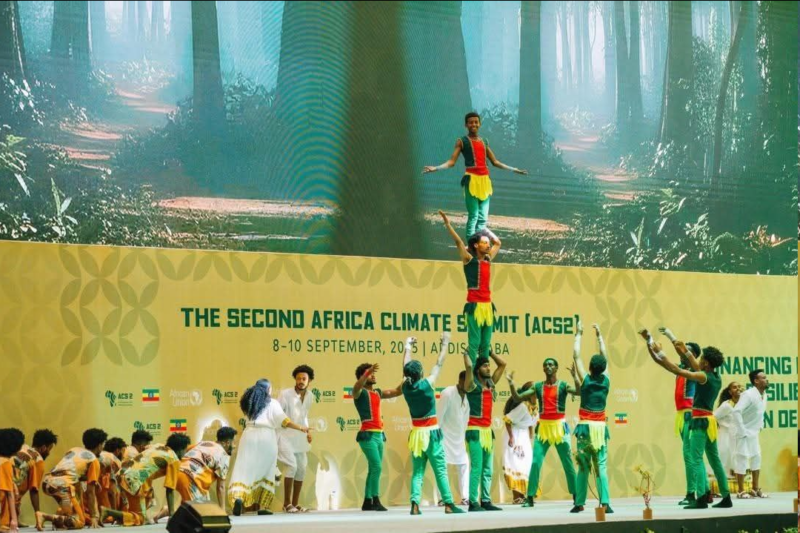
AT THE CLOSE OF ACS2, AFRICA CLAIMS ITS PLACE IN GLOBAL CLIMATE LEADERSHIP WITH MULTI-BILLION-DOLLAR COMMITMENTS TO FINANCE LOCALLY-LED CLIMATE SOLUTIONS
Addis Ababa, Ethiopia, 11 September 2025: The final day of the Second Africa Climate Summit (ACS2) concluded with a clear call to position Africa, not as a mere victim of climate change, but as a driver of solutions and the next global climate economy. ACS2 was hosted by the Federal Democratic Republic of Ethiopia in collaboration with the Africa Union under the theme: “Accelerating Global Climate Solutions: Financing for Africa’s Resilient and Green Development”.
The Addis Ababa Declaration Successfully Adopted
At the close of ACS2, the African Leaders Addis Ababa Declaration on Climate Change and Call To Action was officially adopted, heralding a historic moment that puts Africa at the forefront of global climate action.
The Leaders Declaration called for “strengthened and sustained support to scale up the implementation of African-led climate initiatives such as the African Union Great Green Wall Initiative, the African Forest Landscape Restoration Initiative, and the Ethiopian Green Legacy Initiative.
Climate Finance and Other Commitments and Announcements Made at ACS2, Including;
African leaders and partners of Africa pledged for financial and innovative commitments to the continent for the implementation of African-led solution,s including:
- The Africa Climate Innovation Compact (ACIC) and the African Climate Facility (ACF), were established under the initiative of H.E. Abiy Ahmed, Prime Minister of the Federal Democratic Republic of Ethiopia, committing to mobilize $50 billion annually in catalytic finance to champion climate solutions that accelerate innovation and scale local climate solutions across the continent. The Compact aims to deliver 1,000 African solutions to tackle climate challenges in energy, agriculture, water, transport, and resilience by 2030.
- Leaders were clear that adaptation finance is the legal obligation from the developed world, not charity. Africa stressed that adaptation finance must be delivered in the form of grants, not loans that worsen already fragile debt burdens. To correct the imbalance of the climate finance in Africa, a landmark deal was struck to operationalise the long-awaited African Climate Change Fund, supported by the African Development Bank, which will channel green bonds and innovative financing instruments built for Africa’s realities.
- Heads of State and Government spoke with one voice in demanding urgent reform of multilateral development banks to lower borrowing costs and expand African representation in global financial governance.
- The Government of Denmark announced $79 million for supporting agricultural transformation.
- African financial institutions such as AfDB, Afreximbank, Africa50, and AFC signed a landmark Cooperation Framework to operationalise the Africa Green Industrialisation Initiative (AGII), backed by $100 billion mobilised for green growth and aiming at transforming Africa’s renewable energy, resources, and industries into a climate-smart growth engine.
- The Government of Italy reaffirmed its commitment to its pledge of $4.2 billion to the Italian Climate Fund, devoting about 70% of this to Africa. It signed an MoU with Ethiopia as to benefit from this initiative.
- The second phase of the Africa Adaptation Acceleration Program (AAAP) called on partners to collaborate actively in AAAP 2.0, which aims to climate-prepare Africa’s food systems, future-proof infrastructure and urban zones, seeking $50 billion investment and unlocking resilient finance at scale by 2030.
- The EIB Global has signed technical assistance agreements with Zemen Bank SC, Dashen Bank SC and Hibret Bank in Ethiopia with facilitation through the “Readiness support for greening central banks” of the NDC Partnership as part of EIB Global’s devotion to supporting €100 billion of investment by the end of 2027.
- The Mission 300 Agenda and the Clean Cooking Initiative were advanced to ensure that 300 million Africans gain access to modern energy and 900 million to clean cooking solutions within the decade.
- Leaders further called for Africa’s share of global renewable energy investments to rise from a meagre 2% today to at least 20% by 2030, a shift that would finally reflect the continent’s potential as a renewable energy powerhouse.
- The Summit pushed for the Green Minerals Strategy, a blueprint to ensure that cobalt, lithium, copper, and rare earths fuel not only global clean energy supply chains but also local beneficiation, job creation, and industrialisation.
- Leaders pledged to establish dedicated financial mechanisms for addressing climate-related health threats, from deadly heatwaves to the spread of vector-borne diseases.
- ACS2 also marked the official launch of the newly developed Africa Just Resilience Framework (JRF), which will work alongside the Climate Justice Impact Fund for Africa (CJIFA) to provide a framework and funding for local climate initiatives. CJIFA has already dispersed 64 grants in 17 African countries.
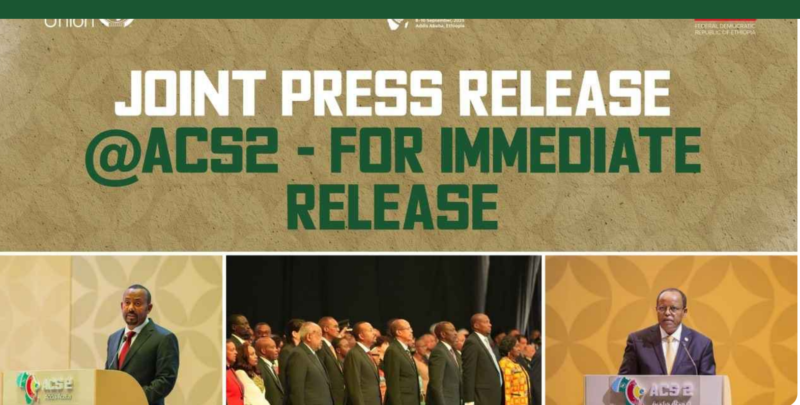
Over the three days of the Second Africa Climate Summit (ACS2), Amazing Interactions among the Participants were Achieved.
- Over 25,000 delegates, including heads of state and government, ministers, representatives of civil society, development partners, the private sector, local community and indigenous peoples, farmers, youth, and academia, converged here to deliberate and chart a way forward for their future and for posterity.
- 23 Pavilions at the Addis International Convention Center (AICC) hosted interactive debates by thousands of participants from African countries, regional organisations and development partners.
- Over 43 exhibitions by the private sector presented innovations and commitments for green growth and low-carbon development.
- Over 240 mandated and official side events focused largely on African-led climate solutions and explored new pathways.
ACS2 Laid Down the Road to Belem for Africa’s Effective Engagement at COP30
At a time when many global summits have been reduced to finger-pointing and stalemates, ACS2 was notable for its spirit of cooperation. The presence of leaders from across the African Union Member States, alongside global partners, representatives of the civil societies, private sectors, faith-based organizations, community-based organizations, local communities and indigenous people all over the globe, reinforced the message that climate is the ultimate test of multilateralism.
This summit has shown Africa and the world that when nations come together to seek solutions, better outcomes follow. The summit’s success is proof that Africa can convene, lead, and deliver outcomes that reverberate globally that will directly Carry into COP30 and beyond.
The Government of Ethiopia and African Union Commission will continue their leadership to implement the Addis Ababa Declaration and support the initiatives that came out of the ACS2.