





By PAUL DELKASO President & CEO | Tritente Global Energy Group Global Infrastructure Development | Energy Systems | Critical Minerals | Sovereign Infrastructure Finance
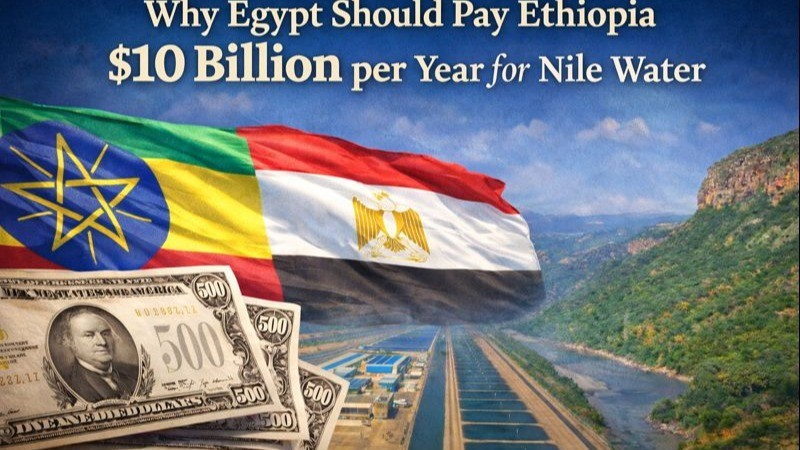
The Water Bill: Why Egypt Should Pay Ethiopia for Nile Water? The Nile’s waters sustain over 160 million people across East Africa. In our age of climate stress, water is no longer an endless free resource – it is turning into a valuable commodity or “liquid gold.” Countries from California to the Middle East already treat water as an economic asset. Ethiopia, Africa’s second-most populous nation and one of the world’s fastest-growing economies (projected ~7.3% GDP growth in 2026 focus rightly asks: if Egypt’s farms and cities derive tens of billions of dollars in value from Nile water, shouldn’t Ethiopia share in that bounty? The time is ripe to move beyond colonial-era claims and negotiate a modern water‐sharing deal.
Even by conservative, back-of-the-envelope economics, the Nile generates roughly 40 to 45 billion dollars in annual value for Egypt, largely through agriculture, water security, and power. Over a century, that flow compounds into well over a trillion dollars of downstream wealth. Yet upstream, Ethiopia has absorbed the hydrology without capturing the economics. Nearly 1.2 trillion dollars in potential value was lost not through scarcity or mismanagement, but because the river’s rent was allowed to flow freely while the ledger remained dry. History turned water into wealth for one nation, while the source country bore the cost without the return.

International Precedents: Water Royalties and Deals
Across the world, countries do not simply pump river water for free. Instead, downstream users often pay upstream or share costs via treaties, contracts, or compensation. Some examples:
- Lesotho – South Africa (Lesotho Highlands Project): Lesotho sells water from the Senqu/Orange River to South Africa. South Africa pays Lesotho royalties and infrastructure fees. In 2015 South Africa’s payments were about R780 million (≈5% of Lesotho’s non-tax revenue)
- Israel – Jordan (Peace Treaty exchanges): Under the 1994 Israel–Jordan Treaty, Israel supplies Jordan with desalinated water (55 MCM/yr) and freshwater from the Sea of Galilee. In return, Jordan provides storage and agreed water releases back downstream. More recently Israel agreed to sell Jordan 200 MCM of desalinated water in exchange for renewable electricity. This is not a simple sale of cubic meters, but a negotiated barter where water, energy and money are traded together.
- India – Pakistan (Indus Waters Treaty): The 1960 Indus Treaty allocates river basins rather than pricing water. India uses the three eastern rivers, Pakistan the three westerns, with no cash payments for flow. Disputes over dams and flow (e.g. the Kishanganga/Baglihar dam cases) have enormous economic and political consequences illustrating how costly “free” water conflicts can become.
- Turkey – Syria/Iraq (Tigris–Euphrates): Turkey controls the headwaters of the Euphrates and Tigris. There is no formal per-unit price, but downstream Syria and Iraq have repeatedly pressed Ankara for guaranteed releases or compensation. For instance, Iraq has sought massive water-storage and demand guarantees and even discussed an “oil-for-water” deal with Turkey. As one analysis notes, Turkey provides roughly 60% of the flow but uses only 29% of tidal downstream neighbors claim the rest. These negotiations hinge on strategic leverage, not open-market sales.
- United States (interstate compacts): In the U.S., rivers cross many jurisdictions. States and districts rarely “sell” water by volume, but they pay for delivery infrastructure, storage and legal rights. For example, Colorado River (CA/AZ/NV): The 1922 Compact and federal projects allocate river water, but California farmers often pay nothing at the water intake. Instead, taxpayers fund dams and aqueducts. As one report notes, California irrigation districts receive millions of acre-feet under federal contracts for free while federal subsidies (to pump, store and transport that water) total hundreds of millions annually. Cities do pay more – often hundreds of dollars per acre-foot – because they cover the full delivery and treatment costs. In short, the “price” of water is hidden in infrastructure costs.
- California State Water Project: Southern California pays Northern California for water transfers via bonds, energy (pumping) and joint infrastructure. The State Water Project’s massive aqueduct requires constant pumping energy and upkeep; Southern agencies shoulder much of this cost through state revenue bonds and water fees. It is one of the world’s most expensive water-transfer systems per gallon delivered.
- Texas New Mexico (Rio Grande): The Rio Grande Compact requires New Mexico to deliver a set volume to Texas. When New Mexico fell short in the 2010s, Texas sued. A recent settlement calls for New Mexico to compensate its Southern irrigation district (Elephant Butte) to make-up shortfalls. Again, no “price per gallon” was set, but legal damages and payments enforce the water share.
- Florida (intra-state transfers): Florida’s South Florida programs (Everglades restoration, water management) are funded by massive state investments (over $9–10 billion in recent budgets). While not interstate sales, these are effectively water fees: South Florida draws heavily on Central/North Florida basins, paying via state taxes and water district fees for pumping, storage and treatment infrastructure.
These cases underscore a key point: No country simply sells river water like oil by the barrel. Yet water does have a price, expressed through royalties, treaty-based exchanges, infrastructure and delivery charges, and even legal penalties. In practice, downstream users either pay upstream governments (Lesotho), trade water for other goods (Israel–Jordan), or finance massive projects to carry water (California, Texas). Looking ahead, many regions treat water increasingly as a strategic asset: Mexico is now discussing water deliveries with the U.S. in trade talks and commodity exchanges even offer California water future. Climate stress and scarcity are turning water into a tradable geopolitical lever.
U.S. Case Study: Infrastructure and Costs
Even domestically, conveying water across borders (or basins) entails huge costs. In the U.S., for example, transferring water from rural areas to cities requires giant aqueducts and energy-intensive pumps (as illustrated above by California’s Colorado River Aqueduct). Yet users rarely pay for raw water itself. California farmers who divert Colorado River water often pay nothing at the intake; instead, taxpayers subsidize $416 million/year or more in project costs. By contrast, California cities pay far higher rates to cover delivery costs, sometimes hundreds of dollars per acre. Similar stories play out in other states: Texas courts enforce water shares by ordering monetary compensation (as Texas-New Mexico disputes show), and Florida spends billions on statewide water projects rather than direct sales. In short, Americans “value” water through infrastructure bills and legal compacts, not simple meter readings.
Valuing Nile Water to Egypt: A Back-of-Envelope
How much is Egypt’s Nile water actually worth each year? Here is a rough calculation based on public data:
- Total Nile allocation: Egypt has ~55.5 billion m³/yr under the 1959 treaty. About 85–89% of that flows into irrigation water.
- Agriculture: Agriculture (crops, livestock, forestry) is roughly 10–11% of Egypt’s GDP in absolute terms on the order of $45 billion per year. If ~85% of irrigated farming depends on Nile water, then roughly $38–40 billions of output are Nile-derived each year (many studies actually estimate the Nile supports ~$42–48B of agricultural GDP annually).
- Drinking water: Egypt pumps ~11.1 billion m³/yr into municipal water systems (for cities/towns). Household tariffs are very low (in 2024 they start around EGP0.36/L7 and top out near EGP0.67/m³owl-research, i.e. ~$0.05–$0.10). Even at those rates, tariff revenue is only on the order of $0.3–1.3 billion/yr (11.1B m³ × ~$0.03–0.12). (Of course, the economic value of clean urban water is far larger – underpinning health, industry and growth – but actual cash flows are small.)
- Hydropower: Major Nile dams in Egypt (Aswan High Dam, Esna, others) generated about 13.9 TWh in 2023. Domestic retail electricity tariffs range roughly 0.68–2.23 EGP/kWh (about $0.013–$0.045/kW depending on usage level). Valuing that 13.9 TWh at even modest rates (~$0.02/kWh) yields only $0.2–0.6 billion/yr.
Putting it together, Nile water drives on the order of $40–45 billion per year of Egyptian economic value (mostly in agriculture). In other words, each cubic meter is worth on average nearly $1 of output. Even charging a fraction of that (e.g. 20–25%) as an upstream “water royalty” would yield around $8–10 billion per year to Ethiopia. Thus the oft-discussed figure of $10 billion per year is plausible: it is only about 20–25% of the Nile’s estimated annual economic value to Egypt. For a country whose economy relies so heavily on Nile irrigation, paying Ethiopia that amount would still leave Egyptians with most of the wealth generated.
(For comparison, Egypt’s government revenue is over $100 billion per year, so $10B is a manageable ~10% hit. And recall Egypt currently subsidizes its own water and power heavily – it effectively forfeits billions in potential revenue by keeping those rates low. Sharing even part of the Nile rent is far cheaper than hydro political conflict.)
How I arrived with $10B? – below is among many scenarios’ ” most conservative”
Income Approach Basis for $10B per Year (Egypt → Ethiopia)
Inputs and assumptions (annual)
• Egypt Nile allocation: 55.5 billion m³/year
• Egypt agriculture value added (current US$): $53.35B (2024, World Bank series)
• Share of agriculture dependent on irrigation: 0.85 (85%)
• Share of irrigation dependent on Nile flows: 0.90 (conservative)
• Upstream capture (royalty) rate: 0.25 (25%)
Step A: I define the income base (annual value created by the water)
Nile-derived agriculture value = (Egypt agriculture value added) × (irrigation dependency) × (Nile share of irrigation)
Calculation
= 53.35B × 0.85 × 0.90
= 40.8B per year (rounded)
Step B: apply a royalty rate (upstream rent capture)
Annual water payment = (Nile-derived agriculture value) × (royalty rate)
Calculation at 25% royalty
= 40.8B × 0.25
= 10.2B per year (rounded)
Cross-check
Implied upstream rent per m³ = $10B ÷ 55.5B m³
This framework is designed to be measured and pragmatic. It does not seek to assign a price to all Nile waters or to past patterns of use. Instead, it introduces a modest upstream rent estimated at about $0.18 per cubic meter, applied to a limited share of the annual economic surplus arising from Nile-dependent agriculture. The structure ensures that Egypt continues to retain the majority of the value created, while allowing for a more balanced recognition of upstream contributions.
A New Nile Paradigm: Cooperation, Not Confrontation
Now is the time for Ethiopia and Egypt to turn this challenge into an opportunity. Ethiopia has signaled that the GERD dam is not an act of aggression, but an asset to share. As one analysis puts it, Ethiopia has invited its neighbors to help monitor and cooperate on the dam’s operations. In its essence, Ethiopia’s position is development is a sovereign right, and downstream needs can be met without strangling upstream growth. Negotiated rules governing filling and releases (perhaps under the Nile Basin Cooperative Framework) would protect Egypt’s water security while recognizing Ethiopia’s legitimate use.
Egypt, for its part, should recognize the strategic costs of confrontation. Years of legal battles, rhetoric and isolation efforts have drained Egyptian resources and yielded little practical gain. As experts argue, “for Egypt, making peace with Ethiopia is not an act of magnanimity, it is a strategically astute bargain. A cooperative approach – involving data sharing, flexible releases in bad years, and yes, financial arrangements – will reduce Egypt’s water anxiety far more effectively than threats. After all, Egypt’s downstream needs are real, but Ethiopia’s upward leap in development is also real. A bilateral deal on water royalties (building on the principles of the Nile Basin Commission/CFA) would convert a zero-sum dispute into a long-term partnership.
Metaphorically, fighting over the Nile is like two people standing on the same sinking raft and arguing over who gets the last bucket of water – in the end, both drown if they don’t work together to bail out the boat. Egypt must understand that Ethiopia’s rise is no flash in the pan: Ethiopia is rapidly industrializing, lifting millions out of poverty, and even building the strongest military in the region. It’s “too late to poison Ethiopian peace and attempts to do so only risk regional instability. Instead, Egypt should acknowledge that its own future security is best served by a stable Ethiopia. A paid water-sharing agreement would be an investment in peace and mutual prosperity, not a concession of rights.
Key Takeaways
- Water Everywhere, Price No Place: No mature economy treats river water as a free-for-all like an oil well. Instead, value is captured via royalties, infrastructure costs, or legal settlement. The Nile deserves the same rule: Ethiopia’s upstream water control gives it negotiating power to demand a fair share.
- Global Comparisons: Countries from Lesotho to Jordan have water‐for‐money deals. Nations like Israel and Jordan share water and energy rather than raw cash. India and Pakistan partition rivers with strict rules. The U.S. charges for moving water between states (through canals and dams), not for the water itself. Egypt pays in other ways (massive agricultural subsidies, dam maintenance); Ethiopia can ask that it pay directly.
- Climate & Commerce: Water is already becoming a geopolitical asset. With worsening droughts, even Mexico is treating treaty water as a trade negotiation. Financial markets now trade water future. Africa should not be left behind this trend – fair pricing mechanisms and markets are likely in the future.
- Suggested Policies: Ethiopia and Egypt should formalize a new Nile Water Partnership. This could involve Ethiopia charging an annual water royalty (e.g. ~$10B/yr) paid by Egypt to fund development projects in Ethiopia, while Egypt secures its guaranteed minimum flows. It could be administered through the Nile Basin Commission or a new treaty annex. International support (from the UN, World Bank or donors) could help bridge the transition, and ensure any deal is equitable.
In conclusion, water is not merely a resource it is an economic engine, a stabilizing force, and a shared inheritance. Egypt’s vast agricultural output, its cities’ drinking water, and its hydropower systems all depend overwhelmingly on flows that originate in the Ethiopian highlands. Recognizing this reality does not diminish Egypt’s civilizational legacy; indeed, Egypt has relied on the Nile for thousands of years, shaping one of humanity’s great cultures along its banks. That historical connection deserves respect. But respect cannot replace fairness, and tradition cannot substitute for equity.
Around the world, nations have learned that peace is the most valuable currency. In ecology, there is a principle called commensalism a relationship in which one party benefits while the other is neither helped nor harmed. For too long, the Nile relationship has resembled an imbalanced form of commensalism: Egypt has benefited immeasurably while Ethiopia has borne the cost without recognition. A healthier future requires transforming this one-sided arrangement into mutualism, where both nations gain and neither is diminished.
To achieve this, Egypt must choose cooperation over confrontation. No nation can build lasting security by attempting to weaken its neighbor. Any policy, whether political pressure, misinformation, or the encouragement of internal divisions aimed at destabilizing Ethiopia is not only unjust, but ultimately self-defeating. It is equivalent to trying to poison the very well from which you drink, a metaphor that captures the impossibility of sabotaging Ethiopia’s stability while still expecting uninterrupted Nile flows. Peace and prosperity in Egypt depend directly on peace and prosperity in Ethiopia.
Instead of strategies that inflame distrust, Egypt’s leaders should heed growing calls even from within Egypt to reframe the relationship with Addis Ababa. A negotiated, data-driven payment for Nile water is not a punishment. It is a modern, globally aligned mechanism that reflects economic reality, honors history, and protects the future. Such an agreement would shift the region from a cycle of suspicion to a framework of stability a historic first step toward a thriving, cooperative Nile Basin in the twenty-first century.
If war is a fire, then water must be the firebreak. And if the Nile is the artery of life for both nations, then peace must be its heartbeat.
Sources: International water agreements and dataen.wikipedia.orginss.org.ilen.wikipedia.orgtexastribune.org; Egyptian statistics and economic dataen.wikipedia.orgwater.fanack.comowl-research.comegyptera.org; policy analyseshornreview.orghornreview.org; and global news reportscalmatters.orgcalmatters.orgsmartwatermagazine.com.








