How Fatigue, Deadlines and Weak Enforcement Are Turning Ethiopia’s Night Roads into Corridors of Death
By AMBELU Ayele Addis (INVESTIGATIVE NEWS ANALYSIS)
The first phone call came before dawn.
At 4:37 a.m., residents near a highway outside Shashemene heard what sounded like an explosion. By the time police and local residents reached the scene, a long-haul truck carrying construction materials had collided with a passenger minibus.
Bodies lay scattered beside twisted metal.
A schoolteacher, a university student and a mother travelling with her two children were among the dead.
The truck driver survived.
According to police records, investigators suspected fatigue.
The crash was not unusual.
Across Ethiopia, many of the country’s deadliest road accidents occur at night, when long-distance truck drivers continue driving after spending long hours behind the wheel and when emergency response services are often limited.
Road safety experts describe driver fatigue as one of the least visible but most dangerous causes of road crashes. Unlike speeding or drunk driving, fatigue leaves no obvious evidence. Yet international studies have repeatedly shown that sleep deprivation significantly impairs concentration, judgment and reaction times.
The World Health Organization estimates that road traffic crashes kill approximately 1.19 million people every year globally and remain the leading cause of death for children and young adults aged between 5 and 29 years. More than ninety percent of these deaths occur in low- and middle-income countries. Africa has the highest road traffic fatality rate in the world despite owning only a small share of the world’s vehicles.
Ethiopia remains among the countries with a significant road safety burden. The WHO Country Profile for Ethiopia and the Global Road Safety Facility both identify speeding, inadequate infrastructure, weak enforcement and unsafe driving behaviours as major contributors to traffic fatalities.
THE MEN WHO DRIVE THROUGH THE NIGHT
Interviews with long-haul truck drivers and transport association representatives Mr Abebe Yalew should seek answers to the following questions:
How many hours do drivers typically spend behind the wheel?
What economic pressures encourage drivers to continue driving while exhausted?
How frequently do companies monitor rest periods?
What role do delivery deadlines and payment systems play in fatigue-related driving?
Several Ethiopian truck drivers previously interviewed by our media have described driving schedules that leave little room for adequate rest. Drivers often transport fuel, agricultural products and construction materials over long distances and may sleep inside their vehicles or rest for only a few hours before resuming their journeys.
A transport economists analysis Dr Letenah Ejegu note that the financial incentives are clear. More trips mean more income. Delays mean lost earnings.
The result is a transportation system in which sleep becomes a luxury.
THE HIDDEN EPIDEMIC OF FATIGUE
Road safety researchers Teferi Abegaz, and Samson Gebremedhin at Ethiopian universities and trauma specialists at major hospitals should be asked to provide evidence regarding fatigue-related crashes.
International research indicates that a driver who remains awake for eighteen hours experiences impairment comparable to someone who is legally intoxicated.
Researchers Vinand M Nantulya, senior research scientist, international health, and Michael R Reich, Taro Takemi professor of international health policy should be asked:
How common is fatigue among commercial drivers in Ethiopia?
How many crashes are officially attributed to fatigue?
What mechanisms exist to monitor driver working hours?
What policy reforms are needed?
The challenge, experts say, is that fatigue is difficult to measure.
A driver may simply say he “did not see” another vehicle.
Or that he “lost control.”
In many cases, sleep itself becomes the invisible cause of death.
THE HUMAN COST
At a modest home in southern Ethiopia, a widow still keeps her husband’s jacket hanging beside the door.
He was travelling home when his bus collided with a truck shortly before sunrise.
Their eldest daughter left university because the family could no longer afford tuition.
The youngest son developed severe anxiety and repeatedly asks when his father will return.
Economists studying road safety repeatedly emphasize that every road fatality creates secondary victims.
Children lose parents.
Parents lose breadwinners.
Businesses lose workers.
Communities lose productive citizens.
Studies estimate that road traffic crashes cost countries as much as three percent of Gross Domestic Product annually through lost productivity, healthcare costs and long-term disability.
For Ethiopia, this likely amounts to billions of birr every year.
WHAT THE GOVERNMENT KNOWS: THE NUMBERS BEHIND THE TRAGEDY
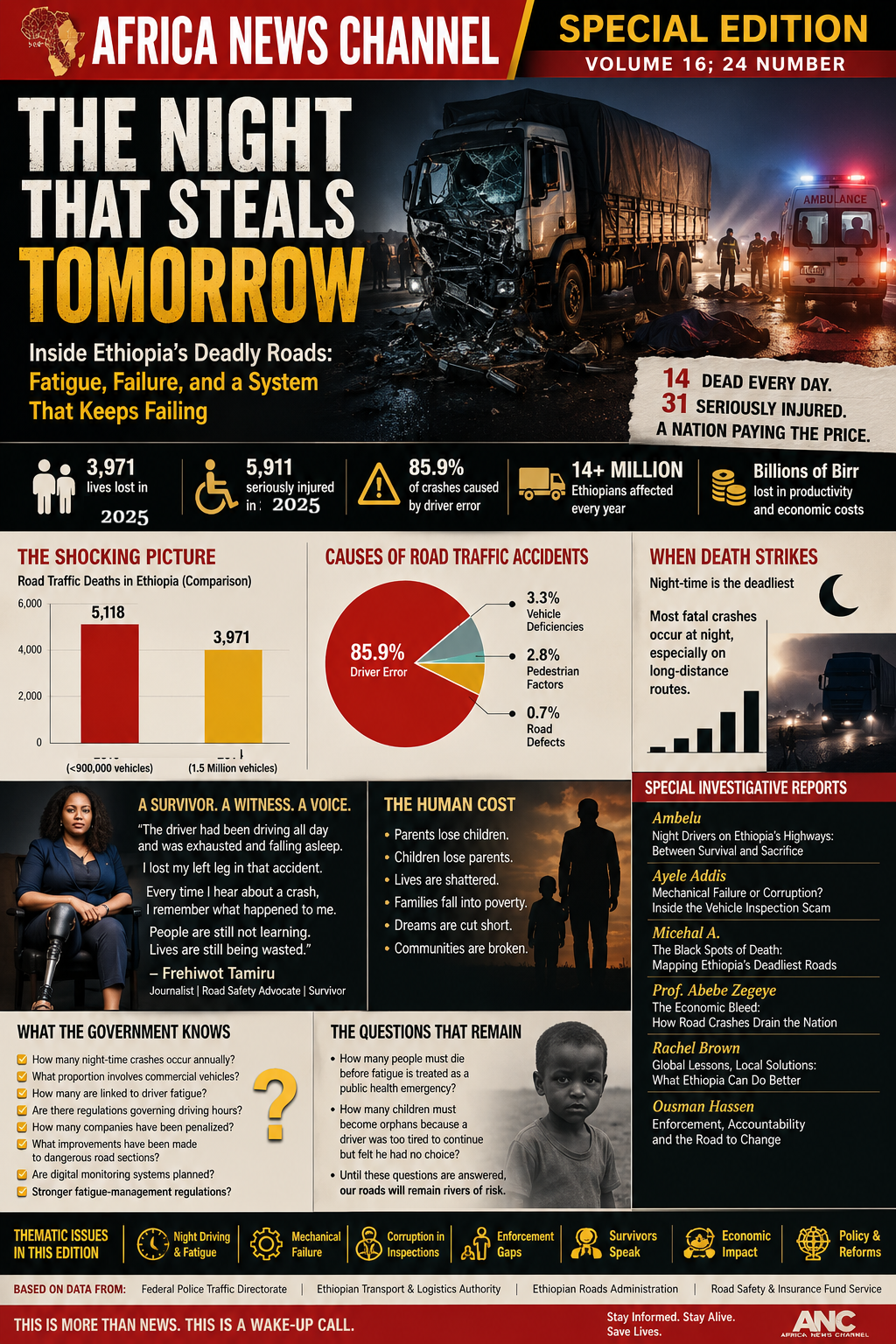
Every morning, Ethiopian roads claim an average of fourteen lives.
By the end of the day, another thirty-one people will have suffered serious injuries.
These are not estimates from advocacy groups or international organizations. They are figures compiled by Ethiopia’s Road Safety and Insurance Fund Service and the Federal Police Commission.
According to official data, more than 15,000 traffic accidents occurred in Ethiopia during one fiscal year alone, killing 4,161 people and seriously injuring nearly 6,000 others. In another reporting year, 3,971 people lost their lives and 5,911 suffered serious injuries.
The statistics tell a troubling story. Ethiopia has one of the lowest rates of motorization in Africa, with approximately 1.4 to 1.5 million registered vehicles for a population exceeding one hundred million people. Yet the country continues to record one of the highest road traffic fatality rates on the continent.
The question is unavoidable:
Why are so many Ethiopians dying on roads when there are comparatively few vehicles?
Government data points overwhelmingly to human behavior.
According to the Road Safety and Insurance Fund Service, 85.9 percent of all traffic accidents are caused by driver error. Only 3.3 percent are attributed to vehicle technical deficiencies, 2.8 percent to pedestrian factors, and just 0.7 percent to road defects.
The numbers challenge a common public perception that poor roads are the principal cause of crashes.
Instead, the evidence suggests that the greatest danger often sits behind the steering wheel.
Speeding, dangerous overtaking, failure to yield to pedestrians, driving under the influence of alcohol, overloading, and, significantly, fatigue are among the behaviors repeatedly identified by experts.
“The biggest problem is not driving ability but behavior,” says Mr. Yohannes Lemma, Executive Director of Road Safety Education and Capacity Building at the Road Safety and Insurance Fund Service.
“Negligence is rampant. Most accidents occur due to driver errors, which is a manifestation of behavior.”
Among those dangerous behaviors, driving at night stands out.
Road safety officials say many of the country’s deadliest crashes occur during nighttime journeys, especially on long-distance routes where commercial vehicles travel at high speed and drivers spend extended periods behind the wheel.
These roads have become known as black spots, sections repeatedly associated with fatal crashes.
“It is their level that differs, but there are places that are repeatedly affected by accidents in each region,” says Mr. Yohannes.
For officials working in road safety, some crash scenes never disappear from memory.
Mr. Yohannes recalls one particularly horrific accident involving a vehicle travelling from Shashemene toward Addis Ababa.
The crash occurred at night near Mojo.
The vehicle collided with a parked truck.
Dozens of people died.
“I was there and saw how terrible it was,” he says.
Another crash in Sululta remains equally haunting.
A vehicle collided with a pole and immediately caught fire.
Passengers trapped inside were burned to death.
The memories still disturb those who witnessed the aftermath.
For journalist Frehiwot Tamiru, road crashes are not merely statistics.
They are personal.
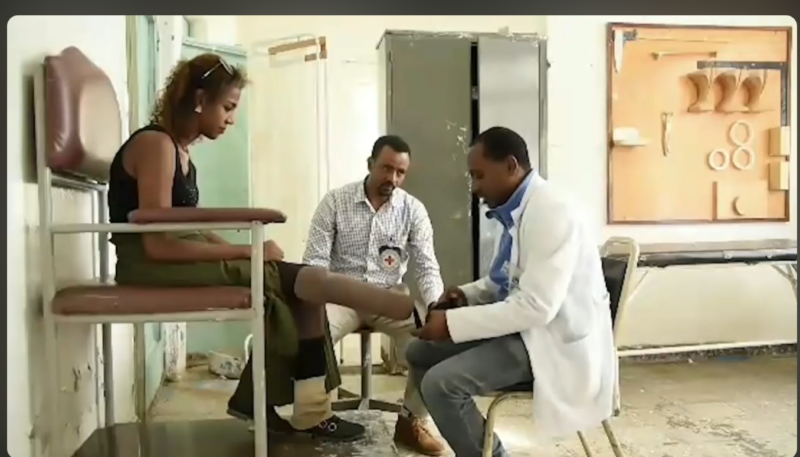
For years, Frehiwot was one of Ethiopia’s best-known television personalities, anchoring news programs for Oromia Broadcast Network.
In 2024, while returning home from work from Addis Ababa to Adama, her life changed forever.
“The driver had been driving all day and was exhausted and falling asleep,” she recalls.
The vehicle overturned.
Frehiwot lost her left leg.
The physical pain was immense.
The emotional wounds were even greater.
“Every time I hear about a traffic accident, I remember what happened to me and I am shocked,” she says.
“In addition to the people who lose their lives in traffic accidents, there are many who are left disabled in their homes due to accidents.”
Today she walks with a prosthetic leg.
She returned to work and has become an advocate for road safety awareness.
But she remains troubled by what she sees.
“People are still not learning from accidents. Overloading, wearing seat belts only when they see traffic police, and other violations have not reduced the number of accidents.”
Her story illustrates another hidden dimension of Ethiopia’s road safety crisis.
The dead are counted.
The disabled often are not.
Every major crash leaves behind survivors who require lifelong care, extensive medical treatment, and emotional support.
Many lose their livelihoods.
Many become dependent on relatives.
Many never fully recover.
Economists describe road crashes as a development crisis as much as a public health emergency.
Every road death removes a productive worker from the economy.
Every serious injury can push an entire family into poverty.
Children leave school because tuition can no longer be paid.
Families sell land and livestock to cover medical expenses.
Parents lose children.
Children lose parents.
The social and economic consequences ripple far beyond the crash site.
Government statistics also reveal a paradox.
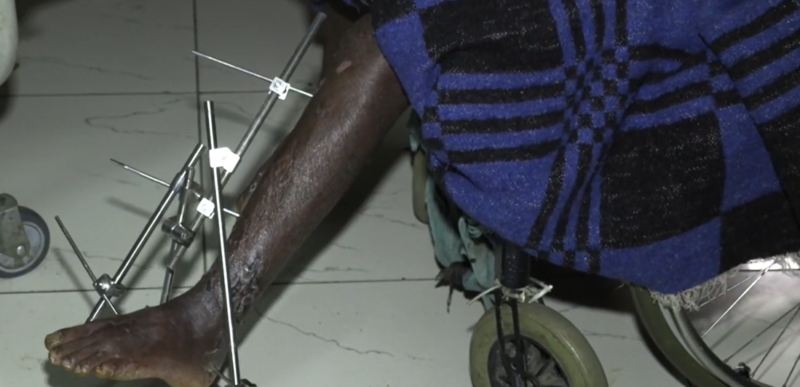
In 2018, Ethiopia had fewer than 900,000 registered vehicles but recorded 5,118 road traffic deaths.
By 2022, the number of vehicles had increased by nearly half a million, but annual road deaths had declined to 3,971.
The number of fatalities per ten thousand vehicles dropped from 54 to 29.7.
Officials see this as evidence that some interventions are working.
Road safety education has been introduced into school curricula from pre-school through Grade 12.
Police have expanded the use of speed radar.
Alcohol testing has increased.
Awareness campaigns have become more frequent.
Yet thousands continue to die every year.
The questions therefore remain unanswered.
How many of these deaths occur at night?
How many involve commercial vehicles?
How many are linked to fatigue?
How many companies have been penalized for allowing exhausted drivers to continue working?
Does Ethiopia plan to introduce electronic monitoring systems to regulate commercial driving hours?
Will stronger fatigue-management regulations be adopted?
And perhaps the most difficult question of all:
How many more people must die before fatigue is treated as a national public health emergency?
How many more children must become orphans because a driver was too exhausted to continue but felt he had no choice?
Until these questions are answered, Ethiopia’s highways will continue to carry not only goods and passengers, but also the constant possibility of tragedy.