





Ethiopians support constitutional amendments to add federal government languages and limit PM terms, divided on other changes

25 Aug 2020
Ethiopians favour amending the country’s Constitution to make the federal government multilingual, limit the prime minister to two terms, and establish a Constitutional Court, a new Afrobarometer survey shows. However, they are divided on private land ownership, the right to self-determination, the national emblem, and the status of the capital city, Addis Ababa.
Large majorities say that the Constitution should be amended – rather than replaced or maintained as it is – to reflect the needs of contemporary Ethiopia and that ordinary citizens should be consulted during the review process.
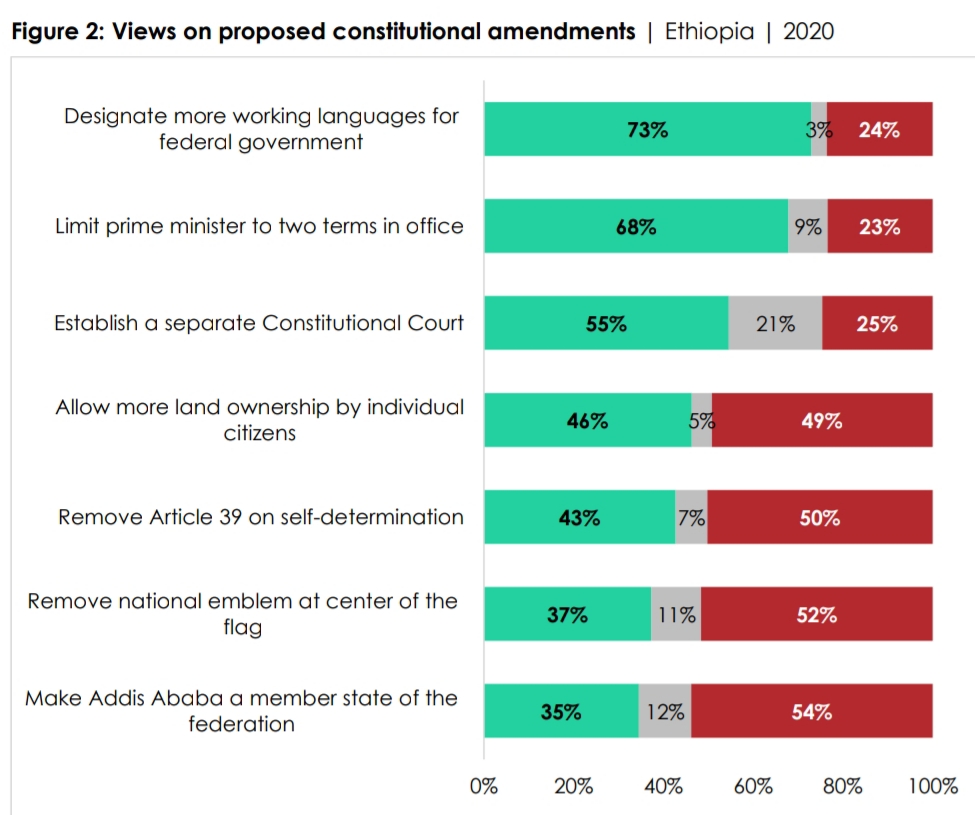
Majorities also support designating more working languages – in addition to Amharic – for the federal government, instituting a two-term limit for the prime minister, and establishing a Constitutional Court separate from the House of Federation.
The survey shows some popular support – as well as significant opposition – regarding proposed constitutional provisions that have been controversial among the political elite. These include the removal of Article 39, which enshrines the right of nations, nationalities, and peoples to self-determination; the extension of land ownership rights to individuals; and removal of the emblem at the center of the national flag.
The survey results will feed into the ongoing debate regarding the Constitution in Ethiopia’s newly opened political space. The past two years have been marked by the return of opposition voices calling for constitutional changes and a proliferation of media outlets that have engaged the political elite in a series of debates on the Constitution.
Key findings
▪ Seven out of 10 Ethiopians (69%) support amending the Constitution, while only 11%
want it to be discarded or replaced and 18% say it should be kept unchanged
(Figure 1).
▪ Proposed constitutional amendments favoured by a majority of survey respondents
include (Figure 2):
o Designating additional working languages for the federal government (73%).
o Limiting the prime minister to serving a maximum of two terms (68%).
o Establishing a Constitutional Court separate from the House of Federation,
which is currently vested with the power to interpret the Constitution (55%).
▪ Other proposed amendments win only minority support:
o Four in 10 Ethiopians (43%) support removing Article 39 guaranteeing the rights
of nations, nationalities, and peoples to self-determination, secession, and
establishment of their own regional state government. But half (50%) of
citizens want to maintain this guarantee.
o Respondents are almost evenly split over whether to change (46%) or
maintain (49%) the constitutional provision that all land be owned by the state
rather than by individual citizens.
o Fewer than four in 10 Ethiopians (37%) want to remove the emblem at the
center of the national flag, while a majority (52%) are opposed to its removal.
o Only about one-third (35%) of respondents think Addis Ababa should be
made a member state of the federation; a majority (54%) oppose the idea.
▪ Ethiopians are divided concerning the best timing for the constitutional review: One-
third (34%) say it should take place before the next national election, while similar
proportions want it to happen soon after the election (33%) or at least a year after
the election (29%) (Figure 3).
▪ An overwhelming majority (92%) of Ethiopians say ordinary citizens should be
consulted during the constitutional review process. Only 7% would leave amendment
decisions to elected political leaders (Figure 4).
Afrobarometer surveys
Afrobarometer is a pan-African, nonpartisan survey research network that provides reliable
data on African experiences and evaluations of democracy, governance, and quality of life.
Seven rounds of surveys were completed in up to 38 countries between 1999 and 2018.
Round 8 surveys in 2019/2020 are planned in at least 35 countries. Afrobarometer conducts
face-to-face interviews in the language of the respondent’s choice with nationally
representative samples.
With support from Freedom House, the Afrobarometer team in Ethiopia, led by ABCON –
Research & Consulting, interviewed 2,400 adult Ethiopians in December 2019 and January.
Via Ayeleradio@gmail.com by Ayele Addis Ambelu








