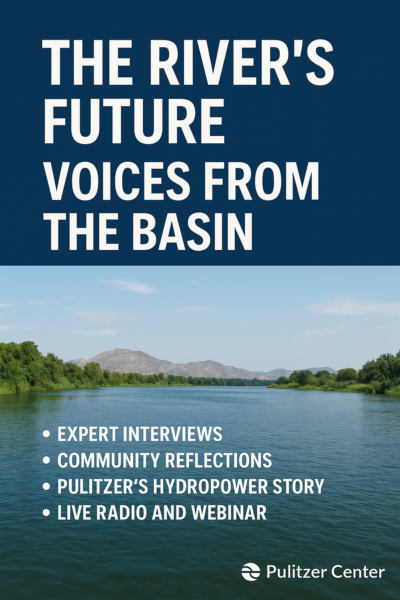
Presented by Amhara Region Media and Art Charitable Association (ARMACA)
Supported by the Pulitzer Center on Crisis Reporting
The afternoon sky over Bahir Dar shimmered like rippled glass when the final episode of ARMACA’s Hydropower and Humanity series went on air. From the banks of Lake Tana, where the Blue Nile begins its long journey to Egypt, a soft wind carried the sound of the river into the radio microphones.
Host voice broke through the hum of cicadas:
“Today, we conclude our series with a question that belongs to every nation along this river: What kind of future do we want for the Nile?”
Behind the microphone, she knew this was more than a program. It was a conversation that had flowed for months , through three live radio based webinars presentation and audience particpation, five community radio stations, and dialogues connecting Ethiopia, Sudan, Egypt and beyond.
The series, funded by the Pulitzer Center on Crisis Reporting, had turned complex geopolitics into stories that ordinary people could feel. From legal frameworks in part one program to diplomatic tensions in part two program and regional cooperation in part three program, the broadcasts linked local life to continental policy.
“The Nile is a shared destiny,” said Dr. Susanne Schmeier, a transboundary water governance expert, during the live webinar based radio program. “If it divides us, we all lose. If it unites us, we all rise.”
Remembering the Beginning: The Promise of Hydropower
When Pulitzer journalist Ann Neumann traveled to Ethiopia and Egypt for her story “Who Owns the Nile? Ethiopia’s War Against Itself”, she uncovered the human cost of politics over water.
She wrote:
“From the Ethiopian point of view, a modern dam is what will make their country a modern state.”
For Ethiopia, that dam, the Grand Ethiopian Renaissance Dam (GERD) symbolized pride, hope, and transformation.
But Neumann also captured the darker truth:
“The Abiy administration has used the same tactic… by silencing media and spreading misinformation.”
It was this duality: promise and peril that inspired ARMACA and the Pulitzer Center to create their participative radio initiative. The goal: bridge the gap between policy rooms and people’s voices, between news headlines and lived experience.
The Legal Foundations: Building Cooperation Brick by Brick
Legal scholars from the part one Legal Institutional Frameworks session reminded listeners that cooperation must begin with law.
Dr. Seid Mohammed, legal consultant at the Nile Basin Initiative, explained:
“We cannot govern a shared river without shared rules. The NBI Cooperative Framework Agreement (CFA) was designed to ensure equitable and reasonable utilization, but not all countries have signed it.”
He pointed out that Egypt and Sudan still resist the CFA’s principle of equitable use, preferring the historical 1959 treaty that grants them the lion’s share of the Nile.
Dr. Hiwot Bekele, a lecturer in international water law, added:
“Law is the skeleton of cooperation, but without trust, it’s a skeleton without flesh.”
Pulitzer’s hydropower investigation echoed that sentiment:
“Ethiopia and Egypt never managed, or maybe never wanted, to go beyond their mutual distrust to find a common approach to the water.”
Through ARMACA’s live broadcast, these legal discourses found human voices.
A caller from Dangila, a farmer named Abate Yilma, said on air:
“We don’t read treaties. But if they mean peace and light, then let the lawyers keep talking.”
Diplomacy in the Depths: Dialogue as Water (TG2 Recap)
The second webinar base live radio program, Multi-Track Water Diplomacy, shifted focus from laws to people, from the courtroom to the coffee table.
Dr. Ana Elisa Cascão, Nile Basin political analyst, explained:
“Diplomacy today is no longer about foreign ministers meeting behind closed doors. It’s multi-track, including scientists, journalists, community leaders, and even students.”
She emphasized that media like ARMACA’s participative radio can create informal diplomacy by humanizing data and amplifying shared concerns.
Dr. Mark Zeitoun, author of Power and Water in the Middle East, summarized it beautifully:
“Hydropolitics is about narrative. Whoever tells the better story shapes the basin’s future.”
This resonated directly with Pulitzer’s framing:
“The Abiy administration has used the same tactic they used in the war with Tigray to quash dissent regarding their management of the GERD: by silencing media and spreading misinformation.”
ARMACA turned that critique into a call to action, free media as water diplomacy.
Community reflections poured in:
“We hear Cairo, Addis, and Khartoum on the same wavelength now,” said Eyerusalem Adane, a youth peace activist from Addis Ababa. “Maybe this is how real diplomacy sounds, people listening, not shouting.”
Governing the Flow: Transboundary Cooperation in Action
By the time ARMACA broadcast its third session, TG3 Transboundary Water Governance, the discussion had matured into a blueprint for regional economic cooperation.
Dr. Clive Lipchin, environmental policy scholar, reminded participants:
“You cannot negotiate the river — you can only negotiate how to live with it.”
He described how joint hydropower markets could stabilize energy supply, reduce duplication, and enhance food security.
“If the GERD and the Aswan Dam synchronize operations, both nations will benefit — more power, less conflict.”
Dr. Lydia Abebe, economist, stressed that energy, food, and water must be seen as one system:
“The Nile’s future lies in regional planning, not national projects.”
ARMACA field correspondents broadcast interviews from Woreta and Fogera, where farmers spoke about irrigation hopes.
“When we see light, we see peace,” said Alemnesh Getu, a vegetable grower. “Hydropower means we can work, not fight.”
These words echoed Pulitzer’s poignant observation:
“Ethiopians are simply not content for tens of millions of them to continue scratching out a living as subsistence farmers.”
In that echo lay the heart of this entire partnership — journalism as bridgework between scholarship and survival.
6. Voices from the Basin: Reflections from the Community
In the series’ final webinar, the microphones opened to farmers, students, and civil servants.
Ayalew Kassa, a fisherman from Tana Kirkos, said:
“We are the first to see when the water rises, the last to be heard when it falls.”
Sr. Meron Gebretsadik, a Catholic nun involved in water education, added:
“Faith teaches us to share water as we share blessings.”
From Cairo, via Zoom, Dr. Ezzedine Fishere, former Egyptian diplomat quoted in Pulitzer’s piece, reminded the audience:
“The tension over Nile waters predates our governments. But we, the new generation, can choose not to inherit mistrust.”
Listeners from across five community radio stations call share messages of hope:
“We will guard the Nile, not with soldiers, but with stories.”
“Let the GERD become our bridge, not our border.”
Challenges Ahead: Misinformation and the Media’s Burden
Both Pulitzer’s hydropower report and ARMACA’s experts warned of a dangerous undercurrent disinformation.
“In the absence of transparency, rumors fill the void, and rivers become weapons,” Neumann wrote.
Dr. Yonas Tefera, a media governance specialist on the panel, called it “the flood of falsehoods.”
“Every basin has floods,” he said. “But today, they come through Facebook.”
He urged media outlets to practice constructive journalism, focusing on cooperation rather than conflict.
ARMACA committed to building an online archive of Nile narratives, verified, multilingual, accessible so that “truth can flow as freely as the water.”
8. Policy Pathways: What Experts Agree On
By the end of the fourth broadcast, a pattern emerged from the three webinars based live radio program:
a. Build Trust through Data Sharing
“Information asymmetry is the mother of suspicion,” said Dr. Monica Mutoni (AMCOW).
b. Integrate Energy, Food, and Water Planning
“No dam should stand alone,” emphasized Dr. Lydia Abebe.
c. Engage Civil Society and Media
“Journalists, youth, and artists are the new diplomats,” said Dr. Cascão.
d. Strengthen Legal Foundations
“Revitalize the Cooperative Framework Agreement with inclusive consultations,” urged Dr. Seid Mohammed.
These consensus points were summarized live by host Tigist Mekonnen for the audience:
“Our experts agree: Cooperation is not charity — it’s shared survival.”
Pulitzer Parallel: From Cairo to Lake Tana
The Pulitzer story had ended on a haunting image, a young Ethiopian woman in Cairo, harassed for her identity, telling the reporter:
“They say we take their water.”
ARMACA mirrored that story with another voice from Bahir Dar:
“We say we give them life,” said Woldeyes Mekuria, a taxi driver from Mekele.
The emotional bridge between these voices, one in exile, one at the source embodied the mission of the Hydropower and Humanity series.
Through journalism, dialogue, and cooperation, these narratives transformed suspicion into empathy across borders and airwaves.
Epilogue: The River’s Future
As the music swelled under the final credits, the host read a closing reflection written collectively by the ARMACA editorial team:
“The Nile has flowed for millions of years without passports or politics. It does not ask us to own it, only to honor it.
From Cairo’s crowded alleys to Lake Tana’s sacred shores, we have learned that hydropower is not just about turbines, it is about trust.
The future of the Nile will not be decided in boardrooms or ministries alone, but in classrooms, radio studios, and the hearts of those who drink its water.”
The outro faded with the signature line:
“Produced by the Amhara Region Media and Art Charitable Association (ARMACA), with the support of the Pulitzer Center on Crisis Reporting, where journalism becomes dialogue, and dialogue becomes peace.”
#Hashtags for Digital Publication
#NileFuture
#HydropowerAndHumanity
#PulitzerCenter
#ARMACAStories
#NileBasinVoices
#SharedWatersSharedDestiny
#BlueNileReflections
#PeaceThroughDialogue
#WaterGovernance
#ClimateAndCooperation
#DataForPeace
#EnergyJustice
#MediaForDevelopment
#TransboundaryTrust
Produced by:
Amhara Region Media and Art Charitable Association (ARMACA)
With Support from the Pulitzer Center on Crisis Reporting
Written by: the ARMACA Editorial Collective
Location: Bahir Dar, Amhara Region, Ethiopia