Foreign Minister Demeke Mekonnen and his Turkish counterpart Mevlut Cavusoglu
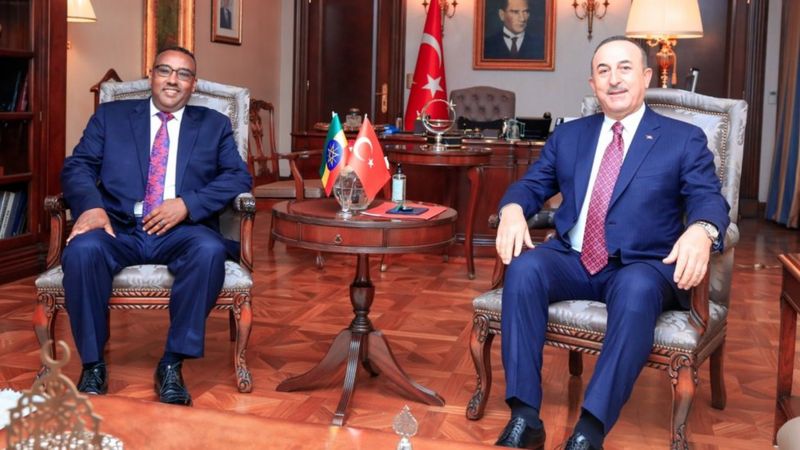
Analysts say Ethiopia’s relationship with Turkey has a number of implications, including the crisis in the Horn of Africa and the situation in the Horn of Africa. Ethiopian Foreign Minister Demeke Mekonnen and his Turkish counterpart Mevlut Cavusoglu met in Turkey for what he called a “successful mission”.
According to Turkish news agency Anadolu, the two leaders discussed the 125th anniversary of the establishment of diplomatic ties between Ethiopia and Sudan. Analysts say Ethiopia’s plans to strengthen ties with Turkey are “strategic”. They also believe that Turkey, which is strengthening its economic and military ties in Africa, can create a balance of power in the ever-changing Horn of Africa politics. According to Gonul Tol, director of the Center for Turkish Studies at the Middle East Institute in Washington, DC, Turkey is working to expand its influence abroad. This is especially true of the policy she has pursued since 2015. Turkey and Ethiopia According to the Horn of Africa, Ethiopia and Turkey have historical and cultural ties. Although this relationship was severed during the Derg regime, Turkey and Ethiopia have good relations with both the EPRDF leadership and the current administration. For a long time, their relationship was largely focused on the economy. For example, Turkey’s investment in Ethiopia is $ 2.5 billion, according to Turkish Ambassador to Ethiopia Yaprak Alp.
According to official reports, Turkey, which invests heavily in the textile sector, is the second largest investor in Ethiopia after China. Turkish companies in Ethiopia have 20,000 Ethiopian employees. According to a statement from the Turkish Foreign Ministry, the number is among the leading private employers in the country. What is the impact of Sudan’s instability on Ethiopia? How can the US election change the politics of the Renaissance Dam? “The consequences of the war will be saved for the region” Awel Alo (Dr.) Speaking at the inauguration of the new Ethiopian Embassy in Ankara, Turkish Foreign Minister Mevlut Cavusoglu; He lauded Ethiopia’s efforts to fight terrorism and pledged his country’s cooperation in this regard. Although relations between the two countries have for centuries been largely dependent on the economic sector, Ethiopian Foreign Ministry Spokeswoman Dina Mufti said there is a desire to expand Ethiopia’s relations with Turkey in a multi-faceted manner, including security.
Turkey’s relations with Egypt and Sudan Analysts say the strengthening of Ethiopian-Turkish relations is not a sign of strained relations between Egypt and Turkey. Negotiations on the Renaissance Dam, which has not been completed for years, have strained Egyptian-Ethiopian relations. “Egypt and Turkey have conflicting views on key Eastern Mediterranean gas resources, or Libya, and more recently Sudan,” said Horn of Africa analyst Abdurahman Seid. “Turkey’s relations with Sudan are changing with the new Sudanese administration,” he said. During the rule of former Sudanese President Omar Hassan al-Bashir, Turkey leased the island of Suwakim from Sudan.
“This island in the Red Sea is a key and strategic location in the region.” “Relations between Sudan, Egypt and the United Arab Emirates appear to be strengthening. The two countries are strongly opposed to Turkey. “As a result, Turkey has lost its influence in Sudan because of Egypt and to some extent because of the United Arab Emirates,” Abdurahman said. In contrast, Awel Alo, a senior law professor at Kill University in the United Kingdom, says “Turkey can still have a significant impact on Sudan.” Why now? Currently, Ethiopia is trying to control the crisis in the northern part of Tigray due to the conflict between the federal government and the regional administration. It has also been embroiled in a border dispute with Sudan. Ethiopian Foreign Ministry spokeswoman Dina Mufti said Sudan has seized large swathes of territory along the border, using the gap created by Ethiopia’s military campaign in the Tigray region. He also accused Sudan of being a “third party” pushing for control of the disputed territory.
“The conflict between the Sudanese government and the military is in the interest of the Sudanese people and the interests of third parties,” the Ethiopian foreign ministry said in a statement. Eritrea, on the other hand, has accused Eritrea of siding with Ethiopia in the border dispute, but Eritrea has denied the allegations. Many Western countries have expressed concern that the conflict in Tigray could escalate into a regional crisis. Analysts say that Sudan plays a key role in this. Ethiopia has attracted the attention of various international bodies due to the various challenges it faces. Analysts say Ethiopia needs strong partners at this time. According to Awel, Ethiopia’s relations with Turkey are “related to the current problems facing the country”. They also say that this decision is strategic. “Turkey and Egypt do not have good relations. Ethiopia wants to take this opportunity to put pressure on Sudan,” he said. Ambassador Dina Mufti told Turkish news agency Anadolu that Ethiopia would accept if Turkey played a role in mediating the border dispute between Sudan and Ethiopia. Will Ethiopian-Turkish relations look military? It is unclear what kind of relationship Ethiopia and Turkey may have in the near future.
Dr. Awel believes that the current relationship between the two countries seems to be “mutually beneficial”. He said that this may be related to what kind of pressure Turkey is exerting on Sudan, but he is skeptical. Abdurahman, for his part, said the support could be military in light of the crisis in Tigray and tensions with Sudan. “Turkey is not far from Ethiopia at the moment. It also has a military base in the Somali capital, Mogadishu.” “Turkey has become a strong country, especially in the production of drones,” he said, citing the recent use of Turkish drones in the recent conflict between Azerbaijan and Armenia as an example of how the war has changed the outcome of the war. “In this regard, there may be Ethiopian interest,” he said.