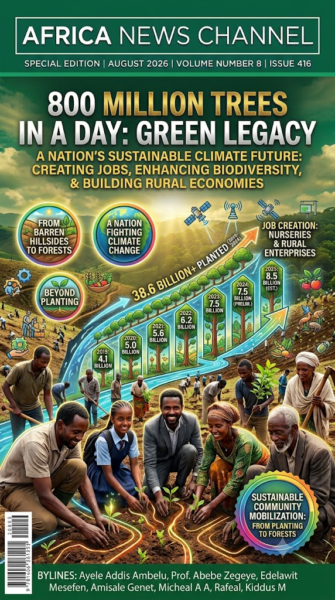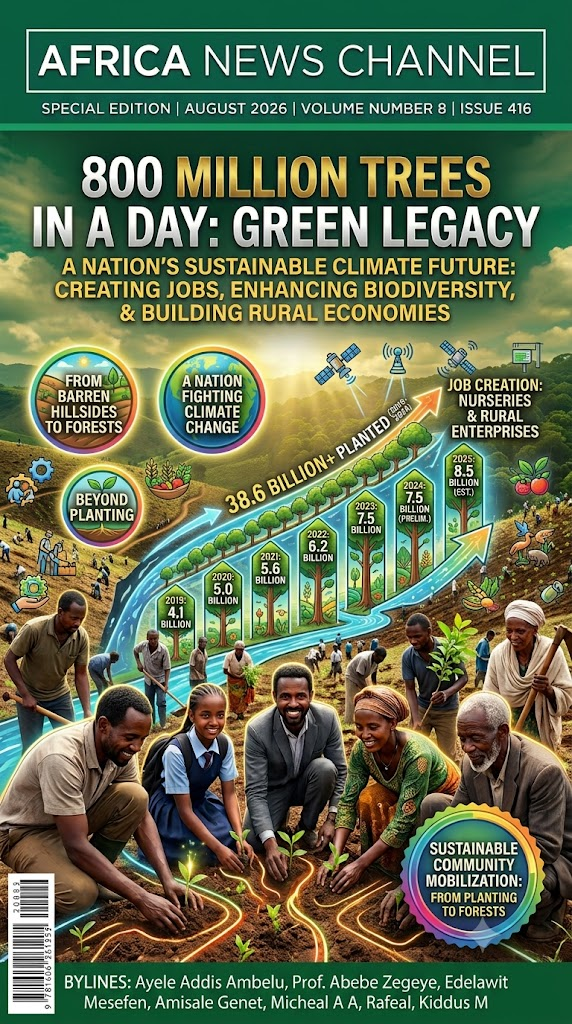
From barren hillsides to ambitious promises, Ethiopia is racing to rewrite its environmental story by planting hundreds of millions of trees in a single day. But as record-breaking numbers capture global headlines, a deeper question emerges: will these seedlings survive long enough to become forests, or will they become another statistic in the world’s climate battle?
By Ayele Addis Ambelu | News Analysis
When the sun rose across Ethiopia, millions of citizens from university students and farmers to civil servants, soldiers, and diplomats took to degraded hillsides armed with hoes, watering cans, and saplings. By sunset, the national mobilization had shattered global benchmarks, planting an unprecedented 805.3 million tree seedlings in a single day under the flagship Green Legacy Initiative.
Prime Minister Abiy Ahmed marked the milestone as “a moment when Ethiopians from all walks of life come together to create a lasting legacy for generations to come,” adding Prime Minister Abiy Ahmed after planting, “Eight years of consistent action. The Green Legacy Initiative continues to grow stronger, driven by public commitment and the shared belief that, together, Ethiopians can nurture a greener, more sustainable future.” This record-shattering effort represents a decisive shift in how an African nation confronts ecological vulnerability, demonstrating how civic engagement can redefine a country’s climate trajectory.
The campaign’s impact extends beyond headline-grabbing statistics, targeting the structural causes of land degradation across the Horn of Africa. Decades of soil erosion, deforestation, and recurrent droughts have long threatened rural livelihoods and agricultural security. By integrating native species with high-yield agroforestry crops such as avocado, coffee, moringa, and frankincense, the initiative transforms land rehabilitation into a engine for rural development.
Briefing journalists from the initiative’s Situation Room, Technical Committee Chairman Dr. Adefris Worku emphasized the societal shift, stating, “Our people have shown that Ethiopia can restore degraded landscapes, recover its forests, and protect its water resources. When Ethiopians unite behind a common objective, they prove that significant national transformation is possible.” According to official assessments, cumulative national efforts have helped elevate Ethiopia’s forest cover from 17.2% prior to the campaign’s launch to over 23.6%, creating roughly 2.4 million green jobs in nursery management and watershed management.
Translating hundreds of millions of delicate saplings into enduring ecosystems presents formidable scientific and logistical challenges. International forestry authorities, including the Food and Agriculture Organization (FAO) and the Intergovernmental Panel on Climate Change (IPCC), stress that long-term survival rates, species suitability, and post-planting stewardship matter far more than initial planting numbers.
Addressing these technical demands, Dr. Adefris Worku noted that planting is rooted in preliminary scientific mapping: “The planting sites are identified in advance. Experts determine which species are appropriate for each location, and monitoring systems are put in place to follow implementation.” By prioritizing soil conservation terracing, satellite tracking, and local community benefit-sharing such as harvesting non-timber products the government aims to ensure seedlings survive seasonal dry spells and livestock grazing pressures.
As international climate negotiations focus heavily on natural solutions, carbon credit markets, and climate finance, Ethiopia’s multi-billion seedling model offers an actionable blueprint for the broader continent. Reaffirming the country’s proactive stance in international climate policy, the Ethiopian Government Communication Service declared that the initiative “reflects the country’s commitment to restoring degraded landscapes, combating drought and desertification, and building a sustainable green economy.”
Dr. Worku echoed this vision, concluding, “While many countries continue discussing solutions, Ethiopia is demonstrating action. The Green Legacy Initiative has received international recognition as a model for environmental restoration.” By linking high-level climate commitments with grassroots civic participation, Ethiopia is demonstrating that community-driven ecosystem restoration is essential for securing Africa’s shared climate resilience.