





By Ayele Addis Ambelu (AU Media fellow), Addis Ababa, Ethiopia
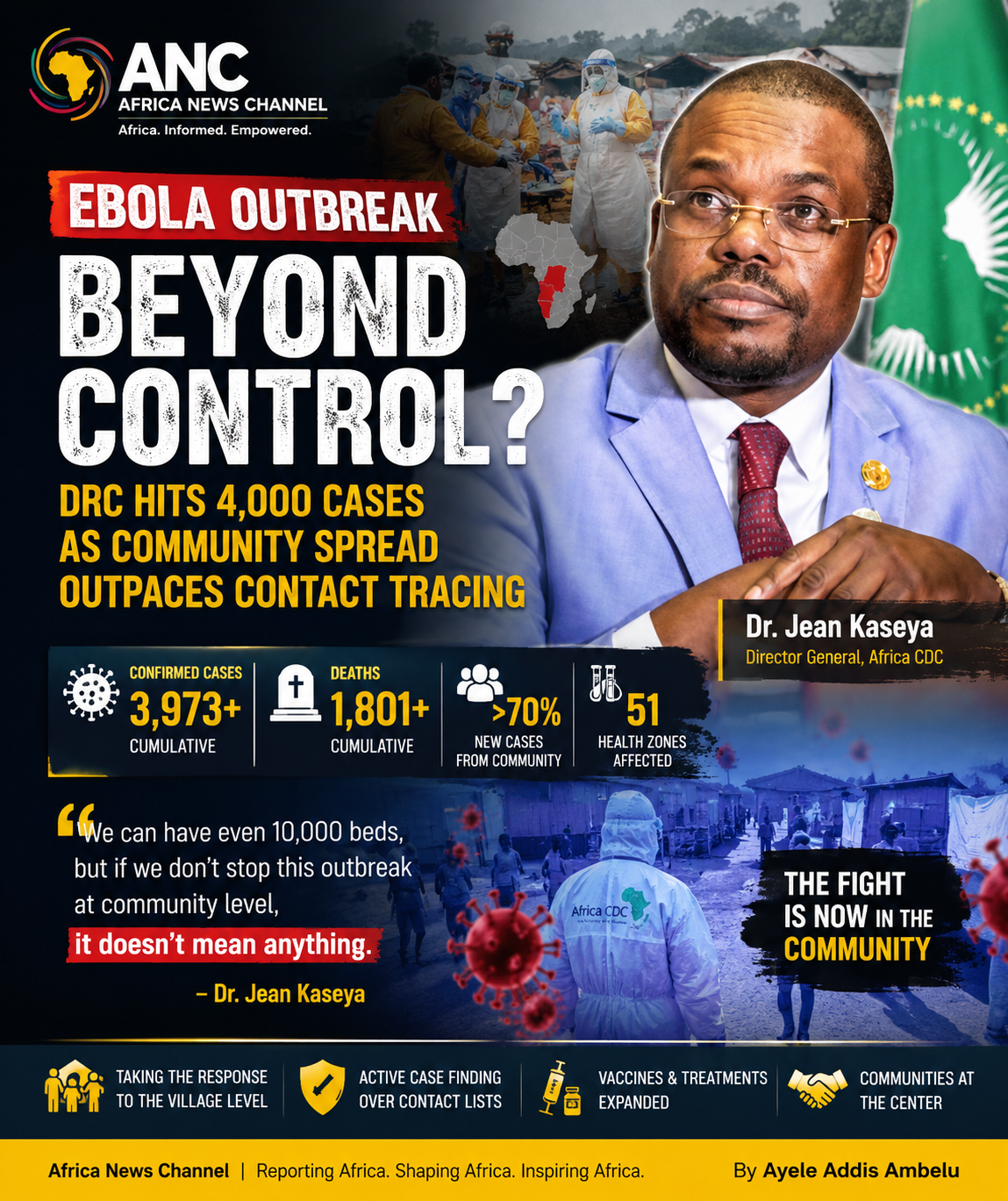
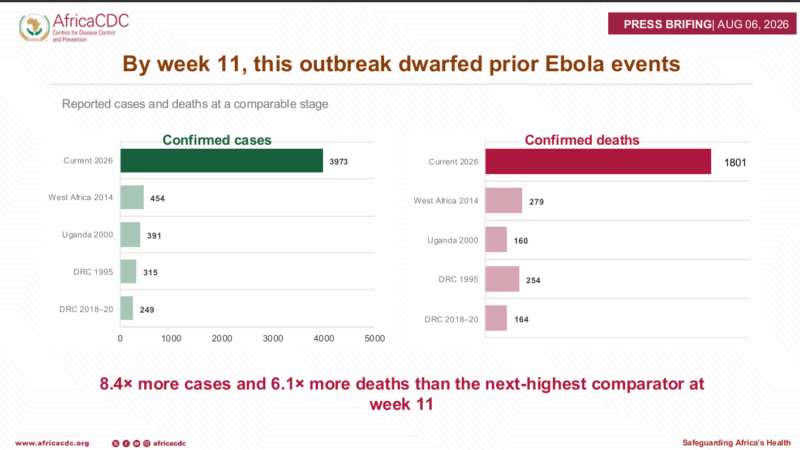
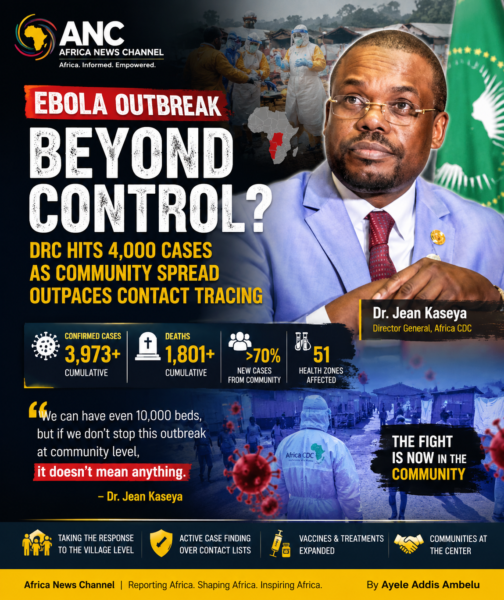
Africa’s battle against Ebola has entered its most dangerous phase, with the Africa Centres for Disease Control and Prevention (Africa CDC) warning that the Democratic Republic of Congo (DRC) outbreak is no longer being driven by identifiable chains of transmission but by widespread community spread. During a high-level press briefing on 6 August 2026, Africa CDC Director General Dr. Jean Kaseya revealed that the outbreak had surpassed 4,000 confirmed infections and approximately 1,800 deaths in just 12 weeks, making it substantially more severe than previous Ebola epidemics at the same stage. The briefing highlighted that the virus has now spread across 51 health zones, while weekly cases increased by 15 percent, underscoring the accelerating pace of transmission.
Unlike previous Ebola outbreaks where health authorities successfully interrupted transmission through contact tracing, Africa CDC officials say the current epidemic is exposing the limitations of conventional containment strategies. Dr. Kaseya disclosed that more than 70 percent of newly confirmed infections are now emerging directly from communities rather than from known contact lists, making traditional surveillance increasingly ineffective. “The contact list doesn’t mean anything, because this contact list is not accurate,” he said, warning that health officials are likely identifying only a fraction of actual infections. He added that community transmission has become so widespread that authorities are considering treating entire affected communities as potential contacts instead of relying solely on epidemiological tracing.
The data presented by Africa CDC reinforces these concerns. The DRC currently records only 10 listed contacts per confirmed case, compared with 57 contacts during the 2018–2020 DRC outbreak, while follow-up coverage remains below international benchmarks. Health officials estimate that with nearly 4,000 confirmed cases, the contact database should contain well over 160,000 individuals instead of the current 17,000. This shortfall has prompted Africa CDC to shift its operational strategy from passive contact tracing to active door-to-door case finding, supported by tens of thousands of community health workers.
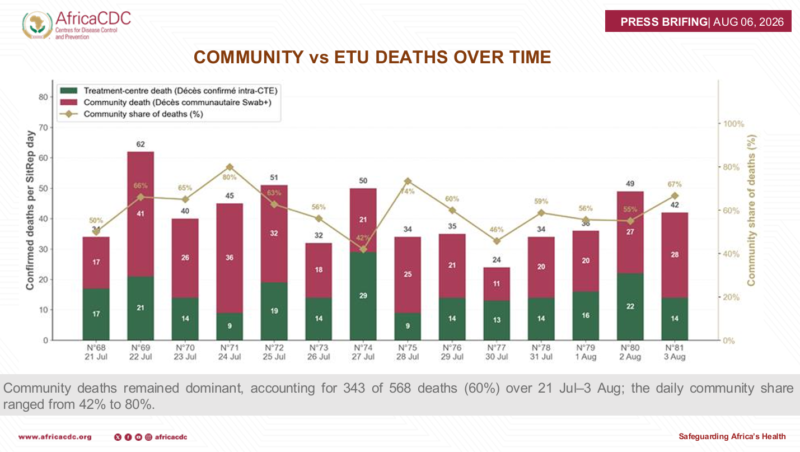
Another troubling indicator is the growing number of deaths occurring outside treatment centres. Africa CDC reported that community deaths accounted for approximately 60 percent of Ebola fatalities during the latest reporting period, suggesting many patients continue to die without seeking medical care or being officially diagnosed. Although new Ebola Treatment Units have expanded hospital capacity, Dr. Kaseya cautioned that increasing bed numbers alone will not reverse the epidemic. “We can have even 10,000 beds, but if we don’t stop this outbreak at community level, it doesn’t mean anything,” he emphasized, arguing that prevention must begin in villages rather than hospitals.
The Africa CDC chief also challenged the common perception that the outbreak is constrained by insufficient funding. Following a new United States commitment of US$242 million, total Ebola response financing has risen to roughly US$700 million, while combined humanitarian support now approaches US$1 billion. “Money is not an issue today,” Dr. Kaseya declared. “The issue is, we are not listening to communities.” According to him, consultations with local leaders, women, survivors, youth groups and civil society in Ituri Province revealed a consistent message: communities feel excluded from decision-making despite being at the centre of the epidemic.
That realization has prompted a significant policy shift. Africa CDC, the DRC Government and the World Health Organization agreed on a Village Leader Initiative, placing communities—not provincial authorities at the centre of outbreak control. The initiative will empower villages to nominate trusted individuals responsible for health education, safe burials, early detection and community mobilization. The partners also agreed to guarantee healthcare worker salaries, expand free healthcare services, accelerate digital disease surveillance through mobile technologies and Starlink connectivity, strengthen cross-border coordination with neighbouring countries, and improve transparency in the management of donor resources.
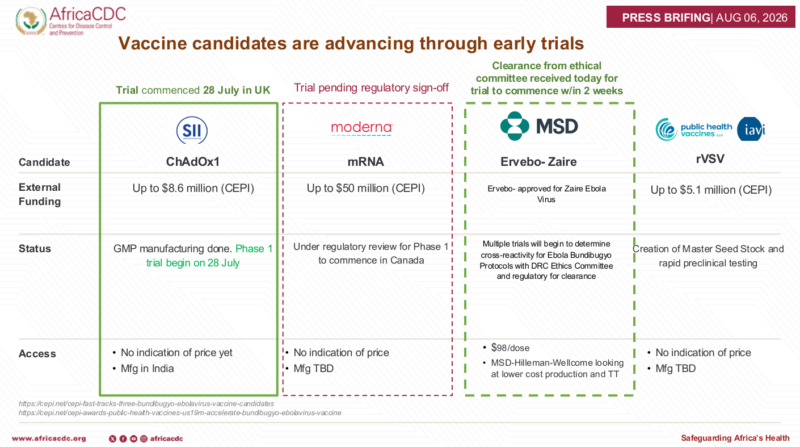
Scientific interventions are also expanding alongside community-based measures. Africa CDC announced wider deployment of the existing Ervebo (Zaire strain) vaccine among at-risk populations after preliminary observations suggested vaccinated individuals experienced milder disease and no recorded deaths despite infection with the Bundibugyo strain. Meanwhile, remdesivir will be used more broadly under compassionate-use protocols while ongoing clinical trials continue to evaluate its effectiveness. Professor Placide Mbala stressed that the strategy builds on previous experience in Uganda and the DRC and will generate additional safety and effectiveness data as enrolment progresses.
The briefing also addressed concerns over digital technologies supporting the response. Responding to questions from journalists, Dr. Kaseya clarified that Starlink is being used solely to provide internet connectivity for surveillance systems and does not collect or control health data. Instead, outbreak information remains under Africa CDC’s digital health platforms, helping reassure concerns over data sovereignty while enabling faster reporting from remote communities.
The Africa CDC’s latest assessment suggests that Africa is confronting not merely another Ebola outbreak but a new epidemiological reality in which delayed detection, community mistrust, displacement and urban transmission are overwhelming traditional public health tools. As Dr. Kaseya concluded, the success of the response will depend less on expanding hospitals or raising additional funds than on rebuilding trust between health authorities and affected communities. “We are not involved, and we want to be involved,” community representatives told Africa CDC officials during consultations in Ituria message that now lies at the heart of Africa’s evolving Ebola response.
Ayeleradio@gmail.com or Media@africanewschannel.org








