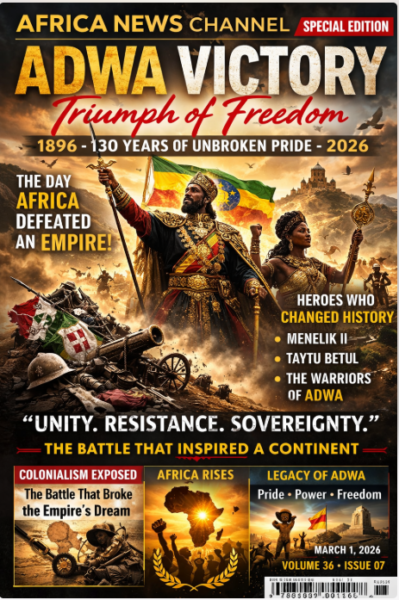
ADWA, March 1, 1896, It was more than a battle in the Ethiopian highlands. It was the moment Africa reclaimed its voice.
At a time when European empires were carving the continent into colonies with ink and gunpowder, one African nation stood upright and refused to be divided. The victory at Adwa was not simply Ethiopia defending its borders—it was Africa redefining its destiny.
A United Continent in One Army
When Italy sought to turn Ethiopia into a protectorate through the disputed Treaty of Wuchale, the response was swift and resolute. Emperor Menelik II understood that this was not just a diplomatic disagreement. It was a test of sovereignty.
From Tigray to Shoa, from Gojjam to Wollo, Ethiopians mobilized in unprecedented numbers. Princes, peasants, clergy, and cavalry united under one flag. Empress Taytu Betul played a decisive role—organizing logistics, advising strategy, and ensuring that resistance was not fragmented but coordinated.
What marched toward Adwa was not just an army, it was a continental statement: Africa could organize, modernize, and strategize on its own terms.
Shattering the Colonial Narrative
For decades, colonial propaganda had painted Africa as weak, divided, and incapable of resisting European militaries. Adwa destroyed that narrative in a single day.
Italy arrived confident, armed with modern artillery and the assumption of superiority. But confidence is not strategy, and arrogance is not unity.
Ethiopian forces used their knowledge of terrain, disciplined formations, and strategic encirclement to overwhelm Italian divisions. By the end of the battle, thousands of Italian troops were dead or captured. The invading army collapsed. The dream of an easy conquest evaporated in the mountain dust.
More importantly, the psychological barrier was broken.
The myth of European invincibility died at Adwa.
A Victory That Belonged to All of Africa
News of the triumph spread rapidly across the continent and beyond. In West Africa, Southern Africa, the Caribbean, and among African Americans in the United States, Adwa became a symbol of pride and possibility.
Ethiopia’s independence was no longer just a national achievement, it became a Pan-African emblem. Intellectuals, freedom fighters, and later independence movements pointed to Adwa as proof that colonial domination was neither natural nor permanent.
Decades before the wave of decolonization swept Africa in the mid-20th century, Adwa had already planted the seed of liberation.
From Battlefield to Blueprint
Adwa was not only a military success; it was a strategic blueprint:
- Unity across ethnic and regional lines
- Modern arms combined with traditional courage
- Diplomatic clarity backed by military readiness
- Leadership that refused to compromise sovereignty
It showed that African states could negotiate, defend, and prevail on equal footing.
The Legacy in 2026
As the continent marks another anniversary of Adwa, its relevance has not faded. The victory continues to inspire conversations about African agency, economic independence, and continental solidarity.
Adwa reminds Africa and the world that the continent’s story is not solely one of colonization. It is also a story of resistance, resilience, and triumph.
On March 1, 1896, in the mountains of northern Ethiopia, Africa did not just win a battle.
It reclaimed its narrative.
And that victory still echoes across generations.
By Ayele Addis Ambelu