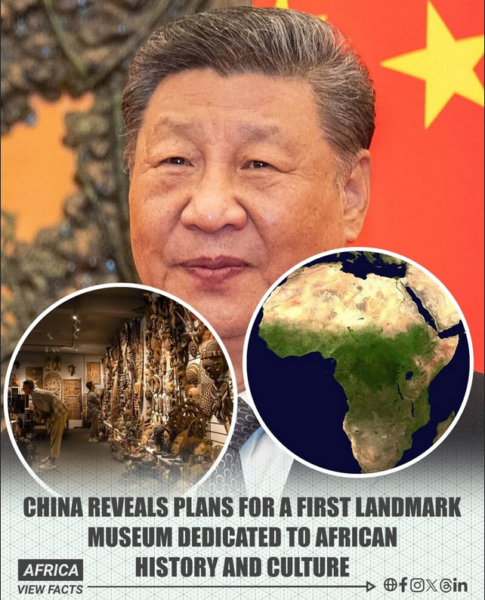
China has announced plans to establish its first-ever national museum dedicated entirely to African history and culture, a landmark move that positions Beijing as more than just an economic powerhouse in Africa. The initiative, spearheaded by the China-Africa Institute under the Chinese Academy of Social Sciences, is part of a broader cultural and academic strategy that also includes the creation of five China-Africa research centres, with one already being planned for South Africa.
A Bold Soft Power Play
For decades, China’s presence in Africa has largely been defined by infrastructure projects, trade, and political partnerships. From railways and ports to energy investments, Beijing has cemented itself as Africa’s largest trading partner. But this museum represents a deliberate pivot toward soft power—an attempt to win hearts and minds through culture, history, and narrative framing.
By showcasing African artifacts, artworks, and cultural traditions in a prominent national institution, China is seeking to build cultural empathy while also countering Eurocentric and colonial narratives that have long shaped global perceptions of Africa. The move is also likely to enhance China’s domestic awareness of Africa, at a time when the number of African students, businesspeople, and communities in Chinese cities continues to grow.
“Culture is the deepest form of diplomacy,” notes Professor Li Yansheng, a Beijing-based international relations scholar. “By building a museum for Africa in China, Beijing is telling its people that Africa is not just a partner in trade, but a partner in civilization.”
Opportunities for Collaboration—or Control?
If implemented inclusively, the museum could be transformative. It has the potential to become a hub for cross-cultural understanding, artistic exchange, and scholarly collaboration. African historians, artists, and cultural custodians could gain an unprecedented platform to present their heritage to a Chinese and global audience. For Africa, the visibility could help amplify cultural pride, attract tourism, and even open pathways for diaspora engagement.
But the key question is: who gets to tell Africa’s story?
Critics caution that without strong African participation, the museum risks becoming a top-down projection of China’s preferred narrative rather than a genuine representation of African voices. “African culture cannot be curated without Africans,” argues Dr. Zanele Ndlovu, a cultural historian at the University of Pretoria. “If this project is to have legitimacy, African scholars, artists, and institutions must be central to every stage—from acquisitions to storytelling.”
The Artifact Dilemma
Another looming issue is that of authenticity and provenance. Where will the artifacts come from? Many African cultural treasures remain in European museums, their ownership tied up in contentious debates over colonial plunder and repatriation. China will need to navigate this sensitive terrain carefully, ensuring that any acquisitions are ethical, transparent, and approved by African governments and communities.
Failure to do so could spark backlash similar to the controversies surrounding Western museums. “We cannot afford another scramble for African heritage,” warns Professor Samuel Osei of Ghana’s Institute of African Studies. “The dignity of this museum will depend on how artifacts are sourced and how communities are involved.”
Beyond Symbolism: The Geopolitical Angle
While the museum is framed as a cultural initiative, its geopolitical implications are impossible to ignore. Africa’s strategic importance is rising, and global powers from the United States to the European Union are racing to strengthen ties with the continent. For China, a museum of African history and culture is not just about art—it’s about influence.
By positioning itself as a custodian of African culture, Beijing gains symbolic capital that complements its infrastructure investments and trade partnerships. This cultural diplomacy could also help soften criticisms of China’s economic footprint in Africa, which some accuse of creating debt dependencies.
“China is rewriting the playbook,” says Dr. Miriam Okeke, a Nairobi-based political analyst. “While the West is still debating debt relief, Beijing is building cultural bridges. It’s a smart move that appeals to hearts as much as it does to wallets.”
A Vision with Risks
Despite its promise, the project is not without risks. Tokenism, political motivations, and sustainability challenges could undermine the initiative. Museums require long-term funding, conservation expertise, and constant public engagement—factors that cannot be guaranteed without genuine commitment.
Still, if Beijing follows through with transparency, inclusivity, and respect for African cultural ownership, the museum could emerge as a defining symbol of a new era in China-Africa relations—one that transcends contracts and trade to embrace identity and history.
The Verdict: Symbolism or Substance?
Ultimately, China’s plan to build its first landmark museum of African history and culture reflects both opportunity and complexity. It could be a groundbreaking space of cultural pride and mutual understanding, or it could falter as a symbolic gesture without real depth.
For now, one thing is clear: in the theatre of global influence, China has just added a powerful new stage—one where Africa is not merely an economic partner but a civilization worth celebrating.