By Ayele Addis Ambelu, Africa News Channel, Addis Ababa, Ethiopia
A Continent Under Siege
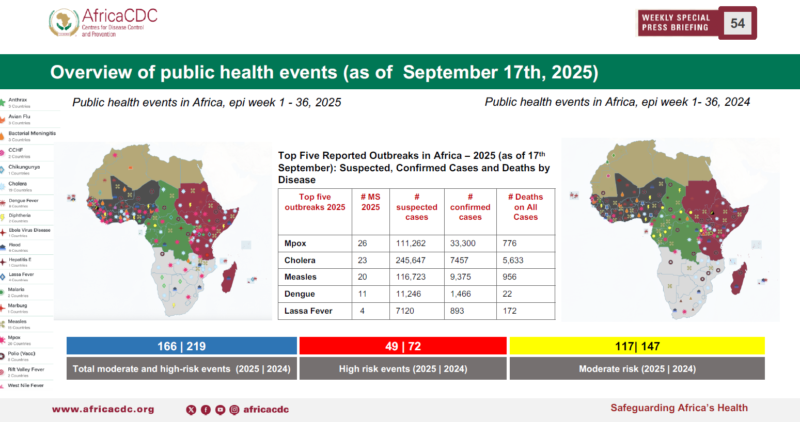
Africa is once again at the crossroads of multiple public health crises. From the deadly resurgence of Ebola in the Democratic Republic of Congo (DRC) to the relentless spread of mpox, cholera, and measles across dozens of countries, the continent’s overstretched health systems face a daunting test. The latest Africa CDC Weekly Briefing paints a sobering picture: by September 17, 2025, Africa had reported more than 253,000 cholera cases, over 111,000 suspected mpox infections, and a rising toll of Ebola patients in DRC’s Kasai region.
Behind these numbers are not just statistics but human stories of loss, resilience, and the struggle to rebuild trust in public health.
Mpox: A Lingering Emergency
Mpox remains classified as a Public Health Emergency of Continental Security. With 33,300 confirmed cases and 212 deaths reported in 2025 alone, the virus has surged well beyond the levels seen in 2024Weekly_DG_briefing_18th_Septemb…. While countries like Uganda and Sierra Leone are seeing declining case trends, others—including Guinea, Liberia, Ghana, Mozambique, Kenya, and Nigeria—are witnessing alarming increases.
At a recent Intra-Action Review in Addis Ababa, Africa CDC, WHO, UNICEF, and partners mapped out a roadmap to integrate mpox response into routine health systems. “We cannot afford to chase outbreaks in circles,” stressed Africa CDC Director General Dr. Jean Kaseya. “Mpox must be managed like other endemic diseases—through strong surveillance, community health engagement, and vaccination campaigns.”
Human stories highlight the stakes. In Liberia, where more than half of mpox cases are among children under 15, communities struggle to cope with both the stigma and the practical realities of home isolation. In Kenya, a targeted vaccination drive in Mombasa and Busia reached 10,700 people, a rare moment of optimism amid rising infections.
Cholera: A Preventable Killer Still Rampant
Cholera continues to devastate communities across Africa. In 2025, 23 countries have reported outbreaks, with more than 245,000 suspected cases and 5,633 deaths. South Sudan and Sudan remain epicenters, though Chad and the Republic of Congo have emerged as new hotspots with dramatic surges.
Despite a 33% decline in cases over the past six weeks, the crisis remains severe. Children under 10 account for nearly a third of new infections in Congo, while refugee movements from Sudan are fueling fresh waves in Chad.
“Cholera should be a disease of the past,” said Dr. Zanele Ndlovu, a public health researcher in Pretoria. “That it continues to kill thousands every year is not just a medical failure, but a political and social one—driven by poor sanitation, conflict, and lack of sustained investment in water systems.”
Advocacy around the Continental Cholera Plan 1.0 is expected to intensify during the upcoming UN General Assembly, where African leaders will push for urgent resource mobilization.
Ebola Returns to DRC: A Familiar Fear
On September 4, the DRC confirmed a new Ebola outbreak in Kasai. By September 16, 23 active cases and 7 new deaths were recorded. Children under 15 represent a shocking 44% of confirmed infections.
Frontline health workers have scrambled to expand Bulape Ebola Treatment Center from 21 to 34 beds, while 613 people—including 68 health workers—have already been vaccinated. Still, with only 70% of contacts traced, the outbreak poses risks of regional spread.
“The trauma of Ebola never really leaves communities,” said Dr. Pascal Mbuyi, a physician working in Kananga. “Even when numbers are small, fear spreads faster than the virus. Every cough, every fever becomes a source of panic.”
A Region Fighting on Multiple Fronts
Adding to the complexity, Africa is also battling measles (116,000 cases), dengue (11,000 cases), and Lassa fever (7,000 cases) this year. Many of these outbreaks intersect with other vulnerabilities, such as HIV co-infections in Kinshasa mpox patients or cholera in flooded refugee camps.
This convergence highlights a deeper issue: the fragility of health systems still recovering from COVID-19. “These crises expose the gaps between emergency response and long-term system building,” notes Dr. Miriam Okeke, a Nairobi-based policy analyst. “Without sustainable investment, Africa will remain locked in a cycle of outbreak-response-fatigue.”
Glimmers of Hope
Amid the grim data, there are signs of progress. Testing coverage for mpox has improved from 30% last year to 61% in 2025. Sequencing rates in Sierra Leone surpassed targets, reaching 10% of confirmed cases. Over 1 million Africans have been vaccinated against mpox in 18 countries, while cross-border surveillance is strengthening in Ebola-affected areas.
“These are victories worth celebrating,” Dr. Kaseya reminded delegates in Addis Ababa. “Every case prevented is a life saved. Every community engaged is a step closer to resilience.”
The Human Dimension
For families across Africa, however, these statistics translate into lived realities. In South Sudan, mothers bury children lost to cholera while bracing for renewed flooding. In Guinea, crowded clinics in Conakry struggle to separate mpox patients from measles cases. In DRC’s Kasai, children are kept home from school as parents fear Ebola’s spread.
These stories reveal a truth often hidden in numbers: outbreaks are not just biological events, but social upheavals that fracture trust, disrupt livelihoods, and scar communities.
The Verdict: Between Crisis and Resilience
Africa’s current health emergencies underscore both vulnerability and resilience. The continent is battling multiple high-risk outbreaks at once, but also innovating with vaccination campaigns, integrated responses, and growing regional solidarity. The challenge is whether these efforts can keep pace with fast-moving pathogens—and whether global partners will commit to long-term investments rather than episodic crisis funding.
For now, Africa stands on the edge: between containment and catastrophe, between despair and determination.