





By Ayele Addis Ambelu (ayeleradio@gmail.com)
In a sweeping transformation across the continent, African governments are significantly increasing their healthcare budgets and expanding insurance coverage for their citizens. As countries strive to meet the goals of Universal Health Coverage (UHC) and align with the Abuja Declaration’s target of allocating at least 15% of their national budgets to healthcare, experts and stakeholders offer their insights into this growing wave of reforms.
“This is a game changer for Africa’s health systems” – Dr. Mary Kamau
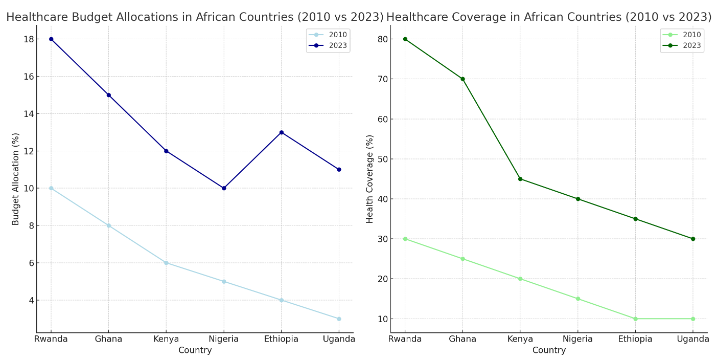
As shown in the first graph, healthcare budget allocations have surged between 2010 and 2023. Countries like Rwanda have gone from spending 10% of their budget on health in 2010 to 18% today. This marks a bold commitment to improving healthcare infrastructure, as explained by Dr. Mary Kamau, a Kenyan health policy expert:
“This is a game changer for Africa’s health systems. By allocating more of their domestic budgets to healthcare, countries are not just relying on foreign aid but are ensuring a self-sustaining approach to healthcare financing. Rwanda’s 18% budget allocation stands as a model for the rest of the continent. It’s an acknowledgment that health is at the heart of human and economic development.”
Ghana has also followed suit, increasing its allocation from 8% to 15%, aligning with the Abuja Declaration’s target. Ghana’s National Health Insurance Scheme (NHIS), which now covers 70% of its population, is being lauded as one of the most successful models in sub-Saharan Africa.
“Access to healthcare is no longer a luxury” – Prof. Maria Owusu
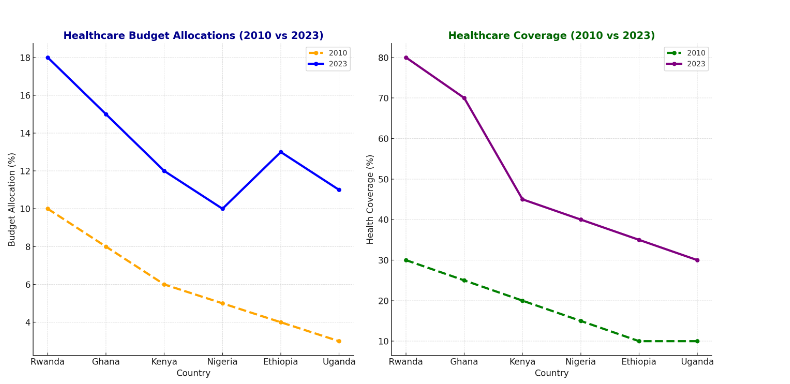
In addition to budgetary increases, the second graph illustrates the progress made in expanding health coverage. Rwanda, again leading the charge, has grown its health insurance coverage from 30% in 2010 to an impressive 80% by 2023. Ghana follows closely with 70%.
Prof. Maria Owusu, a health economist from the University of Ghana, emphasized the importance of this expansion:
“Access to healthcare is no longer a luxury reserved for the few. These numbers reflect the work done to ensure that health services are affordable and available to the majority of the population. It is a critical step toward achieving UHC. We’re seeing the results of deliberate policy choices that prioritize the health of citizens.”
The numbers for Kenya and Nigeria, although improved, still indicate work to be done. Kenya has raised its health coverage from 20% in 2010 to 45%, while Nigeria sits at 40%. These countries are in the process of scaling up their UHC efforts, but issues like infrastructure and personnel shortages remain barriers.
“Challenges remain, but the foundation is strong” – Dr. Adebayo Ige
While the progress is undeniable, experts acknowledge that challenges still exist, especially in rural areas where access to healthcare services is limited. Dr. Adebayo Ige, a healthcare economist from Nigeria, highlights the hurdles in maintaining equitable access:
“The numbers are promising, but the real test will be in reaching rural populations and marginalized communities. Nigeria has increased its health budget from 5% in 2010 to 10% in 2023, but we need to ensure that these funds translate to real healthcare delivery in underserved areas. Challenges remain, but the foundation is strong, and we’re on the right path.”
“A blueprint for other African nations” – Dr. Kwame Mensah
One of the success stories comes from Ghana, where the combination of increased budget allocation and health coverage has positively impacted the health system. Dr. Kwame Mensah, a physician in Accra, explains how these reforms have changed healthcare delivery in his country:
“The health system in Ghana has transformed tremendously over the past decade. The NHIS has made a significant impact, allowing more people to access essential services without financial strain. Our government’s dedication to reaching the 15% Abuja Declaration target is a blueprint for other African nations looking to improve their health systems.”
“The Road Ahead”
The story told through the data in these charts is one of hope and progress. Countries like Rwanda and Ghana are leading the way, proving that substantial budget increases can yield significant gains in healthcare access and coverage. However, as the experts emphasize, the road ahead requires sustained commitment, targeted investments, and ensuring that no population is left behind.
The charts clearly show Africa’s healthcare systems moving toward a future where budget commitments and health insurance schemes are providing a pathway to Universal Health Coverage. As reforms continue, the positive trend looks set to expand across more nations, improving the lives of millions on the continent.








