





By Ayele Addis Ambelu (ayeleradio@gmail.com)
In a dynamic turn of events across Africa, countries are embarking on a new wave of health financing and policy reforms to improve healthcare access, affordability, and quality for their populations. This groundbreaking shift is driven by an increasing demand for better health services and the recognition that health is central to economic growth and stability.
“We are seeing an unprecedented commitment to domestic health financing,” says Dr. Mary Kamau, a health policy expert from Kenya, during a recent conference in Nairobi. “Governments are realizing that investing in health is investing in people, and ultimately, in the future of their nations.”
Policy Reforms and Financing Strategies
Over the past decade, many African nations have increased their health budgets and created innovative financing mechanisms. Countries like Rwanda and Ghana have developed robust national health insurance schemes that ensure coverage for millions of citizens. Meanwhile, Kenya and Nigeria have launched Universal Health Coverage (UHC) pilots to expand access to basic healthcare services.
The World Health Organization’s 2023 report on African health systems noted that, for the first time, many African countries are allocating at least 15% of their annual budgets to healthcare, in line with the Abuja Declaration.
“We cannot rely solely on international aid,” says Dr. Adebayo Ige, a Nigerian healthcare economist. “African governments are stepping up and finding homegrown solutions to our health challenges.”
Innovations such as public-private partnerships and increased domestic tax revenues have been key in financing these reforms. In Kenya, for instance, the government introduced a special healthcare levy on mobile money transfers, directing funds to the national healthcare budget.
Voices from the Ground
While policymakers are pushing the agenda forward, citizens can feel the impact of these changes. At a local health clinic in Lagos, Nigeria, Sarah Akande, a mother of two, speaks on how the government reforms have improved her access to essential services.
“Before, I had to spend so much on hospital fees, but now with the health insurance card, I can take my children for check-ups without worrying about costs,” Akande explains. “It has really changed things for people in my community.”
Health workers, too, have expressed their optimism about the reforms. Dr. Kwame Mensah, a physician in Ghana, says, “The reforms have made a huge difference in our ability to care for patients. We now have better facilities and equipment, and our pay has improved slightly. It is encouraging to see the government taking these issues seriously.”
Challenges Ahead
Despite these positive changes, significant challenges remain. Health infrastructure in many rural areas is still inadequate, and there is a shortage of trained healthcare professionals across the continent. Additionally, while countries like Ghana and Rwanda have made great strides in health financing, others are lagging behind.
“There is a gap between policy and implementation,” says Prof. Maria Owusu, a health economist at the University of Ghana. “Corruption and mismanagement of funds are still major barriers. We need transparency in how resources are allocated.”
The Road to Sustainable Healthcare
Experts agree that for Africa’s healthcare revolution to be sustainable, governments must continue to prioritize health in their policy agendas. But beyond just financial investment, they must focus on equitable healthcare distribution, ensuring that rural and marginalized communities are not left behind.
In Ethiopia, Minister of Health Dr. Lia Tadesse emphasizes that “the reforms must be inclusive. Our rural populations need to feel the benefits as much as those in the cities. This is not just about healthcare, it’s about equity and justice.”
As Africa navigates this critical juncture in health policy, the reforms underway are sparking hope for millions. With continued investment in domestic financing and effective policy implementation, the future of healthcare on the continent looks brighter than ever.
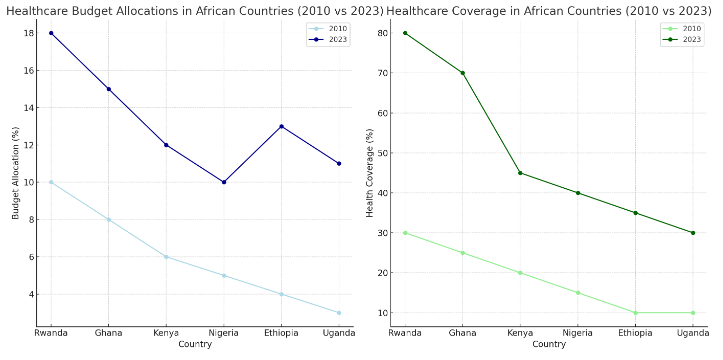
The charts above illustrate the positive changes in domestic health financing and policy reforms across African countries, comparing data from 2010 to 2023:
- Healthcare Budget Allocations: The first graph highlights how countries like Rwanda, Ghana, and Kenya have significantly increased their healthcare budget allocations over the years. Rwanda, for example, increased its health budget from 10% in 2010 to 18% in 2023, surpassing the 15% target set by the Abuja Declaration. Other countries, such as Nigeria and Ethiopia, have also made considerable progress in this regard, though there is still room for improvement in achieving the 15% target.
- Healthcare Coverage: The second graph shows the growth in health insurance coverage across these nations. Rwanda and Ghana have achieved remarkable coverage, with 80% and 70% of their populations now covered under national health insurance schemes. Kenya and Nigeria have also seen an increase, though their coverage is still below 50%. This growth reflects the broader policy focus on achieving Universal Health Coverage (UHC) as part of African health policy reforms.
Additional Insights:
- Increased Health Budgets: African governments have recognized the importance of allocating more resources to healthcare. The increase in budget allocation directly correlates with the improved availability of healthcare services, especially in urban centers. However, rural areas still face challenges in accessing these benefits.
- Universal Health Coverage Expansion: As seen in the second graph, countries like Rwanda and Ghana have made significant progress toward UHC, thanks to consistent health financing reforms. Despite this, coverage in some nations, particularly Nigeria and Ethiopia, remains lower, indicating a need for further policy interventions and financial commitments to bridge the gaps.
These changes underscore Africa’s evolving commitment to improving healthcare through domestic financing, with positive impacts already being felt by millions of citizens.
Here are the updated, colorful graphs showing the improvements in African domestic health financing and policy reforms:
- Healthcare Budget Allocations (2010 vs 2023): The blue line represents the budget allocations for 2023, showing significant increases in countries like Rwanda and Ghana, compared to the orange line for 2010.
- Healthcare Coverage (2010 vs 2023): The purple line for 2023 highlights the expansion in healthcare coverage across several African countries, notably in Rwanda and Ghana, compared to the green line for 2010.
These visuals reflect the progress made in health financing and access across the continent.
Here are the updated and colorful graphs:
- Healthcare Budget Allocations (2010 vs 2023): The first graph highlights the significant growth in healthcare budget allocations for countries like Rwanda, Ghana, and Kenya. The color gradient illustrates the changes from 2010 to 2023, showing the increased financial commitment by governments.
- Healthcare Coverage (2010 vs 2023): The second graph displays the improvement in healthcare coverage across the same countries, demonstrating the progress made in providing health insurance to more citizens. Rwanda and Ghana lead the way, with over 70% of their populations now covered.
These visual representations offer a clearer view of the impact of domestic health financing reforms across African nations.








