






As Africa enters 2024, the African Union (AU) has set a bold and ambitious theme: “Educate and Skill Africa for the 21st Century.” This vision comes at a critical time as the continent grapples with persistent educational challenges while striving to prepare its youth for the demands of a globalized world. The urgency to act was heightened following the United Nations Summit on Transforming Education in September 2022, where the global education crisis was starkly underscored. The AU’s proposal to make education the centerpiece of its agenda signals a continent-wide commitment to tackling these issues head-on.
The State of Education in Africa: A Snapshot of Challenges
Education in Africa remains a multifaceted challenge, with a daunting gap in achieving Sustainable Development Goal 4 (SDG4): ensuring inclusive and equitable education for all. Millions of children remain out of school, literacy rates lag behind global averages, and gender disparities persist, particularly in rural areas. Meanwhile, the quality of education—where it is accessible—often falls short, leaving many young Africans unprepared for the modern workforce.
Dr. Amina K. Mohammed, Deputy Secretary-General of the United Nations, attended the AU High-Level Side Event in New York and described the situation as a “crisis that demands urgent and collective action.”
“Education is the foundation of everything,” Dr. Mohammed emphasized. “Without it, we cannot talk about sustainable development, poverty reduction, or even peacebuilding. Africa’s future hinges on what we do now.”
Moussa Faki Mahamat, Chairperson of the African Union Commission (AUC), echoed this sentiment, formally proposing education as the AU Theme of the Year for 2024. His call for action resonated widely, and the Specialized Technical Committee on Education, Science, and Technology unanimously adopted a draft declaration.
Progress Amidst Challenges
Despite these challenges, significant strides have been made. Countries like Rwanda and Ghana are emerging as role models, implementing innovative policies to increase access to education, improve literacy rates, and address gender disparities. For example, Rwanda’s “Smart Classrooms” initiative leverages technology to enhance learning outcomes, while Ghana’s free Senior High School program has expanded access for thousands of students.
In his address at the New York event, President Paul Kagame of Rwanda highlighted the transformative potential of education in Africa. “Investing in education is not just an expense; it is the most sustainable investment we can make. It is the bedrock upon which we build a skilled and prosperous continent,” he stated.
Expert Commentary: The Skills Gap and the Way Forward
One of the most pressing issues is the growing skills gap between what African youth are taught and what the 21st-century job market demands. Industries across the continent are shifting toward technology and innovation, yet many schools lack the resources or curriculum to prepare students adequately.
Dr. Mary Okello, a prominent educator and founder of Kenya’s Makini Schools, said, “Our education systems need a complete overhaul. We’re preparing students for jobs that no longer exist. Instead, we must focus on critical thinking, digital skills, and entrepreneurship.”
The AU’s 2024 theme addresses these issues by prioritizing education reforms at a continental level. This includes increased funding and strategic partnerships with private sector players, non-governmental organizations, and international donors.
The Road Ahead: Commitment and Accountability
The final declaration from the AU High-Level Side Event reaffirmed commitments to existing continental education strategies, such as the Continental Education Strategy for Africa (CESA 16-25), while emphasizing the need to align with SDG4. Leaders pledged to allocate more resources to education, reduce disparities, and implement policies that ensure every child receives quality education.
However, the path forward is not without obstacles. Political will, corruption, and the sheer scale of the challenges remain significant hurdles. As Dr. Okello aptly put it, “Policies alone are not enough; we need action, monitoring, and accountability.”
As the AU prepares to formally adopt this theme at the 36th Ordinary Session of the Assembly Summit in February 2024, the hope is that this will mark a turning point for education across Africa. The challenges are immense, but so too are the opportunities. With a collective commitment to educating and skilling Africa’s youth, the continent has a chance to transform not only its education systems but its future.
“The time to act is now,” Chairperson Mahamat urged. “The future of Africa depends on the decisions we make today.”
The year 2024 could very well be remembered as the year Africa began to unlock its greatest resource: the potential of its people.
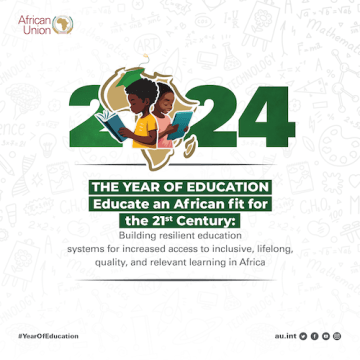
The AU Theme of the Year for 2024 is proposed to be Education, following a global Summit on Transforming Education convened by the UN Secretary-General in September 2022.
The urgency stems from the global education crisis and the off-track progress toward Sustainable Development Goal 4.
Africa faces significant challenges in achieving SDG4, leading to the organization of an AU High-level side event in New York.
The event resulted in a draft declaration, which the Specialized Technical Committee on Education, Science, and Technology reviewed and adopted.
The High-level side event included participation from African leaders, UN representatives, and partners who emphasized the need for collective commitment to address education challenges.
Moussa Faki Mahamat, Chairperson of the AUC, proposed that Education be the AU Theme of the Year 2024, a proposal widely supported.
The final declaration, unanimously adopted, reaffirms commitments to continental education strategies and SDG4.
The proposal is set for consideration and adoption in the 36th ordinary session of the Assembly summit in February 2023.
A snapshot of the education sector in Africa indicates efforts and progress in ensuring access, completion, and quality of education, focusing on reducing out-of-school children and improving literacy rates.








