





A Rain of Fire
In the heart of Ethiopia’s Amhara region, the lush valleys of North Shewa have transformed into battlegrounds marked by fear and devastation. From July 2023 to April 2024, drone strikes conducted by government forces have become an emblem of the ongoing conflict. These attacks, intended to target armed insurgents, have instead killed hundreds of civilians, destroyed livelihoods, and displaced entire communities.
This investigative piece explores the tragic impact of drone warfare on the people of North Shewa, drawing on eyewitness accounts, official reports, and expert analysis to provide a comprehensive understanding of the crisis.
1. The Attack on Showa Robit: A Community Devastated
On March 15, 2024, residents of Showa Robit, a bustling town in North Shewa, awoke to the deafening sound of drones overhead. What followed was a barrage of airstrikes that leveled homes, markets, and schools. Official figures state that 53 civilians were killed and over 120 injured, but local sources insist the death toll is much higher.
Selam Alemayehu, a 32-year-old mother of three, lost her entire family in the attack. In an emotional interview, she recounted the harrowing moments:
“I heard the first explosion and ran outside to see smoke everywhere. My children were inside the house. By the time I reached them, there was nothing left but rubble. My husband was coming back from the market and was caught in another blast. How can I go on when everything I loved is gone?”
The Ethiopian Human Rights Commission (EHRC) described the incident as one of the most egregious examples of civilian harm caused by drone warfare. Their preliminary findings reveal that no insurgent presence was detected in the area during the strikes, raising questions about the military’s intelligence and targeting procedures.
Horrific attack in Gojam
A drone attack carried out in South Achefer Woreda of North Gojjam Zone in Amhara Region killed a significant number of people, including children and pregnant women, according to residents and eyewitnesses who spoke to ANC.
Witnesses and residents said the attack took place over three consecutive rounds on Tuesday, November 5, 2024 (Tikimit 26, 2017 E.C.) in a small town called Aregie (Zibsit) located around 40 km from the woreda’s capital of Durbete.
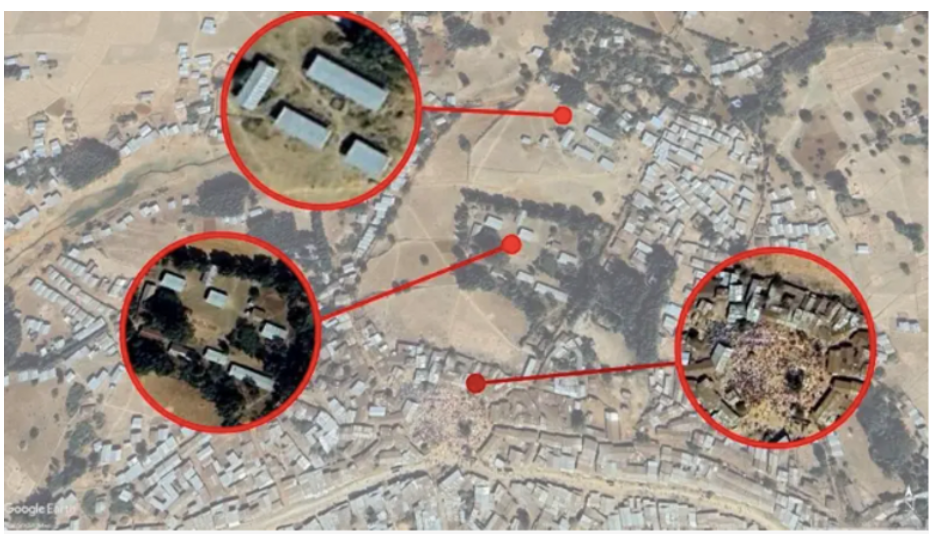
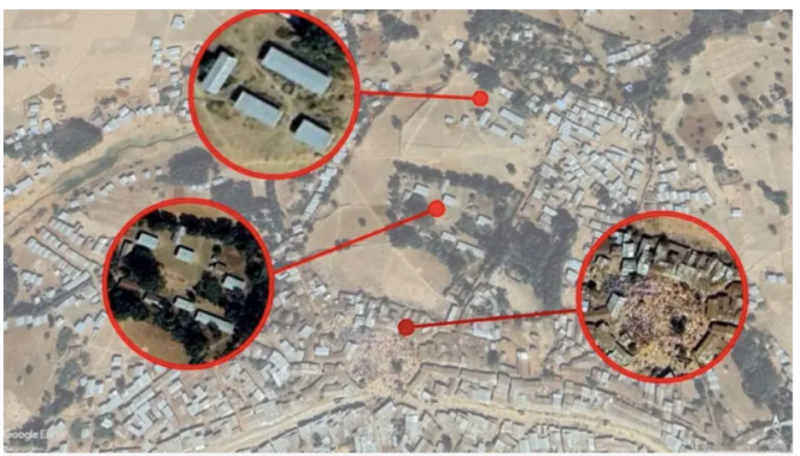
At around 7:10 am, an attack was carried out in the town’s market, a primary school, and a health center, according to witnesses who spoke to ANC, saying “children up to adults perished.”
The Ethiopian Human Rights Commission (EHRC) said it received information about the attack and told ANC it was gathering information.
The drone attack victimized children playing netball, seniors, people who were sitting down, mothers receiving medical care, and day workers striking near a church and striking people who were sitting in a harvest, say residents.
Residents said the three areas where the drone strike hit were nearby, and ANC verified, based on a review of maps and satellite imagery, that these areas were located within a 300-meter radius.
One day before the attack, drone surveillance was noted. “She was circling in the sky,” said residents, saying the attack seemed like it was meant to “destroy the town.”
“There were children, there were seniors, there were youth all across the area [who were struck]. Many houses which were located nearby were also struck,” said one eyewitness, describing the scale of the attack and saying “they were civilians,” describing the identity of the killed victims.
One resident said, “We thought it was God’s wrath. It came down from the sky and struck us like lightning,” testifying that the incident was unexpected.
Another resident who said they came to the area quickly after hearing sounds of an explosion said they saw bodies that had fallen all over the area and called the situation “horrific”.
Another resident said they were in church when the attack was carried out and said to protect themselves, “We lied down where we were.” The resident and the six people who were with them survived “by His grace,” but they said seven people who were near them were killed.
“It feels dreadful to be human. I have never seen human beings inflicting this kind of cruelty onto one another,” said the resident describing the attack, “the attack which took place was severe and devastating,” they said.
They said among the killed victims were more than 13 children playing ball on school property in addition to pregnant women, which was a reflection of the devastation of the attack.
The attack on the health center killed mothers and women who were receiving pregnancy follow-up appointments and who were in labor.
One medical professional who confirmed this and who was in the health center when the attack took place said the extent of damages on the maternal monitoring center was severe, they said five pregnant women and two other patients were killed.
“It struck the mothers who were sleeping inside,” said the medical professional, adding that three female medical professionals were injured and calling the casualties “severe.”
The professional said the “shock” triggered three mothers to have miscarriages.
BBC was unable to verify the attack on the area independently, however photographs and video footage allegedly showing the injuries to victims circulated over the past few days on social media.
The attack in the market area killed five members of a single family as they were having breakfast in their home, including a pregnant mother, a father, and three children, residents told BBC.
One resident who was a neighbor to the killed victims said, “They perished all together.” The children were aged between 10 and 17 years old; the neighbor estimated the mother, who was pregnant at the time, “left before she was able to deliver what was given to her by God…” which caused the residents much sorrow, they told ANC.
Residents told ANC the name of the man who was killed alongside his wife and children was called Ato Simegnew Bewketu.
One resident said among the killed victims were seven of their relatives. “In a single household, there were as many as five people who were killed,” they said about the massacre.
Another resident who said their close relative, who was 15 years old, was killed in the attack said, “There is no home which has not been affected by sorrow” and added there were families where two and three people were killed.
Another resident said the incident “was a slaughter”, saying, “In all our days of living, we have never heard of anything like this, let alone seen it. It is terrible that this kind of disaster could happen against innocent people.”
One resident who retrieved bodies described being disturbed by what they saw, saying, “I am unwell.”
Another resident said, “Anyone who saw all of that could not eat injera. There is no one eating injera. Yesterday and today nobody is eating,” they said, explaining that they were disturbed.
Residents said it was difficult to identify the killed persons from their bodies and faces. They told BBC they were forced to conduct a mass burial due to fear created by ongoing drone surveillance.
“They would say someone’s brother, someone’s sister, someone’s child, someone’s father but they could not be distinguished by their looks” they said explaining that it was difficult to separate the bodies, they said up to 15 bodies were buried in a single grave.
“[The bodies] were retrieved and carried on carriages. They were gathered and buried,” said residents who said the burial was held a short distance away in the Zibsit Maryam Church, which faced minor damages, and said the burial occurred at 6 pm without prayers.
One resident who retrieved bodies said they retrieved 44 bodies on the day of the attack, and they said the following day they found another four.
Another two residents said they counted “43 people” killed in the attack and said 21 people were injured.
A medical professional confirmed that over 64 people were injured in the drone attack, and 43 people were killed.
The professional stated that over 21 injured victims received care in the medical center, “we did everything we could. But we are reaching a stage of being unable to save over eight people.”
Victims with severe injuries were sent for better medical care on two ambulances to Durbete; however, in an area called Lalibela, “government forces” opened fire on them, forcing them to turn back.
Residents said, in addition, there were people whose whereabouts are unknown, so the number of deaths could increase.
“There were people who were not found nearby. They were likely killed…we have discovered killed people even on the third day since,” said one resident who said searches were underway.
Residents said, “The losses were great,” adding, “Beyond those who died, many have become hurt by the trauma.”
After residents heard sounds of explosions, many ran in shock and plunged into ditches, where they suffered breakages.
“There are many people who lost from the shock. Some people were injured, broken, and fell into ditches.”
Residents said locals have been leaving the town out of fear and that it has become “empty.”
“People are overcome with fear, and they are leaving. It is very difficult,” said one resident. Another resident said, “There is no one left,” describing the current situation.
“Today is Wednesday’s market. There are no people here…it does not look like a market.”
Before this, on October 14, 2024 (Tikimit 4, 2017 E.C.), an air strike was carried out in the area, said the resident; two people were killed in this attack, and a large number of houses were damaged.
Residents said the area was under “government control” and added that Fano forces did not operate there.
“How could there be this extent of bombardment without reason?” said one resident questioning why they were attacked, “how could they drop it on us? Is our question. If it is how we hear, they supposedly drop it where the Fano are,” they said explaining that Fano militants were not operating in the area.
“We would see them from time to time pass through but there were no Fano here with us” said another resident adding, “the Fano do not spend their days with us, they do not spend the night, we do not see them, they only pass by from time to time.”
“If anything happened, we would not say ‘it is our problem, or they were our people who had us killed’ to the government. But when it comes down on us without reason, we believe it was an attack on us,” said another resident.
Residents in the small town of Zibsit said the repeated attacks have subjected the people to suffering.
“There is no child who doesn’t tremble at night. Since October 14 (Tikimit 4), the children have given us problems. The majority of the children are in prayer. They say ‘it’s coming, it’s shouting at us,’” said one resident.
Another resident and father of four said, “Whenever there are sounds of gunfire or other noises, the children suffer; many children are in doctor’s offices and prayer.”
“We are now thinking we would have been better off if we had died like the others. How can we deal with this problem? We have no choice. If we were to leave, where could we go? Our people are dying…we are facing very severe losses,” said another resident, describing the scars left by the attack.
Residents said local residents have faced fears “the people are being displaced from the town out of fears they cannot live there. They are closing their homes and leaving. They are saying after this there is no one they can appeal to as they leave.”
BBC’s efforts to contact zonal and local administrators to obtain more information on the reported attacks and resulting casualties were unsuccessful.
In the conflict between government forces and Fano militants, which has continued for more than one year in Amhara Region, repeated drone attacks and killings have been previously reported in North Gojjam Zone.
2. Patterns of Indiscriminate Strikes
The Showa Robit tragedy is not an isolated incident. Drone strikes in North Shewa have followed a grim pattern of targeting densely populated civilian areas under the guise of combating insurgency.
“Between November 2023 and March 2024, at least 15 drone attacks were recorded in North Shewa, causing over 200 civilian casualties,” said Dr. Daniel Bekele, Chief Commissioner of the EHRC. “The strikes have destroyed homes, markets, and public infrastructure, leaving thousands homeless.”
One such attack occurred on February 5, 2024, in Mojana Wadana District, where a school was mistakenly targeted. Ten children were killed, and dozens were injured. Local teacher Tesfaye Hailemariam described the horror:
“The drones came without warning. We were in the middle of a lesson when the school shook violently. Children were screaming, blood everywhere. We thought the school would be a safe place, but now it’s a graveyard.”
3. The Displacement Crisis
The drone strikes have exacerbated an already dire displacement crisis in the region. According to the International Organization for Migration (IOM), over 120,000 people have fled their homes in North Shewa since July 2023. Most of these internally displaced persons (IDPs) live in overcrowded camps, facing shortages of food, water, and medical care.
In the Hagere Selam IDP camp, 56-year-old Ayele Tadesse shared his plight:
“We fled with nothing but the clothes on our backs. My children are hungry, and my wife is sick. The government says it is protecting us, but who will protect us from their drones?”
The Ethiopian government has yet to provide adequate humanitarian assistance to displaced populations, leaving NGOs and local communities to fill the gap.
4. Legal and Ethical Implications
The use of drones in conflict zones raises significant legal and ethical concerns. Under international humanitarian law, parties to a conflict must distinguish between combatants and civilians. The repeated targeting of civilian areas in North Shewa suggests a breach of these principles.
“Drone warfare is not inherently illegal,” said Lemlem Girma, a human rights lawyer based in Addis Ababa. “However, its use must adhere to strict guidelines to minimize civilian harm. In Ethiopia, there is a glaring lack of accountability for these strikes. This sets a dangerous precedent.”
International bodies, including Amnesty International, have called for an independent investigation into the use of drones in Ethiopia.
5. Voices of Resistance and Calls for Justice
Amid the devastation, voices of resistance are emerging. Community leaders and activists in North Shewa are calling for justice and an immediate cessation of drone strikes in civilian areas.
“Our people are not collateral damage,” said Abebe Mekonnen, a local activist. “We demand accountability from the government and the international community. If these atrocities are ignored, the cycle of violence will only continue.”
Families of victims have also begun organizing to seek reparations and justice. Selam Alemayehu, whose family was killed in the Showa Robit attack, has become a vocal advocate for change:
“I’m just one person, but I will not let my children’s deaths be in vain. We deserve answers. We deserve justice.”
6. International Response: Silence or Complicity?
The international community’s response to Ethiopia’s drone warfare has been muted. While some countries have condemned the civilian casualties, no concrete action has been taken to hold the Ethiopian government accountable.
“The lack of international pressure only emboldens those responsible for these atrocities,” said Dr. Mesfin Wolde, a conflict resolution expert. “Ethiopia’s allies must demand transparency and accountability.”
Conclusion: A Cry for Accountability
The human cost of drone warfare in North Shewa is undeniable. Families are shattered, communities are displaced, and trust in the government is eroded. For Ethiopia to heal, justice must prevail.
“We can’t bring back the dead,” said Father Abebe Melaku, a local clergy member. “But we can honor their memory by ensuring that no one else suffers as they did. Accountability is not optional; it is essential.”
As the conflict rages on, the people of North Shewa continue to bear the brunt of a war that shows no signs of abating. Their stories demand to be heard, and their pain demands justice.
By Ayele Addis Ambelu (ayeleradiio@gmail.com)








