A coalition of 21 leading scientists is urging an urgent transformation of global food systems to halt escalating land degradation, warning that without decisive action, the world faces worsening climate change, biodiversity collapse, and food insecurity. In a new study published in Nature, the authors outline a “bold, integrated” action plan to restore half of degraded lands by 2050, slash global food waste by 75%, and unlock sustainable ocean-based food sources. Together, these steps could spare or restore nearly 44 million square kilometers of land — an area larger than Africa — while also cutting annual greenhouse gas emissions by 13 gigatonnes through mid-century.
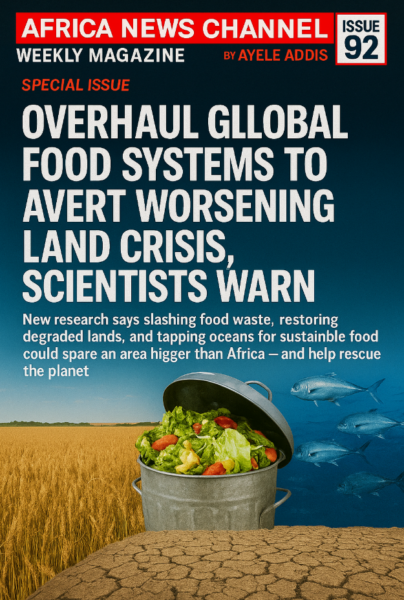
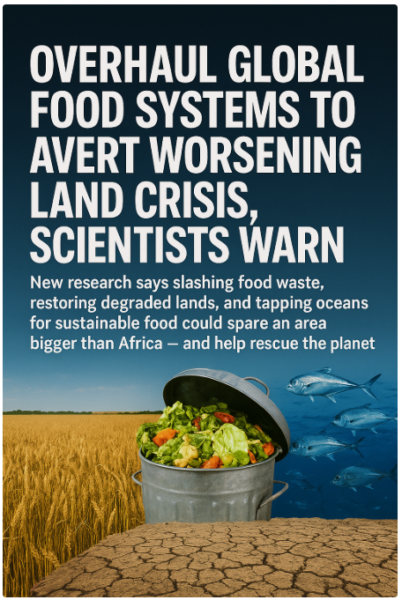
New research says slashing food waste, restoring degraded lands, and tapping oceans for sustainable food could spare an area bigger than Africa — and help rescue the planet.
A coalition of 21 top scientists has issued an urgent call for a radical overhaul of the world’s food systems, warning that without decisive action, escalating land degradation could push climate, biodiversity, and food security into a deeper crisis.
Published today in Nature, the study outlines a “bold, integrated” action plan to restore half of degraded lands by 2050, cut global food waste by 75%, and unlock sustainable ocean-based food sources. Together, these steps could spare or restore nearly 44 million square kilometers of land — roughly the size of North America, South America, and China combined — within three decades.
“Food systems have not yet been fully incorporated into intergovernmental agreements,” the authors write. “Rapid, integrated reforms can move land health from crisis to recovery and secure a healthier, more stable planet for all.”
The paper stresses that food systems remain largely absent from intergovernmental agreements despite being one of the most powerful levers to “bend the curve” of land degradation. Lead author Fernando T. Maestre of the King Abdullah University of Science and Technology (KAUST) calls the plan “a clear pathway” to reverse these trends, emphasizing that transforming diets, farming practices, and global cooperation could restore land health and advance international commitments under the UN Convention to Combat Desertification (UNCCD) and other global accords. Co-author Barron J. Orr, UNCCD’s Chief Scientist, warns that degraded soils, depleted water tables, and lost biodiversity become exponentially more costly to repair, with consequences rippling into food and water insecurity, forced migration, and social unrest.
The researchers propose three main interventions. First, restoring 50% of degraded land — equivalent to 13 million square kilometers of cropland and non-cropland — through sustainable land management that centers Indigenous Peoples, smallholder farmers, women, and vulnerable communities. This would require shifting agricultural subsidies toward sustainable smallholders, introducing land-based taxes that reward good practices, mandating environmental labeling, and improving global data on land use and emissions. Second, slashing food waste by 75% could free up 13.4 million square kilometers of agricultural land. Suggested measures include banning the rejection of “ugly” produce, mandating surplus food donations, running education campaigns to reduce household waste, and improving storage and transport infrastructure in developing countries. Third, integrating land and marine food systems — notably by replacing 70% of unsustainably produced red meat with sustainable seafood, mollusks, and seaweed-derived products — could spare another 17.5 million square kilometers of land while providing nutritional benefits.
The combined land savings from these interventions would total nearly 44 million square kilometers, alongside major biodiversity gains from avoiding the conversion of wild ecosystems into farmland. The study calls on the three Rio Conventions — UNCCD, the UN Framework Convention on Climate Change (UNFCCC), and the Convention on Biological Diversity (CBD) — to unite around shared land and food system goals, streamline science into policy, and accelerate ground-level action. At UNCCD COP16 in Riyadh last year, Parties adopted measures to address agricultural land degradation, but the authors argue that only integrated, cross-sectoral reforms can deliver the scale of change required. “Land is more than soil and space. It harbors biodiversity, cycles water, stores carbon, and regulates climate. It’s time for land stewardship: to care for the land as a living ally, not a resource to exploit,” says co-author Elisabeth Huber-Sannwald.
By acting now, scientists say, the world could achieve a rare triple win — protecting land, securing food supplies, and stabilizing the climate — before the window for action closes. Without such reforms, the pressures of population growth, unsustainable farming, and climate extremes could drive global food systems to a breaking point, threatening not just rural livelihoods but the stability of societies worldwide.
A Plan to ‘Bend the Curve’ of Land Degradation
The researchers warn that current trends — industrial agriculture, overgrazing, deforestation, and unchecked food waste — are eroding soil fertility, draining water tables, and collapsing ecosystems. The consequences are already cascading into food insecurity, migration pressures, and economic instability.
Lead author Fernando T. Maestre of KAUST calls the paper “a clear pathway” to reverse these trends.
“By transforming food systems, restoring degraded land, harnessing the potential of sustainable seafood, and fostering cooperation across nations, we can reverse land degradation while advancing towards the goals of the UN Convention to Combat Desertification and other global agreements.”
Three Pillars of the Overhaul
- Restore 50% of degraded land by 2050
Equivalent to 13 million km² — involving both cropland and non-cropland. Restoration must center on Indigenous Peoples, smallholder farmers, women, and vulnerable communities. Recommendations include:- Shifting subsidies to sustainable smallholders
- Land-based taxes to reward sustainable practices
- Environmental labeling to guide consumer choices
- Better global land use and emissions data
- Slash food waste by 75%
With a third of all food produced currently wasted, the authors calculate that deep cuts could free up 13.4 million km² of agricultural land. Policy models include:- Banning retail rejection of “ugly” produce
- Mandating surplus food donations
- Launching household waste reduction campaigns
- Improving storage and transport in low-income countries
- Shift diets and integrate land–sea food systems
Replacing 70% of unsustainably produced red meat with sustainable seafood and mollusks could spare 17.1 million km² of land. Seaweed farming — requiring no freshwater and storing carbon — could replace part of global vegetable intake, freeing even more cropland.
The Stakes: Climate, Biodiversity, and Stability
The combined measures could avoid 13 gigatonnes of CO₂-equivalent emissions annually through 2050 and sharply reduce biodiversity loss by halting the conversion of remaining wild ecosystems.
Barron J. Orr, UNCCD’s Chief Scientist, warns the costs of inaction are steep:
“Once soils lose fertility, water tables deplete, and biodiversity is lost, restoring the land becomes exponentially more expensive. Land degradation isn’t just a rural issue — it affects the food on our plates, the air we breathe, and the stability of the world we live in.”
A Call for Global Coordination
The paper urges the UN’s three Rio Conventions — on desertification (UNCCD), climate change (UNFCCC), and biodiversity (CBD) — to align around shared land and food system goals. At UNCCD COP16 in Riyadh last year, 197 Parties adopted new measures on agricultural land degradation, but the authors stress that only integrated global action will be enough.
“Land is more than soil and space. It harbors biodiversity, cycles water, stores carbon, and regulates climate. It’s time for land stewardship: to care for the land as a living ally, not a resource to exploit,” says co-author Elisabeth Huber-Sannwald.
By the Numbers
- 56% — Increase in food production needed by 2050 without reforms
- 33% — Share of global food wasted today
- 80% — Proportion of deforestation driven by food production
- 50% — Proposed portion of degraded land to restore by 2050
- $278B — Annual funding gap for UNCCD land restoration goals
If this plan succeeds, scientists say, the world could achieve a rare triple win — protecting land, securing food, and stabilizing the climate — before the window for action closes.