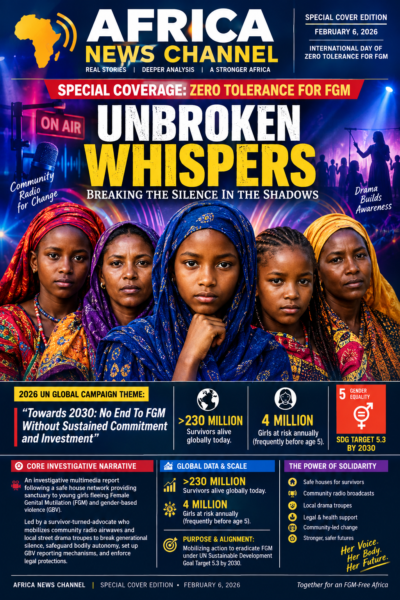
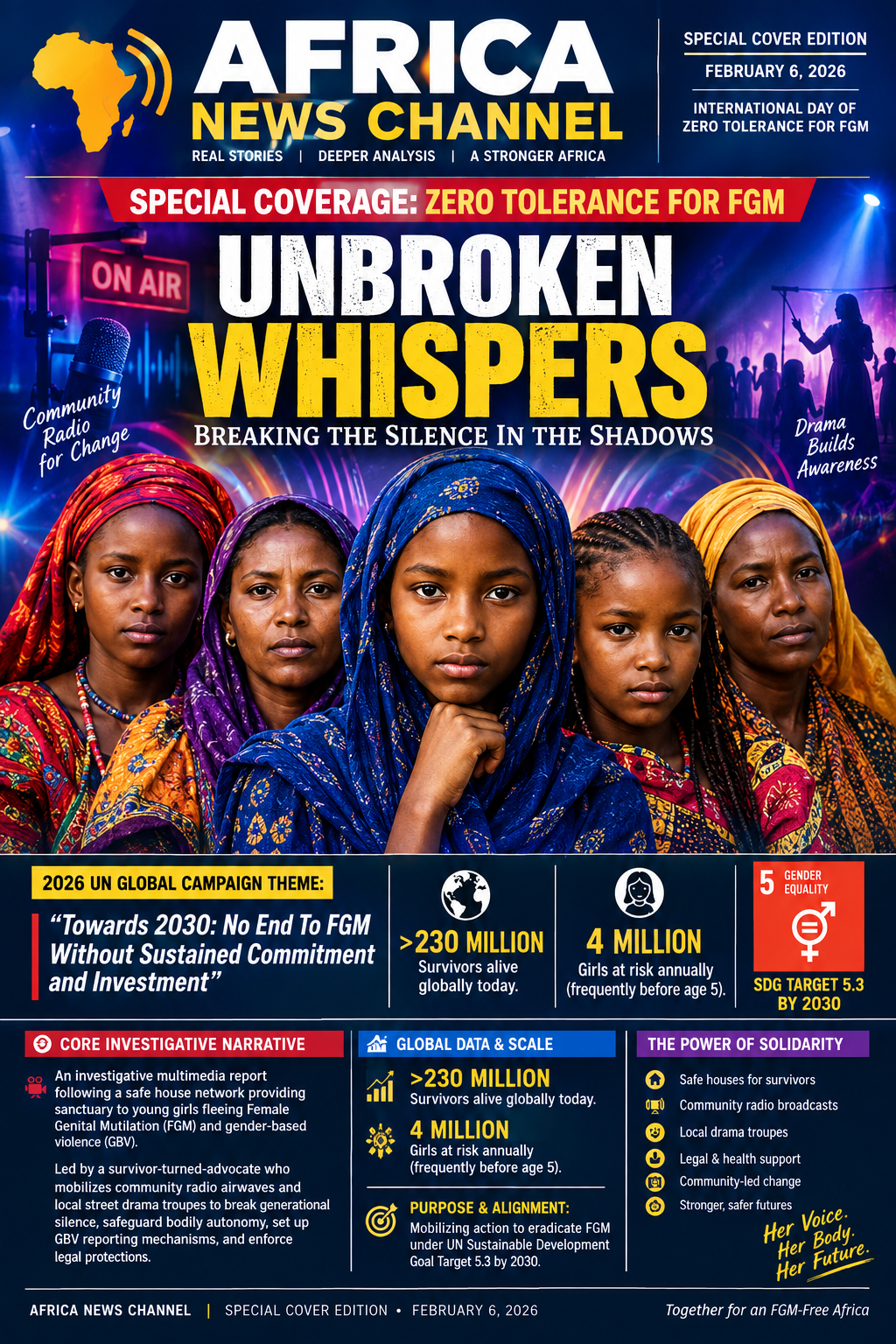
Inside Ethiopia’s hidden battle against FGM and gender-based violence, where safe houses offer refuge, survivors become advocates, and community radio is challenging the beliefs that have protected violence for generations
By Ayele Addis Ambelu | Investigative News Analysis
The first thing she remembers is not the pain. It is the fear. Fear of being taken somewhere she did not want to go. Fear of adults making decisions about her body. Fear of what would happen if she said no. And, perhaps most difficult of all, the fear that nobody would believe her.
For generations, girls across parts of Ethiopia have grown up hearing that female genital mutilation is simply something that happens to girls. In some communities it is connected to marriageability, family honour, purity or social acceptance.
But beneath those explanations is a reality that is rarely discussed openly: a child can be harmed because adults fear what the community will say if they refuse to harm her.
That is where the silence begins. And that is where a new generation of survivors, activists, health workers, journalists, religious leaders and community organizers is trying to break it.
A door that opens when every other door has closed
In one Ethiopian community, a young survivor arrived at a safe house after escaping violence. The address cannot be disclosed. Her name cannot be disclosed. Her story cannot be told in a way that identifies her. For survivors of gender-based violence, anonymity is not a journalistic inconvenience. It can be protection.
The safe house became more than a roof. It became a place where she could sleep without fear. A place where a health worker could examine her. A place where she could speak to a counsellor. A place where legal assistance was available. A place where she could begin imagining a life beyond what had happened to her. Across Ethiopia, such services have become an increasingly important part of the response to GBV.
UNFPA reported that, by November 2024, its Ethiopia programme was supporting 32 One-Stop Centers, 19 safe houses and 63 Women and Girls’ Friendly Spaces, reaching more than 102,600 women and girls with comprehensive GBV services and information. (UNFPA Ethiopia)
These numbers represent infrastructure. But inside every number is a person. A girl. A mother. A survivor. A family.
The violence that hides behind silence
Gender-based violence is not one act. It can include physical violence, sexual violence, psychological abuse, forced marriage, exploitation and other forms of violence directed against women and girls because of gender inequality.
FGM is one part of this wider landscape of harmful practices. The scale remains enormous.
UNICEF’s Ethiopia data currently lists FGM prevalence at approximately 65% among girls and women aged 15–49, based on the 2016 EDHS. (UNICEF DATA)
But there is an important sign of change.
A 2024 nationally representative survey by the Network of Ethiopian Women Associations, covering more than 36,000 households across 12 regions and two city administrations, found FGM prevalence among women aged 15–50 had fallen from 65% in 2016 to 48.5% in 2024. Among women aged 15–29, prevalence fell from 47% to 38.9%. (UNICEF)
The decline matters. But nearly half of women in that 2024 age group reporting FGM means the practice remains far from eliminated. And national averages conceal dramatic regional differences.
The 2016 EDHS reported FGM prevalence of 99% among women aged 15–49 in Somali Region and 91% in Afar, compared with 65% nationally. (DHS Program)
In the former Sidama zone, which later became the Sidama Region, the 2016 EDHS estimated prevalence among women aged 15–49 at 87.6%. (UNICEF)
These figures come from different periods and should not be used as direct measurements of current regional prevalence. But they reveal why Ethiopia cannot fight FGM with a single national message. The problem looks different from one community to another.
The girl who became a voice
Our media has documented the story of Hawa, an adolescent FGM survivor from Sidama. At 13, Hawa was abducted from school and subjected to FGM and sexual assault. Her story could have ended with silence. Instead, she became an advocate.
UNICEF reported that Hawa and other survivors in Sidama began using their experiences to speak about harmful practices and encourage communities to protect girls. (UNICEF)
Her transformation illustrates one of the most important changes in the fight against FGM: survivors are increasingly becoming agents of change rather than merely recipients of services. That shift matters.
For decades, public conversations about FGM were often dominated by institutions speaking about girls. Now, survivors and adolescent girls are increasingly speaking for themselves.
The microphone becomes a safe house without walls
In communities where people may hesitate to report violence to authorities, community radio can become another doorway. A radio programme can reach the household where a girl is too frightened to walk into a government office. A drama can discuss FGM without exposing a real survivor. A call-in programme can allow listeners to ask questions anonymously. A religious leader can explain that a harmful practice is not a religious obligation. A health worker can explain complications without humiliating survivors. A lawyer can explain what the law says. And a survivor can tell her story without revealing her identity.
This is why community radio and local theatre can be more than awareness tools. They can become mechanisms for changing social norms.
UNICEF’s work in Ethiopia repeatedly emphasizes community engagement, adolescent empowerment, engagement of men and boys, religious leaders, community mobilization and stronger service delivery as components of ending FGM and child marriage. (UNICEF)
The challenge is to move the conversation from:
“This is our tradition.”
to:
“Is this tradition protecting our daughters—or harming them?”
When tradition becomes a shield for violence
One of the hardest parts of ending FGM is that many people who continue the practice do not necessarily describe themselves as violent.
They may believe they are protecting their daughters.
They may fear that an uncircumcised girl will not find a husband.
They may believe that refusing the practice will bring shame upon the family.
UNICEF’s reporting from Somali Region found that some families continue FGM secretly because of misinformation and fear of social consequences, including beliefs about marriageability. (UNICEF)
This creates a vicious circle: Parents fear the community. The community fears social rejection. Girls bear the consequences. Silence protects the system. Breaking that circle requires more than telling people that they are wrong. It requires changing the social expectation itself.
The religious leader who joined the conversation
In Somali Region, UNICEF has documented community interventions involving religious leaders, adolescent groups, anti-harmful-traditional-practice committees and local officials.
Religious leaders have been particularly important where FGM is wrongly associated with religious obligation.
One community facilitator described how religious dialogue helped challenge those assumptions. (UNICEF)
This is an important lesson for prevention programmes: social norms cannot be changed only from outside a community. People who already possess trust inside the community can sometimes reach audiences that government campaigns cannot. The messenger matters.
But awareness alone cannot protect a girl running for her life
Imagine a girl who escapes FGM. Where does she go? Who protects her? Where does she sleep? Who pays for medical treatment? Who provides psychological support? Who helps her report the case? Who accompanies her through the legal process? And what happens if she has to return to the same environment where the threat began? These questions explain why safe houses and One-Stop Centers are so important.
Ethiopia’s emerging response has increasingly emphasized integrated services rather than forcing survivors to move from institution to institution.
At a One-Stop Center, health workers, police, prosecutors, counsellors and social workers can coordinate services.
UNFPA describes the model as providing medical care, psychosocial support, sexual and reproductive-health services and legal coordination in one setting. (United Nations Population Fund)
At Bule Hora Teaching Hospital, for example, a GBV facility enabled a survivor of sexual assault to access medical and psychosocial care while police and other institutions coordinated the case. (United Nations Population Fund)
At Dilla University Referral Hospital, UNFPA documented a case involving a mother and her daughters who experienced violence at home; the children were referred to a safe house in Hawassa for counselling, medical and legal support, accommodation and skills training. (UNFPA Ethiopia)
These are not merely buildings. They are bridges between survival and recovery.
The second violence: when the system fails the survivor
For some survivors, escaping the perpetrator is only the beginning. They may encounter disbelief. They may be asked to repeat their story multiple times. They may wait for medical documentation. They may struggle to access legal assistance. They may return to the same economic dependence that made escape difficult. And they may fear community stigma.
UNFPA’s evaluation of its Ethiopia programme found that conflict and crisis had fragmented GBV services, while survivors sometimes faced long and complex recovery processes. The evaluation also found that safe houses and One-Stop Centers provided psychosocial, legal, health and livelihood services and that economic support could strengthen survivors’ independence. (United Nations Population Fund)
The problem, therefore, is not simply whether services exist. It is whether they are: accessible, confidential, coordinated, adequately funded and survivor-centred.
Ethiopia is building a stronger reporting system
There is another quiet revolution taking place away from the microphones. Data.
In 2025, Ethiopia launched its first National GBV Case Management Guideline, designed to standardize survivor-centred case management and referral across sectors. (UNFPA Ethiopia)
UNFPA has also supported the rollout of the GBV Information Management System (GBVIMS+), targeting One-Stop Centers, Women and Social Affairs offices and Women and Girls’ Friendly Spaces.
The purpose is not simply to produce more statistics. Better data can show: Where violence is occurring. Who is accessing services. Which services are missing. Where referrals fail. What survivors need.
And where governments and partners should direct resources. UNFPA says the system is intended to improve case management, strengthen understanding of survivors’ needs and support evidence-based programming. (UNFPA Ethiopia)
The law exists but the law needs a pathway
Ethiopia criminalizes FGM under its legal framework, but legal prohibition alone has not eliminated the practice.
UNICEF’s research is blunt about this: Ethiopia has enacted laws and policy mechanisms, yet legislation alone has not been enough to change deeply rooted social norms. (UNICEF)
This creates a crucial distinction: having a law is not the same as having access to justice. A survivor needs to know where to report. She needs someone to receive the complaint. She needs protection from retaliation. She needs medical documentation where required. She needs legal representation or assistance. She needs confidentiality.
And the justice system needs the capacity to investigate and prosecute appropriately. Without that chain, a legal prohibition can remain distant from the girl it is supposed to protect.
The numbers can fall and still leave millions behind
There is encouraging evidence of progress.
The 2024 survey showing FGM prevalence among women aged 15–50 declining to 48.5% demonstrates substantial change compared with 2016. (UNICEF)
But UNICEF estimates that millions of women and girls in Ethiopia have experienced FGM, and its 2024 strategy report warned that around three million girls and women remain at risk each year. (UNICEF)
That means the country faces a race against both prevalence and population growth.
Even when the percentage falls, the absolute number of girls requiring protection can remain very large.
And humanitarian crises create additional risks. Conflict. Displacement. Drought. Poverty. School closures. Loss of family livelihoods. Breakdown of community protection systems. Each can weaken the mechanisms that prevent violence.
What actually works?
There is no single intervention capable of ending FGM or GBV.
The emerging evidence points toward a layered protection system.
Keep girls in school
Education gives girls information, networks, confidence and access to trusted adults. It can also delay marriage and strengthen economic opportunities.
Give girls a voice
Life-skills groups and adolescent-led initiatives can help girls understand their rights and speak about issues previously considered taboo.
In Somali Region, UNICEF documented adolescent groups where girls learned to discuss FGM and child marriage more openly and support one another. (UNICEF)
Engage religious and traditional leaders
Where social norms are powerful, trusted community leaders can help redefine what is socially acceptable.
Use community radio and drama
Radio can reach remote households.
Drama can make sensitive issues discussable.
Storytelling can create emotional understanding without exposing survivors.
But programmes should provide accurate referral information—not simply awareness.
Strengthen safe houses
Survivors need somewhere safe to go.
Safe houses can provide accommodation, counselling, medical referrals, legal support and livelihood skills. UNFPA reports supporting safe houses and rehabilitation services as part of Ethiopia’s GBV response. (UNFPA Ethiopia)
Expand One-Stop Centers
A survivor should not have to navigate five disconnected institutions while traumatized.
Integrated care can reduce delays and secondary trauma.
Invest in survivor economic independence
Skills training and livelihood support can reduce dependence on abusive partners and make it more realistic for survivors to rebuild their lives. (United Nations Population Fund)
Build reliable referral pathways
A radio programme that tells a survivor to “report” without explaining where to go is incomplete journalism and incomplete advocacy. Information must connect people to actual services.
The survivor becomes the messenger
Perhaps the most powerful image in this story is not a courtroom. It is a microphone. A survivor sits behind it. She does not describe the details of her trauma. She does not identify her attacker. She does not expose herself to another round of public judgment. Instead, she asks a different question:
“What if the next girl does not have to experience what I experienced?”
That is where survivor advocacy becomes prevention.
Her experience becomes information.
Her silence becomes speech.
Her pain becomes a warning.
Her survival becomes a map.
And the community radio programme becomes a conversation that can reach thousands of homes.
Theatre in the village square
A local drama troupe performs a story.
A father wants his daughter circumcised.
A mother fears social rejection.
A girl says no.
An elder intervenes.
A health worker explains the consequences.
A religious leader challenges the misconception.
The audience laughs at one moment.
Falls silent at another.
Then someone asks:
“What would you do if this were your daughter?”
That is how social change sometimes begins.
Not with a policy document.
Not with a conference.
But with a question asked publicly for the first time.
The hardest silence to break
The fight against FGM is not simply a fight against an instrument, a procedure or an individual practitioner.
It is a fight against a system of expectations.
And GBV is not simply a collection of individual crimes.
It is also connected to unequal power, economic dependence, discrimination and social norms.
That is why prevention has to begin before violence occurs.
Before the girl is taken.
Before the marriage is arranged.
Before the cutting is performed.
Before the first beating.
Before the first threat.
Prevention has to reach the community while there is still something to prevent.
From survivors to defenders
Ethiopia’s experience offers evidence that change is possible.
FGM prevalence has fallen significantly over time.
Young people are organizing.
Religious leaders are participating.
Community committees are challenging harmful norms.
Safe houses are providing sanctuary.
One-Stop Centers are connecting medical, psychosocial and legal services.
National guidelines are improving case management.
Data systems are being strengthened.
And survivors are increasingly becoming advocates.
But progress is fragile.
The next phase requires more than awareness campaigns.
It requires sustained financing, survivor-centred services, functioning referral systems, accountable justice institutions, girls’ education, economic empowerment, community leadership and evidence-based communication.
Unbroken whispers
At the safe house, the survivor finally sleeps.
Outside, the world continues.
Markets open.
Children walk to school.
Radio stations begin their morning programmes.
A drama troupe rehearses its next performance.
A health worker prepares for another day.
A lawyer reviews a case.
A community elder attends a dialogue.
And somewhere, a girl is listening to the radio.
She may be hearing the words for the first time:
Your body belongs to you.
Violence is not your fault.
You have the right to seek help.
You have the right to be protected.
You have the right to say no.
That is the real battle against silence.
Not simply making survivors speak.
But building a society in which girls do not have to suffer before they are believed.
The ultimate measure of success will not be how many awareness programmes were broadcast, how many workshops were held or how many posters were printed.
It will be whether a girl can refuse FGM without losing her family.
Whether a survivor can report violence without being blamed.
Whether a woman can leave an abusive relationship without becoming economically homeless.
Whether a community can abandon a harmful practice without fearing social exclusion.
And whether the next generation grows up understanding that tradition can evolve, culture can protect, and a girl’s body is not a community’s property.
The whispers are no longer silent.
They are becoming a chorus.
And that chorus is asking Ethiopia and the wider African community a question that can no longer be postponed:
How many more girls must suffer before protection becomes the norm rather than the exception?