In-Depth News Analysis by Ayele Addis Ambelu – Africa News Channel | June 30, 2025
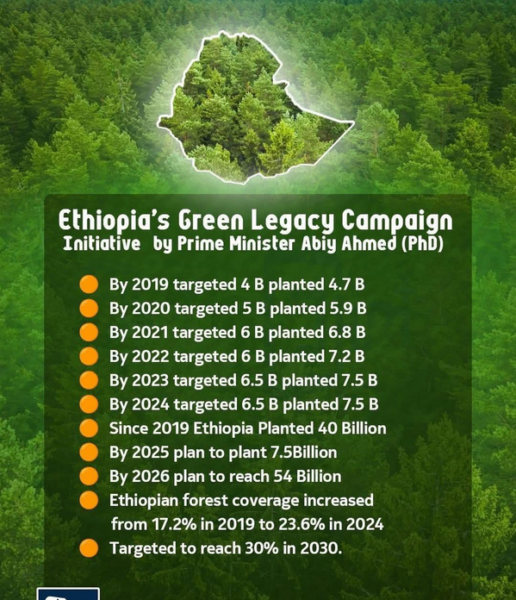
In July 2025, Ethiopia launched its seventh year of the Green Legacy Initiative (GLI), a national reforestation campaign aimed at addressing climate change, land degradation, and ecological imbalance. The campaign, introduced by Prime Minister Abiy Ahmed (PhD) in 2019, aims to plant 7.5 billion seedlings this year alone, which would bring the cumulative total to an ambitious 47.5 billion trees planted over seven consecutive rainy seasons. The initiative, which is estimated to cost approximately $3.5 billion for this season, has emerged as one of the world’s largest climate action projects led by a single country. However, behind this monumental effort lies a complex intersection of environmental urgency, political symbolism, and public skepticism.
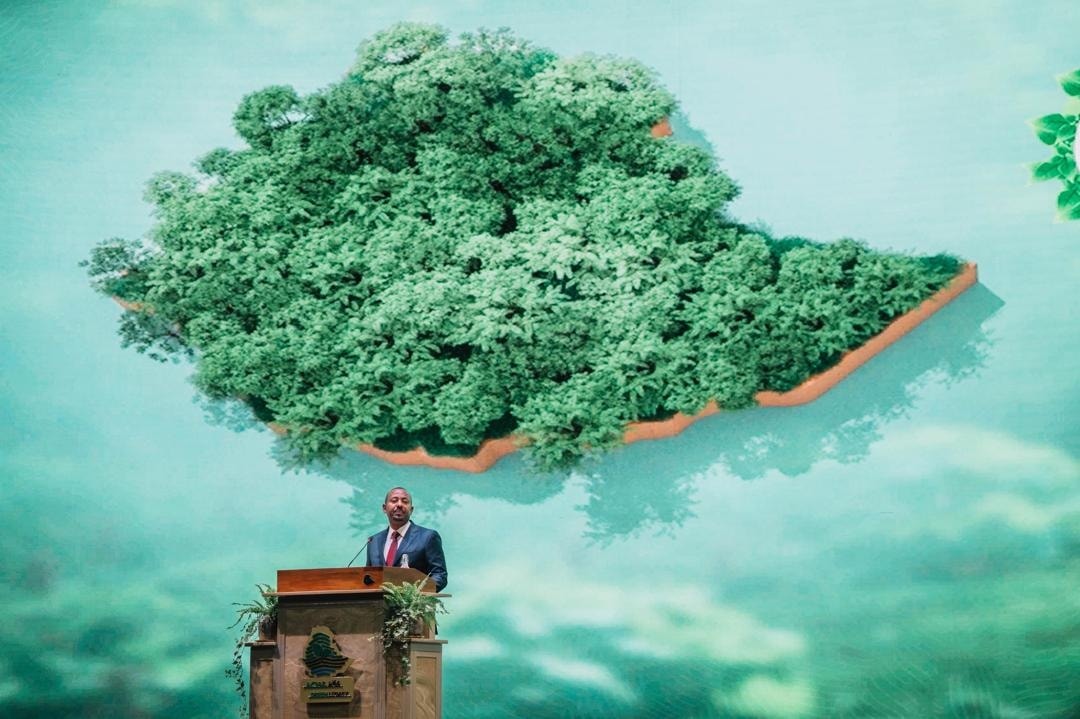
This year’s campaign, launched under the theme “Renewal through Planting,” was inaugurated in a high-profile ceremony attended by federal and regional leaders, youth representatives, environmental experts, and civil society actors. Prime Minister Abiy Ahmed declared, “I extend my heartfelt congratulations to all Ethiopians who believed in this vision—to those who took part, touched the soil, planted the seedlings, nurtured them, championed the cause, and supported the dream, both at home and abroad.” His message, both inspirational and strategic, sought to galvanize a divided nation around a shared environmental cause, at a time when Ethiopia continues to grapple with ethnic conflict, economic challenges, and political distrust.
Since its inception, the Green Legacy Initiative has focused on planting a mix of forest, agro-forest, and ornamental species, with a renewed emphasis this year on indigenous trees to promote biodiversity and long-term sustainability. The campaign also integrates principles of climate adaptation, watershed management, soil conservation, and urban beautification. Regional governments have been tasked with mobilizing communities, educational institutions, and youth groups to participate in mass planting events. Religious institutions, particularly the Ethiopian Orthodox Church, play a central role in mobilization efforts, providing land, blessings, and volunteers.
The Green Legacy’s reported achievements by year include:
- 2019: Target 4.0 Billion – Planted 4.7 Billion
- 2020: Target 5.0 Billion – Planted 5.9 Billion
- 2021: Target 6.0 Billion – Planted 6.8 Billion
- 2022: Target 6.0 Billion – Planted 7.2 Billion
- 2023: Target 6.5 Billion – Planted 7.5 Billion
- 2024: Target 6.5 Billion – Planted 7.5 Billion
If the 2025 target is achieved, the initiative would total 47.5 billion seedlings by the end of the year, with a further goal of reaching 54 billion trees by 2026.
While the numbers appear impressive, experts and watchdog organizations warn that the real measure of success lies not in the number of seedlings planted, but in how many survive and thrive. A growing number of environmental scientists, such as Dr. Yonas Getahun from Addis Ababa University, caution that without robust post-planting care, regular monitoring, and data transparency, the campaign risks being remembered more for its media spectacle than for its ecological impact. “Planting billions of trees is meaningless if they don’t survive or if monoculture plantations threaten biodiversity,” Dr. Yonas explains. “We need independent auditing systems, diversified planting, and community ownership for it to succeed.”
Environmental activists have similarly pointed out inconsistencies in reporting and the absence of third-party verification. Some regional administrators have been accused of inflating numbers to meet federal targets, and limited digital infrastructure has hindered satellite verification. Moreover, while the federal government touts the economic and ecological benefits of the campaign, some communities have raised concerns about displacement and loss of grazing land due to massive plantation schemes, especially in parts of Oromia, Amhara, and the Southern Nations.
Media efforts have played a significant role in shaping the public narrative. A new documentary titled “The Green Legacy: Ethiopia’s Answer to Climate Challenge” was released in time for this year’s campaign. Styled after Ethiopia’s rich oral storytelling tradition and influenced by the fables of Aesop and native folklore, the film portrays both the environmental devastation caused by climate change and the heroism of grassroots tree planters. It features stories from farmers, school children, scientists, and elders, many of whom recount personal losses due to droughts, floods, and soil erosion. One elderly woman from Wollo region in the Amhara zone says in the film, “I have seen the land die before my eyes. But now, with these trees, I see hope growing again.”
International bodies such as UNEP and the African Union have acknowledged Ethiopia’s pioneering role in climate action. Yet they have also called for a stronger institutional framework to ensure the long-term survival of these planted trees and to evaluate their environmental returns. The Green Legacy Initiative could serve as a model for other African nations, but only if it demonstrates tangible results beyond photo ops and political speeches.
Public opinion remains sharply divided. On Ethiopian social media, hashtags like #GreenLegacy and #TreeByTree are often accompanied by pictures of schoolchildren planting saplings or volunteers holding green flags. Yet parallel discussions highlight contradictions in government policy: the juxtaposition of massive reforestation campaigns with ongoing armed conflict in forest-rich regions. Critics point to deforestation due to war, illegal logging, and infrastructure projects, arguing that Ethiopia must reconcile its green aspirations with its peace and development agenda.
A Twitter user with the handle @LemlemT wrote, “Planting trees while burning down forests in Oromia and Amhara? Hypocrisy. Let’s talk about peace first. #DoubleStandards.” Another user, @DiasporaVoices, asked, “Why can’t we contribute more? Let’s fund satellite monitoring to make this credible and replicable elsewhere. #AfricaClimateLeadership.”
Participants in the Green Legacy campaign include a broad coalition of actors: federal ministries, regional states, schools and universities, faith-based organizations, civil society groups, the Ethiopian diaspora, and international NGOs. The Office of the Prime Minister remains the central coordinating body, supported by the Ministry of Agriculture and the Ministry of Innovation and Technology.
Moving forward, the success of Ethiopia’s Green Legacy Initiative will depend on more than just ambitious numbers. It must invest in nurturing the trees already planted, establish transparent reporting systems, integrate reforestation with local livelihoods, and ensure that planting is based on ecological science rather than political targets. As the climate crisis deepens, Ethiopia’s experience offers both inspiration and caution: a vision that has taken root, but one that must be carefully cultivated to truly blossom.