Nairobi, Kenya — 13 August 2026
by Ayele Addis Ambelu, AU Media fellow.
The global effort to stop biodiversity loss has reached a decisive moment: the world has the plans, the promises and an unprecedented level of political engagement, but it is still moving too slowly to deliver them. That is the stark message emerging from nearly three weeks of United Nations biodiversity negotiations in Nairobi, where governments acknowledged progress across the 23 targets of the Kunming-Montreal Global Biodiversity Framework while confronting a far more uncomfortable reality: unless implementation accelerates rapidly, the international community will not achieve the biodiversity targets it adopted for 2030. The Nairobi meetings have therefore done more than prepare the technical ground for the next UN biodiversity summit. They have exposed the central contradiction of the global biodiversity agenda—ambition is expanding faster than implementation.
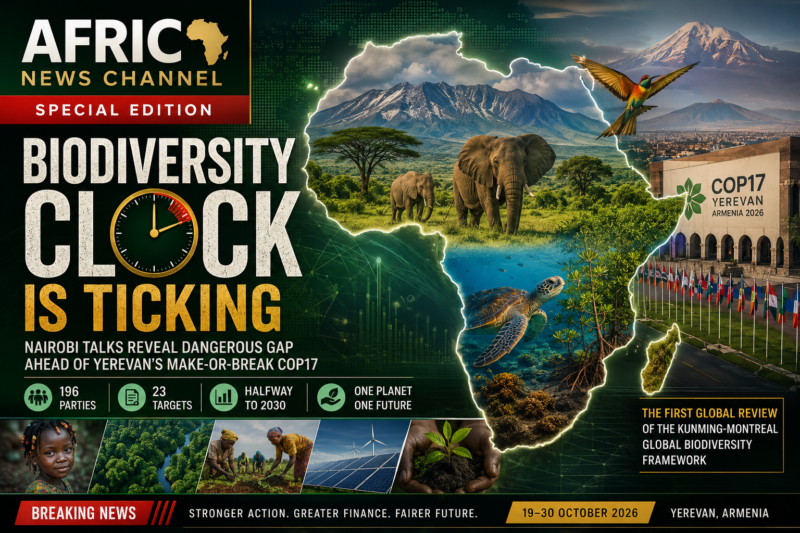
The stakes will rise sharply in October, when governments gather in Yerevan, Armenia, for the 2026 United Nations Biodiversity Conference, including the seventeenth meeting of the Conference of the Parties to the Convention on Biological Diversity (COP17). The conference, scheduled for 19–30 October 2026, will conduct the first global review of collective progress in implementing the Kunming-Montreal Global Biodiversity Framework. The outcome could become a defining test of whether the agreement adopted in 2022 is capable of transforming political commitments into measurable ecological and economic change. The evidence assembled for the global review suggests that the world has crossed the halfway point in time toward 2030, but not in implementation.
The revised global assessment is particularly revealing because it draws on a substantial body of national reporting and other sources of evidence. The report examined national reports from 129 Parties, representing 66 percent of all Parties, national biodiversity strategies and action plans from 89 Parties, and 3,693 national targets from 162 Parties. It also incorporated scientific information, traditional and other knowledge systems, submissions from biodiversity-related conventions and international organizations, and information from non-governmental and other actors. Yet the report itself cautions that it cannot definitively measure changes in biodiversity outcomes resulting from actions taken since 2022. What it provides instead is a crucial snapshot of implementation during the first two to three years of the Framework.
That distinction matters. The biodiversity crisis is not simply a question of whether governments have adopted policies; it is a question of whether those policies are being implemented at sufficient speed and scale to change the trajectory of ecosystems and species. The assessment’s overarching conclusion is therefore alarming: the Framework has generated unprecedented engagement, action, innovation and collaboration across all 23 targets, but collective implementation must accelerate rapidly if the 2030 targets and mission are to be achieved. The report warns that the slow rate of current progress is already creating a long-term risk to the 2050 goals and vision.
In other words, the problem is no longer a lack of global biodiversity targets. The problem is the distance between political declarations and practical delivery.
That gap is visible across the Framework. Governments and other actors are taking action on all 23 targets, but none presents a fully positive picture. Two fundamental weaknesses stand out. First, many national targets do not yet fully reflect the scope or ambition of the global targets. Second, even where commitments exist, implementation is advancing unevenly. The assessment finds particularly serious gaps in areas addressing the underlying drivers of biodiversity loss, while marine, coastal and inland-water ecosystems are consistently less well covered than terrestrial ecosystems. The means of implementation—including finance, capacity-building, technology transfer, scientific cooperation and knowledge-sharing—also remain major barriers.
This is the hidden story behind the biodiversity negotiations. The global community has become better at agreeing on what should happen than at financing, governing, monitoring and enforcing the actions required to make it happen.
The Nairobi negotiations nevertheless produced important areas of consensus. During the 27 July–1 August meeting of the Subsidiary Body on Scientific, Technical and Technological Advice, known as SBSTTA-28, Parties advanced recommendations concerning sustainable wildlife management, protected areas, synthetic biology, and marine and coastal biodiversity. Among the notable developments was work toward the first update of the Convention’s Programme of Work on Protected Areas since its adoption in 2004. The discussions also produced global voluntary guidance on sustainable wildlife management and a thematic action plan aimed at strengthening capacity-building, technology access and knowledge-sharing in synthetic biology.
The scientific and technical progress achieved in Nairobi is significant because biodiversity policy increasingly depends on translating complex ecological science into operational national systems. Protected areas, for example, cannot be judged solely by their existence on a map. They require effective governance, financing, community participation, monitoring and ecological connectivity. The global assessment illustrates precisely this problem. For Target 3, which concerns protected and conserved areas, national targets cover approximately half of the elements of the global target, while the overall score is only 0.38. Parties have expanded protected areas, including marine and coastal areas, but significant weaknesses remain in equitable governance, recognition of Indigenous and local territories, monitoring and financing.
That finding should force a rethink of what governments mean when they announce conservation progress. Expanding the number of protected areas can create a powerful headline, but conservation cannot succeed if protection exists primarily on paper. A protected landscape without adequate financing, local participation, enforcement and ecological management can become a statistical achievement rather than a biodiversity solution.
The second Nairobi meeting, the seventh meeting of the Subsidiary Body on Implementation, or SBI-7, held from 4–12 August, brought the political economy of biodiversity into sharper focus. Discussions examined finance, biodiversity mainstreaming, access to information, capacity-building, digital sequence information and other mechanisms needed to convert international commitments into implementation. Parties showed willingness to advance discussions on resource mobilization, the Convention’s financial mechanism, communications and education, and the mainstreaming of biodiversity into wider policy and development processes.
This is where the biodiversity debate becomes much larger than environmental policy. Biodiversity loss is deeply connected to agriculture, infrastructure, energy, trade, finance, consumption, urbanization and industrial development. The global assessment makes clear that environmental ministries cannot deliver the Framework alone. Biodiversity needs to move into finance ministries, agricultural policy, infrastructure planning, trade policy, urban development, public procurement and national investment decisions. The report notes that although countries are increasingly engaging ministries beyond the environmental sector, such engagement is often described only generally, without sufficient evidence of coordinated implementation across sectors.
The biggest warning, however, may be hidden in the financing figures.
Target 19, the central financing target of the Framework, received an overall score of just 0.13 in the global assessment. International and domestic biodiversity finance have generally increased, but the report concludes that financing remains below the level required and that the 2025 milestone of US$20 billion per year in international biodiversity-related financial resources was likely not met, although a definitive assessment requires complete data for 2024 and 2025. Private biodiversity finance remains particularly underdeveloped.
This is more than an accounting problem. Finance determines whether biodiversity commitments become protected landscapes, restored wetlands, functioning monitoring systems, community conservation programmes, sustainable agricultural practices and enforceable environmental rules or remain policy documents sitting on government shelves.
The financing gap is especially consequential for developing countries. The assessment records persistent shortages of financial and human resources, limited institutional and technical capacity, difficulties accessing technology and inadequate resources for Indigenous peoples and local communities, women, youth and subnational authorities. The report emphasizes that developing countries, particularly least developed countries and small island developing states, are more likely to identify gaps in the means of implementation.
This exposes one of the central political questions heading toward Yerevan: who pays for the global biodiversity transition?
The answer cannot simply be that developing countries must do more. Many of the ecosystems and genetic resources that underpin global ecological stability are concentrated in countries with far fewer financial resources than the economies and corporations that benefit from global production and consumption. If the international community expects countries with limited fiscal space to protect forests, wetlands, rangelands, freshwater systems and biodiversity-rich landscapes while simultaneously pursuing poverty reduction and economic development, then finance, technology and institutional support become fundamental components of implementation rather than optional assistance.
The same contradiction appears in Target 18, which addresses harmful incentives and subsidies. The target scored only 0.17. The global assessment says limited progress has been made in scaling up positive incentives and reforming harmful ones, and that the 2025 milestone was not achieved. While positive incentives have increased, harmful subsidies remain substantial.
This may be one of the hardest political battles ahead. Governments can establish protected areas and announce restoration projects, but biodiversity objectives become much harder to achieve when fiscal and economic systems continue rewarding activities that degrade ecosystems. The biodiversity crisis therefore cannot be solved exclusively through conservation budgets. It requires changing the economic incentives that determine what gets produced, consumed, financed and subsidized.
Target 16 offers another warning. It focuses on sustainable consumption and related measures, yet the assessment gives it an overall score of 0.38 and reports that 70 percent of national targets related to it show insufficient progress. Waste infrastructure, enforcement, extended producer responsibility and high material footprints remain major challenges.
The implication is uncomfortable but unavoidable: biodiversity loss is partly a consumption crisis. The destruction of ecosystems is not happening only inside forests or protected areas. It is embedded in supply chains, cities, agricultural systems, financial decisions, resource extraction and consumer behaviour. Unless economic systems begin to reflect the true ecological costs of production and consumption, biodiversity policy will continue fighting the consequences while leaving many of the underlying drivers untouched.
The report’s assessment of Target 15, concerning business impacts and dependencies on biodiversity, reinforces this concern. Despite growing corporate disclosure, policy implementation and national-target coverage remain limited. Nearly one-fifth of reporting Parties identified more than 5,000 companies disclosing biodiversity-related risks, but measures to actually deliver the target remain largely under development. Two-thirds of relevant national targets were assessed as showing no or insufficient progress.
This is why the Cali Fund has become such a politically sensitive issue. Discussions in Nairobi underscored its potential role in encouraging the private sector to give back to nature, while Parties stressed that its governance and operations must remain aligned with the Convention’s priorities. The debate illustrates a broader transformation in global biodiversity politics: conservation is increasingly being linked to the financial architecture of the private sector, corporate responsibility, genetic resources and benefit-sharing.
But the question is whether financial mechanisms can move quickly enough.
The biodiversity assessment also reveals a governance problem. The Framework cannot be implemented effectively by governments acting alone. Indigenous peoples and local communities, women, youth, cities, subnational governments, civil society, researchers, businesses and financial institutions are already contributing to biodiversity action. More than 100 non-governmental actors had submitted commitments through the Convention’s dedicated portal by the time the report was prepared. Yet their contributions, financial resources, capacity needs and progress are not consistently tracked or integrated into national implementation systems.
This matters particularly for Africa, where biodiversity governance often intersects directly with the livelihoods and cultural practices of rural and Indigenous communities. Conservation that excludes the people living alongside ecosystems risks producing conflict, weak enforcement and unsustainable outcomes. Conversely, community participation can transform conservation from a government project into a locally owned development strategy.
The Nairobi assessment gives data and knowledge a similar strategic importance. Parties have invested in monitoring and knowledge-management systems, but significant gaps remain in data availability, data sharing, indicators, infrastructure and technical capacity. No Party reported on every headline indicator, and reported data frequently lack comparable time series or adequate disaggregation by ecosystem, sex, age and other relevant characteristics.
This means the world is confronting two crises at once: a biodiversity implementation crisis and an information crisis. Governments cannot effectively manage what they cannot measure, and they cannot convincingly demonstrate progress when national monitoring systems are fragmented or underfunded.
The consequences are particularly important for African countries. Africa contains globally significant biodiversity and ecosystems that provide food, water, livelihoods, climate regulation and cultural value to hundreds of millions of people. Yet many African countries face the exact constraints identified in the global assessment: limited domestic fiscal space, shortages of technical capacity, weak monitoring infrastructure and difficulties accessing international finance and technology. The global biodiversity agenda therefore cannot succeed in Africa without addressing implementation capacity as seriously as conservation itself.
For Ethiopia, this global debate carries direct implications. The country’s biodiversity is closely connected to its highland ecosystems, forests, wetlands, agricultural landscapes, rangelands, freshwater systems and culturally important natural areas. Yet the assessment’s broader findings suggest that biodiversity policy cannot remain isolated within conservation institutions. Spatial planning, agriculture, water management, infrastructure development, urban expansion, tourism, finance and local governance all influence biodiversity outcomes. The global Framework’s emphasis on mainstreaming and whole-of-government approaches therefore provides a powerful lens through which Ethiopia and other African countries can evaluate their own national biodiversity strategies and implementation systems.
The challenge is particularly visible in Target 1, where the global assessment finds that progress has been made in biodiversity-inclusive spatial planning, but major gaps remain in integrating biodiversity into wider planning processes and ensuring participation. The overall score is 0.25. The assessment emphasizes that implementation remains far below what is needed for full coverage and effective participatory planning.
This is crucial for rapidly urbanizing and economically transforming African countries. Roads, industrial parks, housing, agriculture, mining, hydropower and other infrastructure can generate economic opportunity, but without biodiversity-inclusive spatial planning they can also create irreversible ecological costs. The choice facing policymakers is therefore not simply conservation versus development. It is whether development will be planned in a way that recognizes ecological limits and the long-term economic value of functioning ecosystems.
There are also signs of progress that should not be ignored. Target 8, addressing climate resilience and adaptation, received one of the strongest overall scores at 0.75. Actions on climate resilience and adaptation are progressing, and half of the indicators submitted show positive trends. Yet even here, Parties acknowledge that implementation is not occurring at a sufficient rate for many national targets, and ecosystem restoration and nature-based solutions are not yet being deployed at the scale required.
Target 21, concerning biodiversity data, information and knowledge, also shows relatively stronger progress, with an overall score of 0.63. Many Parties are improving access to biodiversity information, although major gaps remain in data availability, traditional knowledge safeguards and monitoring capacity.
These examples matter because the Nairobi outcome is not a story of failure. It is a story of uneven progress. Some pieces of the global biodiversity architecture are beginning to work, while others remain dangerously weak. The political challenge is therefore to accelerate the weakest links without undermining the areas where progress is already being made.
That is precisely why Yerevan could become a turning point.
At COP17, governments will not merely discuss another set of biodiversity aspirations. They will undertake the first global review of collective implementation of the Kunming-Montreal Global Biodiversity Framework. The Nairobi meetings have provided the technical and implementation recommendations that will feed into that review. The political question will be whether governments respond to the evidence with stronger action, stronger financing and stronger accountability.
The Convention’s Executive Secretary, Astrid Schomaker, captured the mood after the Nairobi meetings, saying that Parties could leave Nairobi with satisfaction over what had been accomplished but warning that the task awaiting them in Yerevan would require “all the stamina and determination” they could summon. She stressed that implementation is not yet occurring at the pace and scale needed to achieve the Framework and identified biodiversity finance, harmful subsidies, business impacts and dependencies, and sustainable consumption among the largest gaps.
That warning should not be treated as diplomatic language. It is the central political message of Nairobi.
The world has already spent years negotiating biodiversity targets. It now has only a few years left to demonstrate that those targets can change reality.
The first half of the decade has produced national plans, international commitments, scientific assessments and growing public awareness. But the global assessment shows that fewer than half of national targets aligned with the global framework are currently considered on track in the relevant assessments, while the indicators do not yet consistently demonstrate progress at the rate required to meet the global targets. The report therefore calls attention to a dangerous mismatch between political ambition and implementation capacity.
The next phase must therefore move beyond counting commitments. Governments will need to demonstrate where money is going, which harmful incentives are being removed, which ecosystems are being restored, which species are recovering, how local communities are participating, which businesses are reducing biodiversity impacts, and whether national policies are changing the economic drivers of ecological destruction.
The coming months will also test whether the biodiversity agenda can escape the traditional boundaries of environmental diplomacy. The six central messages emerging from the global assessment are strikingly broad: political will and ambition, action and implementation, means of implementation, whole-of-government approaches, whole-of-society participation, and data and knowledge. Together they demonstrate that biodiversity is no longer simply a conservation agenda. It is an issue of governance, economics, finance, technology, rights, development and accountability.
The choice confronting governments in Yerevan is therefore becoming clearer. They can celebrate the unprecedented political momentum generated since 2022 and continue with incremental implementation, or they can treat the global review as a warning signal and substantially accelerate action.
The difference could determine whether the 2030 biodiversity targets become a landmark achievement or another entry in the long history of international environmental promises that fell short of their ambitions.
Nairobi has shown that the world knows where the gaps are. It knows that finance is insufficient. It knows that harmful subsidies remain. It knows that business impacts are inadequately addressed. It knows that implementation is uneven. It knows that monitoring systems remain incomplete. It knows that communities and other non-state actors are not yet fully integrated into implementation. And it knows that biodiversity must be mainstreamed across government rather than left to environmental institutions alone.
What remains uncertain is whether political systems can move fast enough.
That is the real countdown to Yerevan.
The biodiversity crisis will not wait for another negotiating cycle. Forests will not wait for another declaration. Species facing extinction will not wait for another funding mechanism. Communities dependent on healthy ecosystems will not wait for another global review.
The Nairobi meetings have cleared the road to Yerevan. The evidence is now on the table.
The question is no longer whether the world has a biodiversity plan. It is whether the world has the political courage, financial resources and institutional capacity to execute it before the clock runs out.