By Ayele Addis Ambelu
The briefing’s legal review examined concluding observations relating to African countries issued by the two children’s rights monitoring bodies over the period from 1990 to 2026. Its findings suggest that recognition of environmental harm has evolved, but unevenly.
Earlier reviews frequently discussed unsafe water, poor sanitation, malnutrition, pollution and preventable disease as aspects of poverty or public health. Over time, environmental issues increasingly appeared in discussions of children’s health, survival, development and protection.
However, the authors argue that this evolution has not produced a consistent framework connecting environmental degradation, structural inequality and antimicrobial resistance.
This distinction matters. Recognising that pollution harms children is important. Recognising that environmental harm can interact with healthcare failures, antimicrobial use and resistance is a further step. Establishing clear obligations, assigning institutional responsibility and monitoring compliance are steps beyond both.
The briefing identifies a continuing weakness in the African Committee of Experts’ engagement with environmental human rights. Although the committee has addressed some environmental and climate-related concerns, the paper finds that its jurisprudence has not systematically integrated these issues into a comprehensive rights-based approach to AMR.
The UN Committee on the Rights of the Child has developed environmental guidance, including General Comment No. 26 on children’s rights and the environment, with a special focus on climate change. Nevertheless, the briefing argues that environmental concerns remain fragmented and that the specific implications of AMR require greater attention.
The consequences extend beyond legal terminology. If continental institutions do not explicitly connect these risks, they may fail to provide governments with sufficiently coordinated guidance. National authorities may continue to develop separate health, environmental and child-protection policies without adequately addressing their combined effects.
The result is a governance gap: the problem crosses institutional boundaries, while responsibility can remain divided between them.
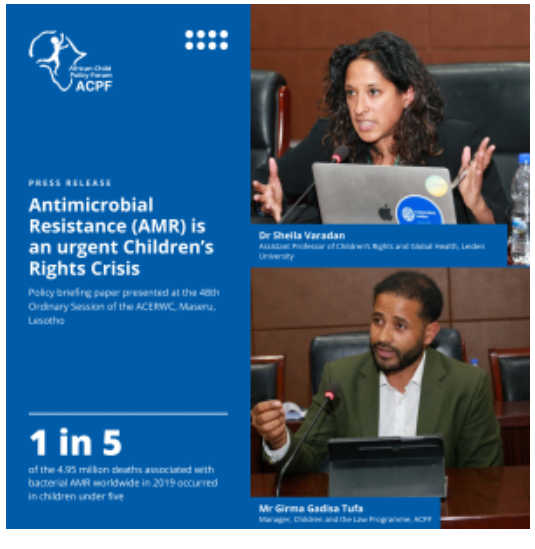
Dr Sheila Varadan: ‘Not only a public health problem’
Dr Sheila Varadan, Assistant Professor of Children’s Rights and Global Health at Leiden University, emphasised the relationship between drug resistance and the wider inequalities affecting African children.
“These numbers point to the urgency of addressing AMR in Africa, where the burden of drug-resistant infections intersects with poverty, malnutrition, inadequate access to clean water and sanitation, environmental pollution and gaps in healthcare provision,” Varadan said.
She added: “Antimicrobial resistance is not only a public health problem but also a children’s environmental rights crisis.”
Her remarks challenge a response centred exclusively on the medical management of resistant infections. They direct attention towards the social and environmental conditions that make children vulnerable before they ever reach a hospital.
This has major implications for public spending and development priorities. Investments in effective medicines and diagnostic capacity remain essential, but they must be accompanied by preventive measures that reduce infection, improve sanitation and ensure safe living environments.
The challenge is particularly significant for children in underserved rural communities, informal settlements and displacement settings, where access to healthcare and basic services can be limited. The briefing identifies poverty, malnutrition, inadequate housing and weak water and sanitation systems as structural factors that can intensify vulnerability.
A child-centred response must therefore consider not only the immediate needs of a patient but also the circumstances of the household and community.
It must ask whether safe water is consistently available, whether health facilities can diagnose infections accurately, whether medicines are prescribed appropriately, whether waste is safely managed and whether environmental risks are monitored and controlled.
These are not peripheral questions. They are part of the conditions required to protect children from preventable illness and to reduce the unnecessary use of antimicrobial medicines.
Girma Gadisa Tufa calls for continental coordination
The African Child Policy Forum has called for closer collaboration between regional children’s rights institutions and public-health agencies.
Sharing recommendations from the briefing paper, Girma Gadisa Tufa, Manager of the Children and the Law Programme at ACPF, said:
“It is imperative for the African Committee of Experts on the Rights and Welfare of the Child and the UN Committee on the Rights of the Child to work closely with the Africa Centers for Disease Control and Prevention and World Health Organization to ensure that continental frameworks and initiatives recognize antimicrobial resistance as a child health and children’s rights priority.”
The proposal points to a practical problem: AMR cannot be effectively addressed by a single institution operating in isolation.
Public-health authorities have expertise in surveillance, infection prevention, diagnostics and antimicrobial stewardship. Environmental agencies oversee pollution and waste management. Children’s rights institutions can examine state obligations, inequalities and accountability. National governments control many of the laws, budgets and services that determine whether these interventions reach children.
Without coordination, the same problem can be addressed through disconnected initiatives, leaving gaps between policy commitments and implementation.
Continental cooperation could help align children’s rights monitoring with AMR surveillance, strengthen the inclusion of children in national action plans, improve environmental risk assessments and establish clearer mechanisms for tracking progress.
However, coordination must result in more than meetings and declarations. It should produce measurable commitments, adequate funding, transparent reporting and clear responsibility for implementation.
The question is whether governments and continental institutions will turn recognition of the crisis into action that can be assessed against concrete outcomes.
Who should be held responsible?
A central contribution of the briefing is its insistence that AMR must be considered in relation to both state obligations and the conduct of non-state actors.
Governments have responsibilities to establish and enforce appropriate standards, protect children from foreseeable harm, maintain essential public services and ensure access to healthcare. Businesses can also contribute to environmental risks through activities that generate pollution or improperly managed waste, making effective regulation and oversight important.
The briefing identifies mining and extractive activities, industrial pollution, pharmaceutical waste and certain agricultural practices among the environmental concerns requiring attention.
But accountability requires evidence. Not every industrial activity or environmental exposure causes AMR, and not every resistant infection can be attributed to a particular company, facility or government decision. The relevant risks must be assessed using appropriate scientific evidence, environmental monitoring and public-health surveillance.
A credible accountability framework should establish which hazards exist, who is responsible for managing them, whether applicable rules are being enforced and what remedies are available when children suffer harm.
It should also examine whether environmental and health assessments adequately consider children, particularly those living in disadvantaged communities.
Businesses should be subject to appropriate environmental and health requirements, monitoring and enforcement. Where harmful practices are established, authorities should ensure that the responsible parties meet their legal obligations and that affected communities can access appropriate remedies.
Governments, meanwhile, should not treat private-sector compliance as a substitute for their own duties. Effective regulation, public oversight and enforcement remain essential.
The rights-based approach proposed in the briefing thus creates a broader standard for judging progress. Success should not be measured only by whether a country has an AMR policy, but also by whether children are better protected from infection, environmental exposure and unequal access to effective treatment.
The way forward: Seven priorities for protecting Africa’s children
The briefing’s recommendations point towards a more integrated approach to AMR under the African Charter on the Rights and Welfare of the Child. Translating that approach into practice requires action at continental, national and community levels.
1. Make AMR an explicit children’s rights priority.
The African Committee of Experts and the UN Committee on the Rights of the Child should give greater attention to AMR in their guidance, country reviews and recommendations. This would help governments understand how antimicrobial resistance intersects with children’s rights to health, life, survival, development and a healthy environment.
2. Integrate children’s rights into national AMR strategies.
Governments should ensure that national action plans consider the particular vulnerabilities of newborns, young children and children living in poverty, conflict-affected areas and underserved communities. Targets should be accompanied by funding, assigned responsibilities and transparent progress reports.
3. Strengthen access to effective treatment and diagnostics.
Children need timely diagnosis, appropriate antimicrobial medicines and quality healthcare. Governments should strengthen diagnostic capacity, infection prevention and clinical guidance while promoting responsible antimicrobial use. Stewardship must protect medicines from unnecessary use without creating barriers to treatment for children who genuinely need them.
4. Invest in clean water, sanitation, nutrition and prevention.
Safe drinking water, adequate sanitation, hygiene, vaccination and good nutrition can reduce the burden of preventable infections. These investments should be prioritised in communities where service gaps and environmental risks overlap.
5. Regulate environmental pollution and antimicrobial waste.
Authorities should strengthen monitoring and enforcement concerning relevant industrial, pharmaceutical, agricultural and healthcare waste. Environmental assessments should consider risks to children, while remediation and other corrective measures should be pursued where contamination and harm are established.
6. Strengthen continental coordination and public accountability.
ACERWC, WHO, Africa CDC and relevant national institutions should work towards stronger links between AMR surveillance, environmental monitoring and children’s rights reporting. Governments should publish information on implementation, identify gaps and establish clear mechanisms for accountability.
7. Ensure children’s participation and equitable protection.
Children and their communities should have meaningful opportunities to contribute to policies affecting their health and environment. Data should be disaggregated where possible to identify unequal risks and assess whether interventions reach the children most in need of protection.
These priorities are mutually reinforcing. Effective medicines cannot replace safe water, just as sanitation cannot replace timely diagnosis. Environmental regulation cannot compensate for inaccessible healthcare, and policy commitments cannot protect children without implementation and accountability.
The goal must be a coordinated system that prevents infection where possible, treats illness effectively and reduces the environmental and social conditions that contribute to resistance.
The wider cost: A threat to development, food security and future generations
The implications of AMR reach beyond individual patients and hospital wards.
The briefing cites a World Bank projection that economic losses could reach 3.8 per cent of global gross domestic product by 2050 if no action is taken. This is a projection, not a prediction that a particular level of loss is inevitable, but it illustrates the potential scale of the economic consequences.
Resistant infections can increase healthcare costs, complicate treatment and place additional pressure on already constrained public services. Families may face greater expenses and lost income when illness lasts longer or treatment becomes more complex.
The problem also intersects with food systems. Antimicrobial resistance affects human, animal and plant health, although the relevant organisms, medicines and transmission pathways differ. Poorly managed antimicrobial use and environmental contamination can create risks that cross sectors, making cooperation between human health, animal health, agriculture and environmental authorities important.
For children, these pressures can reinforce existing inequalities. Household income may be diverted from education and nutrition towards medical expenses. Communities with weak infrastructure may struggle to prevent infection, while governments face competing demands on limited budgets.
The briefing’s broader argument is that AMR cannot be separated from sustainable development. Health, nutrition, clean water, environmental protection and poverty reduction are interconnected foundations for children’s survival and development.
Ignoring those relationships risks allowing preventable infections, environmental harm and unequal access to care to reinforce one another across generations.
Conclusion: Africa must act before the crisis becomes even harder to control
Antimicrobial resistance presents African governments with a challenge that cannot be solved by medical technology alone. It demands effective healthcare, responsible use of medicines, environmental protection, social investment and institutions capable of enforcing their commitments.
The ACPF and Leiden University Children’s Rights Legal Clinic briefing makes a compelling case for placing children at the centre of that response. Its analysis highlights a gap between the growing recognition of environmental threats to children and the limited attention given to AMR as a distinct children’s rights concern.
Closing that gap requires more than acknowledging the problem. Governments must strengthen prevention, improve access to effective treatment, address environmental risks and demonstrate that their policies protect the children facing the greatest disadvantages.
The African Committee of Experts and the UN Committee on the Rights of the Child have an important role in advancing a more integrated rights-based framework. WHO, Africa CDC and national institutions must help translate that framework into effective public-health action. Environmental regulators, healthcare providers and businesses must meet their respective responsibilities, with appropriate oversight and accountability.
The ultimate test is not whether AMR appears in another declaration or strategy. It is whether children experience fewer preventable infections, gain timely access to effective treatment and live in safer environments.
The figures cited in the briefing make the stakes unmistakable. The legal analysis makes the accountability challenge harder to ignore.
Africa’s response to antimicrobial resistance must protect both the effectiveness of essential medicines and the rights of the children who depend on them. A future in which infections become harder to treat cannot be separated from the present-day responsibility to provide clean water, safe environments, quality healthcare and equal protection.
The question now is whether African institutions and governments will act on that responsibility with the urgency, coordination and accountability the crisis demands.