





By Zelalem Birhanie, (abechu2015@gmail.com)
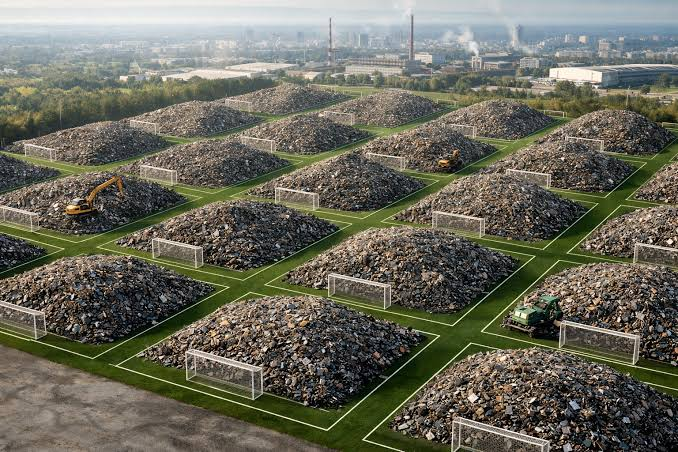
Brussels — Europe’s mounting waste problem could become one of its biggest strategic assets. A new EU-funded assessment has found that discarded electronics, batteries, vehicles, buildings, industrial residues and wind turbines contain enough critical raw materials to potentially supply more than half of Europe’s demand for these materials by 2050 if recycling and recovery systems are significantly strengthened.
The findings, produced by the FutuRaM (Future Availability of Secondary Raw Materials) project, represent one of the most comprehensive attempts yet to map Europe’s so-called “urban mine”: the stock of valuable metals and minerals already embedded in products, infrastructure and waste across the continent.
The study examined 42 critical raw materials across seven major waste streams in the EU27 plus the United Kingdom, Switzerland, Iceland and Norway. These materials are increasingly indispensable to batteries, electric vehicles, renewable energy technologies, digital equipment, defence and advanced manufacturing.
Its central message is striking: Europe does not have to rely entirely on new mining to strengthen its supply of critical materials. A substantial part of the resources it needs may already be sitting in its cities, factories, landfills, dismantling yards and waste-processing facilities.
A resource hiding in plain sight
The FutuRaM analysis estimates that 5.2 million tonnes of critical raw materials were contained in products placed on the European market in 2022. By comparison, 2.1 million tonnes were contained in waste, while only about 1.4 million tonnes were recovered.
That gap illustrates both the scale of Europe’s material consumption and the enormous amount of value that remains outside effective recovery systems.
By 2050, the quantity of critical raw materials entering products each year could rise to 8.4–12.2 million tonnes, while the amount embedded in waste could reach 5.2–6.4 million tonnes annually.
With stronger recovery systems, Europe could potentially recover 4.1–5.7 million tonnes of critical raw materials every year by 2050.
Depending on how quickly Europe improves its collection, treatment and recycling systems, secondary materials could substitute for between 33% and 56% of primary raw-material demand. The highest figure assumes a more fully developed circular economy and, critically, that recovered materials are of sufficient quality to replace newly extracted resources.
That would not eliminate Europe’s dependence on imports, but it could substantially reduce its exposure to supply disruptions and geopolitical pressure.
From Chinese imports to European recovery
The strategic significance is particularly important because Europe remains heavily dependent on foreign suppliers for many critical materials.
China is a major source of rare earth elements, lithium and cobalt; the Democratic Republic of Congo dominates cobalt mining; Australia is a major lithium supplier; South Africa is important for platinum-group metals; and Turkey is a leading source of boron.
That dependence has become increasingly uncomfortable as competition for critical minerals intensifies.
The energy transition itself is likely to increase the pressure. Batteries require lithium, cobalt, nickel and other materials, while wind turbines and electric motors depend on rare earth elements used in permanent magnets.
The paradox is that the technologies designed to reduce fossil-fuel dependence could create new dependencies on mineral supply chains.
Recycling offers Europe a way to partially break that cycle.
Batteries could become Europe’s biggest urban mine
Some of the most dramatic growth is expected in battery-related materials.
Lithium recovery, currently below 1,000 tonnes a year, could reach 30,000–52,000 tonnes annually by 2050. Cobalt recovery could rise from around 1,000 tonnes today to 25,000–40,000 tonnes, while nickel recovery could increase from approximately 4,000 tonnes to 103,000–171,000 tonnes per year.
The underlying driver is straightforward: millions of electric vehicles and energy-storage systems placed on the market today will eventually become tomorrow’s waste.
This creates a strategic opportunity. The batteries that Europe imports or manufactures today could become a domestic source of raw materials decades later.
But that opportunity is not automatic. Batteries must first be collected, transported, dismantled and processed through systems capable of recovering their constituent materials economically and at high quality.
Europe is still building that capacity.
The rare-earth problem
The situation is even more challenging for rare earth elements.
Many rare earths currently have extremely low recovery rates. Across the EU27+4 in 2022, 22 critical raw materials generated recovery of less than one tonne per year, with many rare earth elements falling into this category.
Yet these materials are becoming increasingly important for electric motors, wind turbines and electronic equipment.
The report suggests that the situation could change dramatically if Europe makes the right investments and policy choices now. Within the next 24 years, 17 critical raw materials—including cobalt, lithium and rare earth elements such as dysprosium and neodymium—could potentially achieve recovery rates above 80%.
The challenge is therefore not simply whether these materials exist in waste. They clearly do.
The question is whether Europe can build an economically viable system capable of retrieving them.
Not all waste is being recycled
The study exposes a major weakness in Europe’s circular economy ambitions: collection is often the missing link.
Europe is considered a global leader in managing waste electrical and electronic equipment, yet nearly half of its electronic waste is handled outside compliant recycling systems. Losses also occur within compliant systems during collection and processing.
WEEE alone accounted for an estimated 500,000 tonnes of critical raw-material losses in 2022, according to the study.
End-of-life vehicles present another major leakage point. Vehicles can be exported as used cars rather than being formally dismantled and recycled in Europe, while some are lost to informal or poorly tracked treatment channels. Together with other losses, this contributed to more than 200,000 tonnes of critical raw materials being lost from end-of-life vehicles in 2022.
Batteries face similar problems. Some are improperly discarded or exported, while Europe’s expanding battery-recycling industry still does not capture the full value of materials contained in spent lithium-ion batteries.
Even “black mass”—the partially processed material








