





By Ayele Addis Ambelu (ANC)
Addis Ababa, Ethiopia, 01 May 2026 A powerful shift is underway across the continent, with the African Union stepping decisively into the driver’s seat of Africa’s financial future, as high-level UN officials, economists, and private sector leaders converge with a stark consensus: Africa must urgently mobilize its own resources or risk falling behind on its development ambitions.
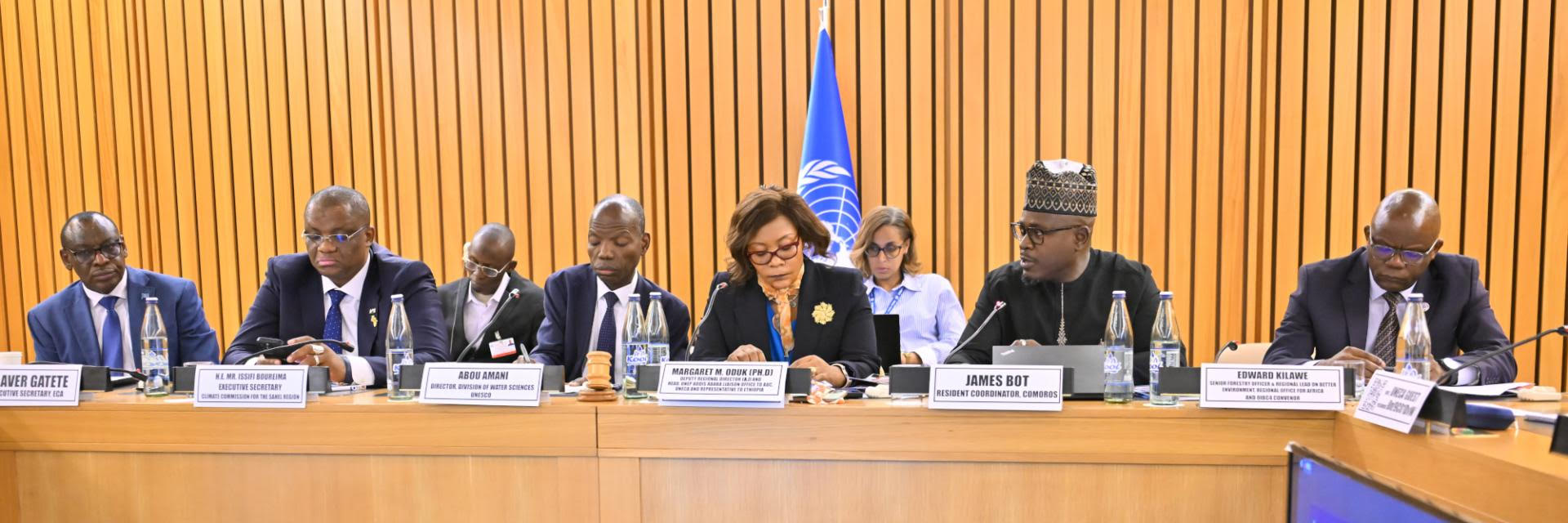
At the center of this momentum, discussions held ahead of the Africa Regional Forum on Sustainable Development 2026 positioned the African Union’s Domestic Resource Mobilization Strategy not just as policy but as a survival blueprint for Agenda 2063 and the Sustainable Development Goals. The meeting, convened by the United Nations Economic Commission for Africa alongside the African Union Commission and UN coordination bodies, delivered what insiders describe as one of the clearest acknowledgments yet that external financing can no longer carry Africa’s development burden.
Officials speaking at the closed-door session did not mince words. Representing the ECA, Said Adejumobi stressed that Africa’s previous development cycle faltered for a fundamental reason: “the continent’s earlier ten-year plan fell short due to insufficient funding,” underscoring the structural financing gap that continues to constrain growth. This aligns with broader research frequently cited by ECA economists, showing that illicit financial flows alone cost Africa tens of billions of dollars annually, resources that could otherwise fund infrastructure, health, and industrialization.
From the African Union Commission, Botho Kebabonye Bayendi reinforced the political urgency behind the strategy, stating that “the AU and UN share a framework for integrated financing, focusing on domestic resource mobilization for Africa’s vision,” while urging stronger coordination to “turn commitments into results.” Her remarks reflect a growing policy consensus that Africa’s challenge is no longer a lack of frameworks, but a gap in execution, institutional alignment, and financial sovereignty.
The analysis emerging from the meeting highlights a deeper structural reality: African economies remain constrained by low tax collection efficiency, fragmented financial systems, and governance bottlenecks. Experts note that tax-to-GDP ratios across many African countries lag significantly behind global benchmarks, limiting governments’ ability to invest in long-term development. At the same time, rising debt vulnerabilities have narrowed fiscal space, making the AU’s push for domestic resource mobilization not just strategic but urgent.
Parallel discussions at the Private Sector Forum of ARFSD12 added another layer to the debate, reinforcing that even a fully optimized public sector would not be enough. Speaking on behalf of ECA leadership, Ngone Diop captured the scale of the challenge bluntly: “Africa’s development ambitions are clear, but the scale of financing, innovation and delivery required cannot be met by public resources alone.” Her statement reflects a widely supported economic view that private capital will be indispensable to closing Africa’s multi-billion-dollar annual SDG financing gap.
Convened with partners including the United Nations Global Compact and the United Nations Development Programme, the forum emphasized that the private sector is no longer a peripheral actor but a central pillar of Africa’s transformation. Diop further stressed this shift, noting that “the private sector is not only a source of capital; it is a driver of job creation, technology development, industrial transformation, and value chain strengthening.” Analysts say this framing signals a deliberate move away from traditional aid-driven models toward investment-led growth.
Emerging financial instruments are beginning to reflect this transition. Discussions highlighted debt-for-climate and debt-for-development swaps already being piloted in countries such as Senegal, The Gambia, and Ghana mechanisms that economists view as innovative tools to simultaneously reduce debt pressure and unlock funding for climate and social investments. Alongside blended finance and risk-sharing instruments, these approaches are increasingly seen by development finance experts as critical to expanding fiscal space without exacerbating debt risks.
Still, the tone of the was not purely optimistic. Participants acknowledged persistent barriers, including weak institutional coordination, political economy constraints, and fragmented development ecosystems that often dilute impact. This diagnosis aligns with broader academic and policy research on African development, which consistently identifies governance and institutional capacity as decisive factors in translating financial resources into tangible outcomes.
In response, stakeholders are pushing for urgency and accountability. A proposed 12-month Leadership Compact aims to fast-track implementation, reflecting what insiders describe as growing impatience with slow progress. The shift is significant: Africa is moving from agenda-setting to delivery pressure, with measurable outcomes now expected within tight timelines.
Taken together, the discussions in Addis Ababa signal more than routine policy dialogue, they mark a turning point in Africa’s development narrative, with the African Union asserting financial sovereignty as the foundation of its future. Backed by UN institutions, informed by economic research, and increasingly supported by private capital, the continent is redefining how its ambitions will be financed.
The message emerging from policymakers, experts, and development leaders is clear and uncompromising: Africa’s transformation will not be funded from the outside, it will be built from within, led by the African Union and driven by Africa’s own resources.
AfricaRising #Agenda2063 #AfricanUnion #SDGs #ARFSD12 #DomesticResourceMobilization #AfricaDevelopment #UNAfrica #EconomicTransformation #SustainableDevelopment #FinanceForDevelopment #PrivateSectorAfrica








