





Awot Haileslassie – Addis Ababa, Ethiopia| 12 February 2026
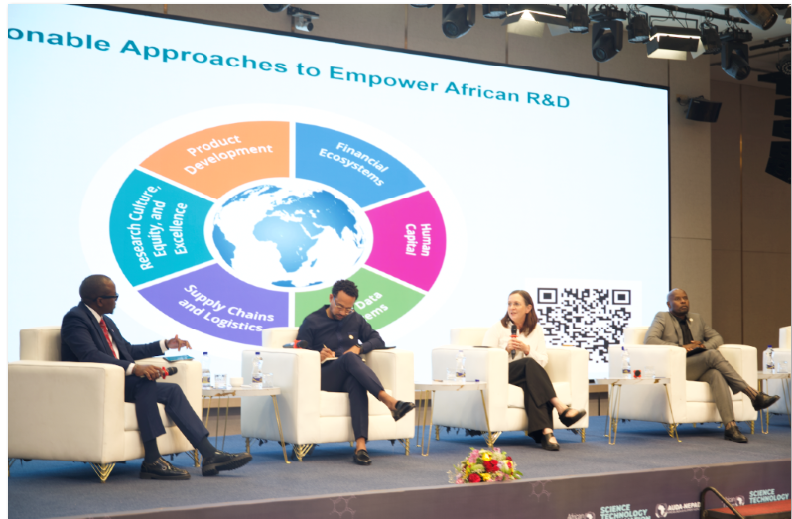
AUDA-NEPAD held a high-level Barazaon Science, Technology, and Innovation (STI) at Ethiopian Skylight Hotel, under the theme of “Translating Evidence into Action: Actionable Approaches to Empower African Research & Development.”
The CalestousJuma Science Leadership Fellows (CJ Fellows) brought together a high-level Baraza in Addis Ababa aimed at addressing the challenges in Africa’s Research and Development (R&D), which is a rising stock of scientifically skilled individuals and scientific output, alongside an inability to match these with an appropriate policy and funding base to support knowledge translation in to relevant actionable solutions, and setting priority areas.
The CJ Science Leadership fellows advocate for reforms that aim to diversify research funding, create favorable policy landscapes, and scale up innovation processes to fully utilize and realize Africa’s R&D economy. Thus, CJ Fellows, participants, African science leaders, policymakers, and development partners voiced for immediate reforms needed to reinforce research financing, enhance policy environments, and speed up innovation practices to enhance theeconomic contribution of R&D in Africa.
From Research Output to Economic Impact
Opening the session, Dr. Moses Alobo, Head of Programs for Science Innovation and Entrepreneurship (SITE) at the SFA Foundation, stressed that Africa’s challenge is not a shortage of ideas or talent, but weak policy and financing ecosystems that limit the output and economic contribution of R&D.
He emphasized, “Africa does not lack ideas or talent; what we often lack are policy environments that enable research to thrive and translate into impact,” that science should be treated as economic infrastructure rather than a peripheral academic activity. Dr.Moses A. added the commitment of AUDA-NEPAD’s leadership in strengthening national and regional frameworks that enable research, innovation, and industry growth to advance STI ambitions and accelerate progress towards Agenda 2063.
Structural Bottlenecks Holding Back Innovation
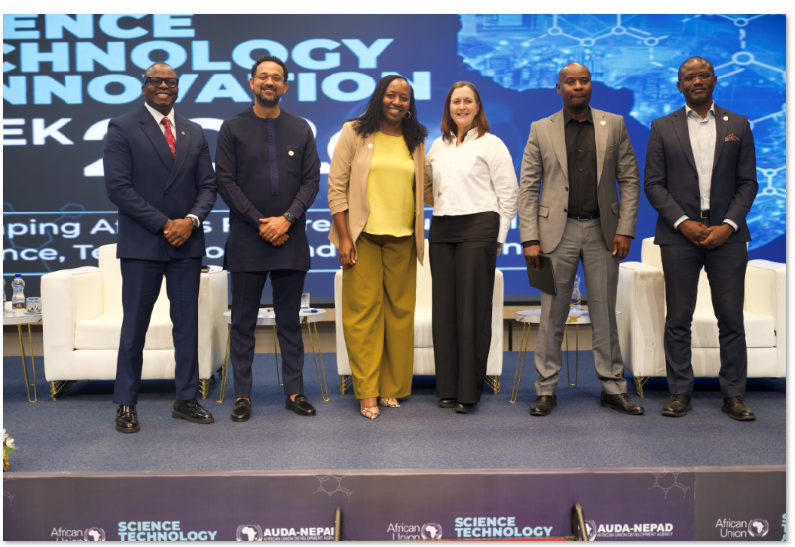
The panel, moderated by George Ndirangu of the Africa Leadership and Dialogue Institute, featured Prof. Nicki Tiffin of the South African National Bioinformatics Institute; Dr. Yaw Bediako, CEO of Yemaachi Biotech and Dean of Research and Innovation at Ashesi University; and Dr. Vincent Okungu, Senior Researcher and Health Economist at the University of Nairobi. Panelists outlined tenacious structural constraints undermining Africa’s R&D advancement, as most of the African states invest 0.3-0.4% of their GDP in R&D, which is very far below the continental aspiration of 1%. The panelists also stressed that the R&D will not come to a competitive ecosystem only by public funding, but rather the investment opportunities of the private sector, government support, and de-risking mechanisms.
Fellows described that Africa produces strong research, though missing the Development infrastructures and support systems like market access, easing regulatory strategies, and staff engagement beyond academic publication into practical outputs and industry engagements.
Panelists also raised the policy barriers that are hindering Africa’s R&D, including imposing import customs duties on donated scientific equipment, which inadvertently increase the cost of innovation. In this regard, Prof. Tiffin stressed that research infrastructure should be treated as a strategic national asset rather than a taxable commodity.
Health Research as Africa’s Economic Resilience
During the panel discussion, health R&D was highlighted as a strategic investment in Africa’s economic resilience. Dr. Vincent Okunguhighlighted the importance of locally led health research schemes in order to strengthen productivity, enhance health security, and reduce reliance on imported technologies. He added that states shouldn’t consider health research as an expense, but rather should be recognized as long-term economic infrastructure with workforce productivity, continental, and national development outcomes.
A Reform Agenda for the Next Decade
The CJ Science Leadership fellowsproposed the following practical reforms for the period of 2026 – 2034.
- Establishing clear and concise national R&D prioritized frameworks aligned with the international and continental development objectives
- Strengthening Public-Private partnership, diversifying co-investment mechanisms
- Easing regulatory bottlenecks and enhancing the de-risking mechanisms to attract private capital
- Introducing new economic and regulatory incentives and lowering the cost of innovation
- Developing transparency dashboards to attract investments in R&D
The high-level Barazaalso advocated for structured research translation pathways within universities and stronger engagement of the African diaspora through investment vehicles and collaborative platforms, promoting favorable R&D ecosystems.
The panel discussion echoed that Africa’s central challenge is no longer the production of knowledge, but the ability to finance, govern, and scale it into competitive products and industries. Delivering a few well-supported product successes, they argued, could demonstrate return on investment, shift market confidence, and catalyze long-term private capital. It also stressed that researchers and policymakers should strengthen their engagement for the continental advancement in R&D, reinforcing science as a cornerstone of Africa’s competitiveness, resilience, and inclusive economic development.








