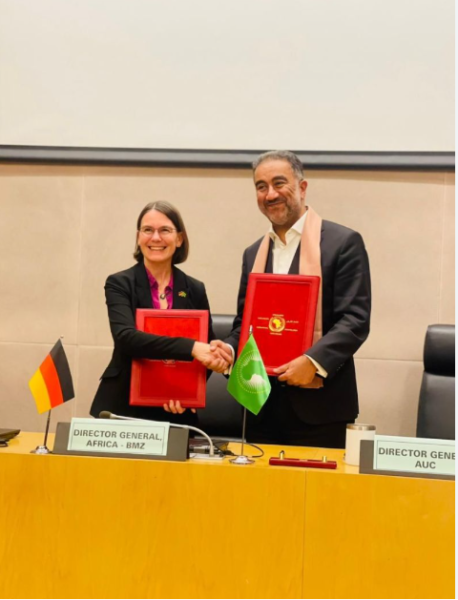
Addis Ababa — November 24, 2025
The African Union and Germany have signaled a deeper strategic alignment after Berlin pledged €88 million in new development cooperation funding, reinforcing a two-decade partnership that increasingly shapes Africa’s economic, security, and institutional landscape.
The commitment emerged from the AU–Germany Negotiations on Development Cooperation, held 6–7 November at the AU Commission in Addis Ababa. While the meetings are routine—held every two years—the 2025 session underscored Germany’s bid to remain a central actor in Africa’s green energy transition, trade integration, and continental health security.
A Partnership Positioned for Agenda 2063
For the AU, Germany’s renewed engagement comes at a time when the bloc is pushing to accelerate implementation of Agenda 2063, its long-term blueprint for economic transformation and political integration. Analysts note that Germany has consistently moved from being simply a donor to a strategic co-architect of continental initiatives, especially those requiring technical depth and long-term financing.
With cumulative support now exceeding €1 billion, Germany remains one of the AU’s most dependable partners.
1. Economic Integration: AfCFTA Moves From Design to Delivery
A central pillar of the talks was Germany’s continued backing of the African Continental Free Trade Area (AfCFTA) as it shifts from negotiation to implementation.
What’s notable is Berlin’s emphasis on private-sector empowerment, particularly small and medium enterprises. The AU sees SMEs as the engine that must drive cross-border trade and industrialization, yet most still face constraints such as limited financing, regulatory fragmentation, and infrastructure gaps.
Germany’s support is expected to target these structural bottlenecks—signaling that the AfCFTA’s success will hinge not only on political agreements but on market-level functionality.
2. Green Energy & Infrastructure: Aligning with Africa’s Energy Future
Energy cooperation remains the most technically ambitious piece of the partnership.
Germany is backing two flagship AU energy initiatives:
- Africa Single Electricity Market (AfSEM)
- Continental Power System Masterplan (CMP)
Both aim to create a unified electricity market across Africa—a goal that experts say could be transformative but requires long-term investment and political coordination. Germany’s involvement positions it as a major external supporter of Africa’s green industrialization agenda, particularly as Europe looks to secure climate partnerships beyond its borders.
3. Peace & Security: Structural Prevention Takes Center Stage
Germany’s approach to peace and security in Africa continues to evolve away from crisis-response toward preventive action.
At this year’s negotiations, priorities included:
- Strengthening early-warning systems
- Addressing the climate–peace–security nexus
- Expanding the role of women and youth in peacebuilding
This shift aligns with AU reforms that stress self-reliance and long-term resilience, especially amid persistent instability in the Sahel, the Horn of Africa, and the Great Lakes region.
4. Health Security: Building a Future-Proof Architecture
In cooperation with the Africa CDC, Germany is scaling support toward a continental health system capable of responding to pandemics, epidemics, and routine public health challenges. The focus on a “future-fit” architecture comes in the post-COVID landscape where the AU has prioritized vaccine manufacturing, emergency preparedness, and rapid response capacity.
Statements Underscore Trust-Based Partnership
German delegation head Birgit Pickel, Director-General for Africa at BMZ, framed the renewed cooperation as a continuation of a partnership grounded in “mutual respect, trust, and understanding,” noting that Africa remains a strategic priority for Germany.
AU Commission Director-General Amb. Fathallah Sijilmassi highlighted the negotiations as a mechanism to ensure “concrete, measurable impact” and reaffirmed the AU’s appreciation for Germany’s consistent support.
Why These Negotiations Matter
The AU–Germany cooperation framework is more than a funding pipeline. It provides:
- A biannual platform to evaluate the performance of Germany-funded AU programs
- Mechanisms to adjust priorities as continental needs shift
- A stable financing model that supports AU institutional reforms
Germany’s role in Joint Financing Arrangements (JFAs)—where it is a lead signatory—has also helped stabilize AU operations, including capacity-building and program delivery.
What Comes Next
The next AU–Germany negotiations are scheduled for 2027, but implementation work will intensify immediately. With major AU projects—AfCFTA rollout, AfSEM integration, and Africa CDC strengthening—now entering critical phases, Germany’s funding is expected to influence tangible outcomes on the ground.
For observers, the real test will be whether these renewed commitments translate into measurable progress toward Agenda 2063’s ambitious targets.