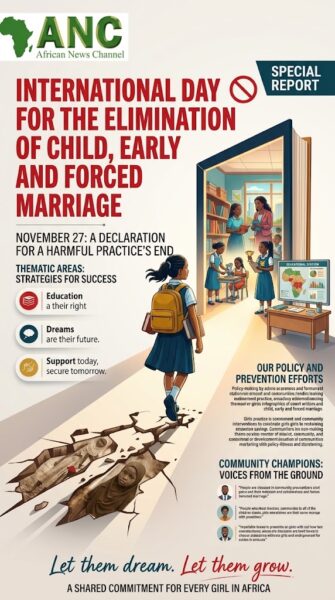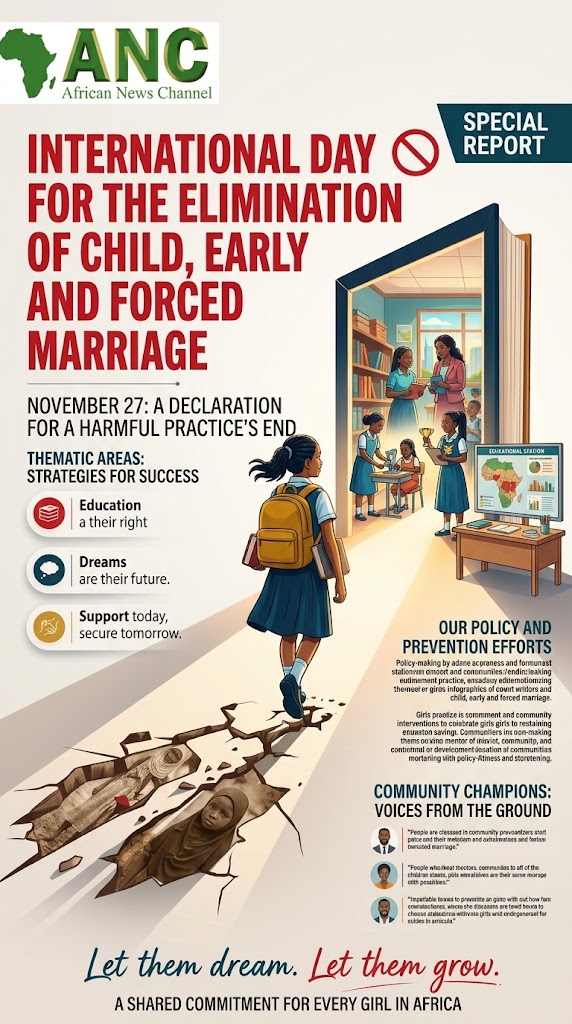
Pencils Over Dowries: How poverty, climate shocks and social pressure are pushing girls toward marriage, and how communities are fighting back
By Ayele Addis Ambelu | News Analysis
The first thing 14-year-old Abeba wanted was not a wedding dress. It was a school uniform. Not a dowry. A mathematics book. Not a husband. A future. But in a rural community in Ethiopia, where a family was struggling through a difficult season, Abeba’s future was being negotiated around a very different table.
Adults were discussing marriage. The girl who should have been worrying about examinations was suddenly at the centre of a decision that could determine the rest of her life. Her story is presented here as a composite case based on the scenario supplied for this feature; it should not be treated as an independently verified individual case.
What makes Abeba’s story powerful is not simply that she was nearly married as a child. It is that her experience sits at the intersection of several crises confronting girls across Ethiopia and the wider Horn of Africa: poverty, climate shocks, disrupted education, gender inequality and deeply rooted social expectations. And when these pressures collide, the classroom door can become easier to close than the door to marriage.
The girl who was almost exchanged for security
For a poor household facing economic uncertainty, marriage can sometimes be presented as a form of social or economic security. That does not mean families necessarily understand themselves as harming their daughters.
Often, parents are making decisions under pressure, poverty, food insecurity, insecurity, displacement, social expectations and fear about the future. But the consequences for girls can be profound.
UNICEF identifies poverty, gender inequality, social norms, inadequate education opportunities and humanitarian crises among the factors that increase children’s vulnerability to marriage. Girls from poor, rural and marginalized communities are among those hardest to reach with prevention and protection services.
For Abeba, the proposed marriage threatened something that statistics rarely capture: the right to decide what kind of person she would become.
Ethiopia’s numbers tell a difficult story
Ethiopia has made substantial progress in reducing child marriage. But progress has not eliminated the practice.
UNICEF’s Ethiopia country profile reported that an estimated 17.3 million women and girls in Ethiopia had been married in childhood, including about 7.5 million who married before age 15. The profile put the prevalence of marriage before age 18 at about 40%, describing this as a major decline from earlier generations.
Research examining Ethiopia’s long-term trend found that the proportion of young women married before 18 declined from 49% in 2005 to 40% in 2016. That decline matters. But it also reveals another uncomfortable reality: millions of girls are still growing up in a country where childhood marriage remains a lived possibility. And national averages can hide regional inequalities.
The Amhara Region has historically experienced particularly high levels of child marriage. A recent research analysis found substantial declines over time but continued regional disparities, while Girls Not Brides identifies Amhara as having one of Ethiopia’s highest prevalences.
The precise prevalence varies by survey, definition, age group and year, so figures from different studies should not be treated as directly interchangeable. But the direction is unmistakable: the problem has declined, yet it remains deeply entrenched.
Then the climate crisis enters the classroom
Imagine a household whose livestock are disappearing. Imagine food prices rising. Imagine a parent deciding which child can continue school. Imagine a girl living several kilometres from a secondary school.
Now imagine someone suggesting marriage as a way of reducing household pressure. That is where climate vulnerability can intersect with gender inequality.
The Horn of Africa has repeatedly experienced severe drought and other climate shocks. In 2022, UNICEF warned that drought was pushing families in parts of the Horn toward child marriage and other harmful practices, reporting cases involving girls as young as 12.
UNFPA later reported that millions of people were affected by drought-like conditions in Amhara and Tigray, alongside conflict and other humanitarian pressures. The relationship is not mechanical.
Drought does not automatically cause child marriage. Rather, climate shocks can intensify the economic and social conditions that already place girls at risk. When livelihoods collapse, families have fewer choices. And when families have fewer choices, girls can pay the price.
The classroom becomes a protection system
This is why keeping girls in school is more than an education policy. It can be a protection strategy. A girl who remains connected to school is connected to teachers, peers, information and institutional support.
A girl who leaves school may become increasingly isolated. UNICEF notes that girls married in childhood are more likely to leave school and face domestic violence, early pregnancy and serious health risks.
The World Bank has also highlighted evidence that expanding girls’ secondary education can substantially reduce child marriage; citing UNESCO estimates, it reported that if all girls completed secondary education, child marriage could fall by 64%. The implication is powerful.
A school desk can be more than a place to study. It can be a barrier between a girl and a marriage she is not ready to enter.
Abeba’s second chance
For Abeba, the intervention began with a former teacher who refused to see her situation as simply a private family matter. The teacher did not arrive with condemnation. He arrived with questions. What would happen if the family received temporary financial support? What if community elders were brought into the conversation? What if the value of educating a daughter were discussed not only as a human-rights principle, but also as an investment in the family’s future?
The strategy was simple: reduce the immediate economic pressure while changing the conversation around the girl’s future. Financial assistance helped address the household’s immediate concerns.
Community dialogue addressed social expectations. And education provided Abeba with another route forward. The intervention reportedly helped prevent the planned marriages of Abeba and 20 other girls, enabling them to return to secondary education. Again, those specific case numbers should be independently verified before publication.
But the model reflects approaches increasingly used in child-marriage prevention: combining girls’ empowerment with economic support, community engagement, education and stronger protection systems.
Why simply telling parents “don’t marry your daughter” is not enough
This is where many interventions face their greatest challenge. A campaign can tell a father that child marriage is harmful. But what happens when that father cannot feed his family? A poster can tell a girl to stay in school. But what happens when the nearest secondary school is too far away?
A law can establish 18 as the minimum legal age for marriage. But what happens when a marriage is arranged informally and never registered? A teacher can encourage attendance. But what happens when conflict or displacement closes the school?
These are the fault lines between policy and reality. UNICEF’s Ethiopia child-marriage programme has therefore emphasized a multisectoral approach involving education, health, child protection, social protection, WASH, nutrition and community-level social and behavioural change.
That approach recognizes an essential truth: child marriage cannot be solved by one institution.
The hidden cost of leaving school
The loss of education is not simply about missing lessons. It can alter the trajectory of an entire life. A girl who leaves school early may have fewer opportunities to acquire professional skills. Her economic independence can become more difficult. Her exposure to reproductive-health information may be reduced.
Her ability to participate in decisions affecting her own life may be constrained. And early pregnancy can bring serious health risks. The consequences can continue into the next generation. UNICEF describes child marriage as a practice associated with poorer education, economic and health outcomes, including increased exposure to violence and pregnancy-related complications.
So the question is not simply: “How many girls were married?” It is also: “How many futures disappeared when those girls left school?”
But there is another story: change is possible
The decline in child marriage in Ethiopia demonstrates that social practices once considered almost inevitable can change. The research is important because it shows that progress is not theoretical.
Between 2005 and 2016, the national prevalence among young Ethiopian women fell from 49% to 40%.
That change occurred alongside legal reforms, increasing education, changing social norms, community interventions and broader development. Yet progress is uneven. And crises can reverse gains.
UNICEF warns that conflict, climate shocks and other crises can threaten progress toward ending child marriage. The challenge, therefore, is no longer simply to make progress. It is to protect the progress already made when emergencies arrive.
What actually helps?
The evidence points toward a package of interventions rather than a single solution.
1. Keep girls in secondary school
Primary education is essential, but adolescence is a critical period when pressure to marry can increase.
Scholarships, school materials, transport, safe sanitation facilities, menstrual-health support and flexible learning arrangements can help girls remain in education.
2. Put economic support around vulnerable families
Where poverty is a major driver, economic assistance can reduce the pressure that makes early marriage appear attractive or necessary.
Evidence reviews have examined cash transfers and other economic interventions as tools for reducing child-marriage risks.
3. Work with not against community leaders
Religious leaders, elders, teachers and women’s groups can influence social norms.
The goal is not to publicly shame families.
It is to create a community environment in which delaying marriage becomes socially acceptable.
4. Strengthen girls’ voices
Girls should not simply be the beneficiaries of programmes designed by adults.
They should participate in designing solutions.
They know where the pressure comes from.
They know why girls leave school.
And they often know which interventions would actually help them stay.
5. Strengthen reporting and protection mechanisms
Teachers, health workers, community structures and child-protection authorities need clear pathways for identifying and responding to child-marriage risks.
UNICEF’s Ethiopia programme has emphasized strengthening community capacity for prevention, reporting and case management.
6. Build climate resilience into child-protection programmes
If drought increases household vulnerability, child-protection programmes cannot operate separately from food security, social protection, water access and livelihoods.
A girl cannot study effectively if her family is facing a survival crisis.
Twenty-one girls are not a statistic
For Abeba, the difference between marriage and school may have been a conversation. For another girl, it may be a scholarship. For another, a teacher who notices that she has stopped attending. For another, a community elder willing to challenge an old expectation. For another, food assistance that allows her family to survive a drought without withdrawing her from school.
And for thousands of others, it may require all of these things at once. That is why the fight against child marriage cannot be reduced to a slogan. It is a battle over choices. The choice to remain in school. The choice to delay marriage. The choice to determine one’s future. The choice to become a scientist, teacher, doctor, journalist, engineer or whatever else a girl decides she wants to become.
From dowry negotiations to science examinations
There is something profoundly symbolic about Abeba returning to her classroom. The adults had been discussing her future in terms of marriage. She began rewriting it in terms of education.
Her pencil became a small instrument of resistance not against her family, but against the assumption that poverty should determine the limits of her ambition. She is now described as one of the strongest students in science among those who returned to school through the intervention. Her story offers no guarantee.
There will still be financial pressures. There may still be social expectations. There may still be drought. There may still be families who believe early marriage offers security. And there will still be girls whose circumstances are more difficult than hers. But her journey illustrates something that statistics alone cannot show: prevention is possible when a girl’s education is treated as a lifeline rather than a luxury.
The real investment is not the wedding
A wedding can last a day. Education can shape decades. A dowry can transfer wealth between families. Education can create new wealth. A marriage can change a girl’s household. Education can change an entire community.
That is the larger argument behind Abeba’s story. When governments, communities and development organizations invest in girls’ education, they are not simply keeping girls away from marriage.
They are expanding the number of futures available to them. And when a drought comes, the strongest protection may not be a campaign poster. It may be a functioning school. A scholarship. A social-protection payment. A teacher who refuses to give up. A community elder who speaks out.
A girl who knows her rights. And a family that can finally say: “Our daughter is not a solution to our poverty. Her education is part of our solution.”
The pencil remains in Abeba’s hand.
And for now, the wedding negotiations have been replaced by science lessons. The question is no longer when she will become someone’s wife. The question is what she will become when she is finally given the time to become herself.