

Ethiopia’s insurance industry is expanding at a striking pace, posting record-breaking figure that signal rapid growth, but a closer look reveals a more complicated story when measured against regional peers and global benchmarks.
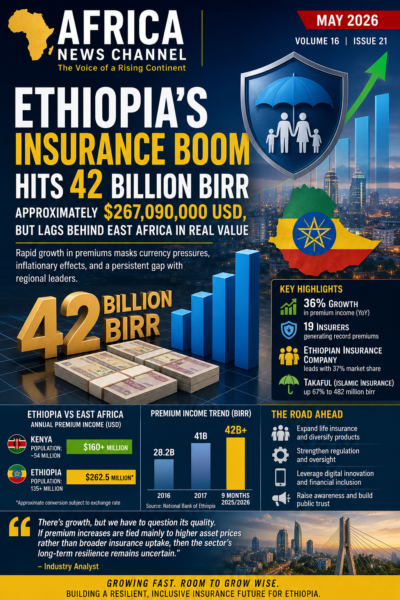
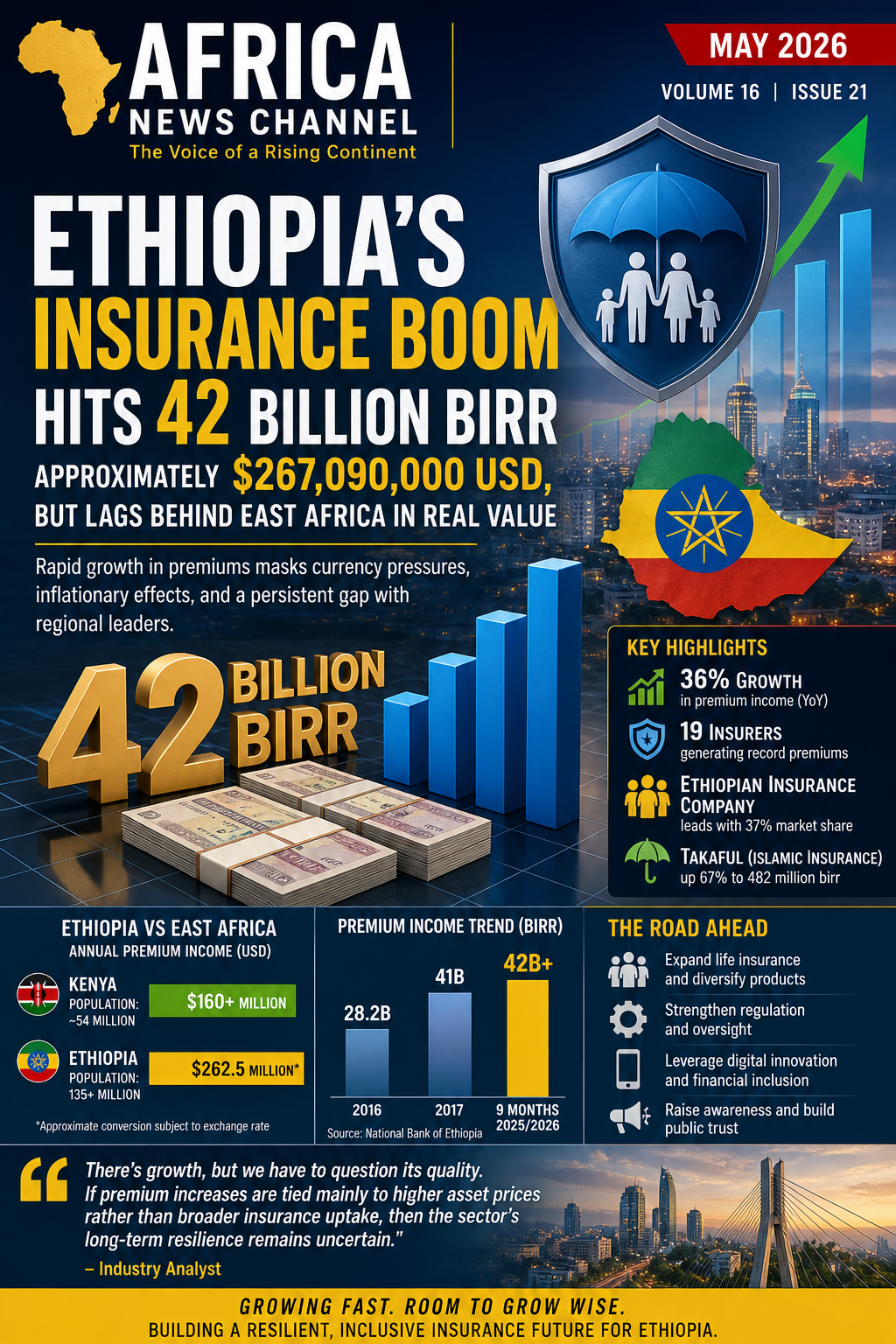
In the first nine months of the 2025/2026 fiscal year, the country’s 19 insurers generated more than 42 billion birr approximately $267,090,000 USD in premium income, putting the sector on track to surpass the 50 billion birr mark by year’s end. This represents a 36 percent increase compared to the same period the previous year, making it one of the fastest-growing segments of Ethiopia’s financial services industry.
The bulk of this income nearly 39 billion birr came from non-life insurance, underscoring the dominance of general insurance products such as motor, property, and liability coverage. Life insurance, by contrast, remains underdeveloped, contributing only about 2.75 billion birr despite growing by 26 percent year-on-year. Meanwhile, the emerging Takaful (Islamic insurance) segment, though still small, is expanding rapidly, reaching 482 million birr after a 67 percent jump.
At the center of this growth is Ethiopian Insurance Company, which continues to dominate the market with a 37 percent share. The state-owned giant collected 15.7 billion birr in premiums during the nine-month period, marking a 43 percent increase from the previous year. Much of its earnings over 15 billion birr came from non-life insurance alone.
Other major players such as Awash Insurance, Nyala Insurance, Oromia Insurance, and Nile Insurance are also strengthening their positions. Awash, in particular, leads the Takaful segment, capturing nearly half of that market and significantly expanding its share within a year. Smaller firms are also showing aggressive growth, with companies like Nice Insurance and Hebtia Insurance recording triple-digit increases, albeit from a low base.
Yet beneath these impressive figures lies a sobering reality: Ethiopia’s insurance boom looks far less dramatic when viewed in dollar terms. Due to currency depreciation, the sector’s total premium income translates to roughly $262.5 million only slightly higher than the previous year’s $238 million. This muted growth highlights the impact of exchange rate pressures on the country’s financial sector.
Industry experts argue that much of the recent expansion is driven less by structural transformation and more by rising prices particularly in the automotive sector. As vehicle costs climb, so do insurance premiums, especially for mandatory third-party coverage. Some analysts warn that this trend may reflect inflationary effects rather than genuine market deepening.
“There’s growth, but we have to question its quality,” said one industry analyst. “If premium increases are tied mainly to higher asset prices rather than broader insurance uptake, then the sector’s long-term resilience remains uncertain.”
A broader regional comparison further puts Ethiopia’s performance into perspective. In neighboring Kenya, one of East Africa’s most developed insurance markets; annual premium income exceeds $160 million despite serving a population less than half of Ethiopia’s. Kenya’s higher insurance penetration supported by stronger regulatory frameworks, diversified products, and deeper financial inclusion offers a stark contrast.
Across East Africa, countries like Tanzania and Uganda are also working to expand insurance access, particularly through micro insurance and digital platforms. Ethiopia, however, still has fewer than a dozen companies offering life insurance services, often through limited “window” operations rather than fully developed divisions.
Historical data shows that Ethiopia’s insurance sector has been on a steady upward trajectory. Total premiums rose from 28.2 billion birr in 2016 to 41 billion birr in 2017, before reaching over 42 billion birr in just nine months of the current fiscal year. While this suggests strong momentum, experts emphasize that the industry’s overall size remains small relative to the country’s population of more than 135 million people.
For Ethiopia to catch up with regional leaders, analysts point to several priorities: expanding life insurance products, improving public awareness, strengthening regulatory oversight, and leveraging digital technology to reach underserved communities.
“The opportunity is enormous,” noted a financial sector expert. “But without structural reforms and innovation, Ethiopia risks remaining a high-growth yet low-impact insurance market.”
As the sector races toward new financial milestones, the challenge now is not just to grow but to grow meaningfully, sustainably, and inclusively in a rapidly evolving regional landscape.
By: Ayele Addis Ambelu (ayeleradio@gmail.com)