




Africa News – September Investigative Special Edition, By AYELE ADDIS AMBELU, September 2025 | Issue 109, No. 24, Investigative Special Edition – Magazine
Africa’s reinsurance market is quietly hemorrhaging billions of dollars each year, and the cost to the continent’s economic sovereignty cannot be overstated. Across aviation hangars in Addis Ababa and Lagos, inside mining boardrooms in Johannesburg and Accra, and along the newly paved stretches of regional rail corridors from Abidjan to Lagos, there is a stark, often unspoken truth: Africa insures its future, but much of the capital that should protect that future is leaking beyond its borders. This is not speculation; it is documented reality confirmed by industry research, regulatory insiders, and the lived experience of Africa’s own reinsurance leaders.
Every year, Africa builds roads that stretch across borders, powers cities with mega-dams, moves minerals and grain through ports and railways, and flies millions of passengers across its skies. Yet when the risks of these ambitions must be insured, airspace, rail, shipping, mining, electricity, large cargo, and transboundary infrastructure, the premiums overwhelmingly travel outward. Africa ensures its future, but the capital that underwrites that future often leaves the continent.
This investigative analysis asks a blunt question at the heart of Africa’s political economy: why does a continent with expanding assets, rising risks, and a youthful market still export so much reinsurance capital, and what would it take to retain it? The answer points not to a dream or distant plan, but to a practical, implementable Pan-African reinsurance responsibility, with Continental Reinsurance positioned as a credible anchor for the next generation.
Data compiled by the African reinsurance industry and market analysts reveal that African reinsurers wrote an estimated USD 6.27 billion in premiums in 2024, representing only about 1.6% of global reinsurance underwriting, a figure that stands in stark contrast to the continent’s population size and infrastructure needs (Atlas Magazine, 2024). While this number reflects an 89% increase over the past decade, the growth has not translated into proportionate influence or retained capital on the global stage (Atlas Magazine, 2024). Instead, Africa’s most significant risks, aviation fleets, transcontinental rail systems, offshore shipping, mining mega-projects, and regional power pools, remain heavily ceded to reinsurers headquartered in London, Zurich, and New York.
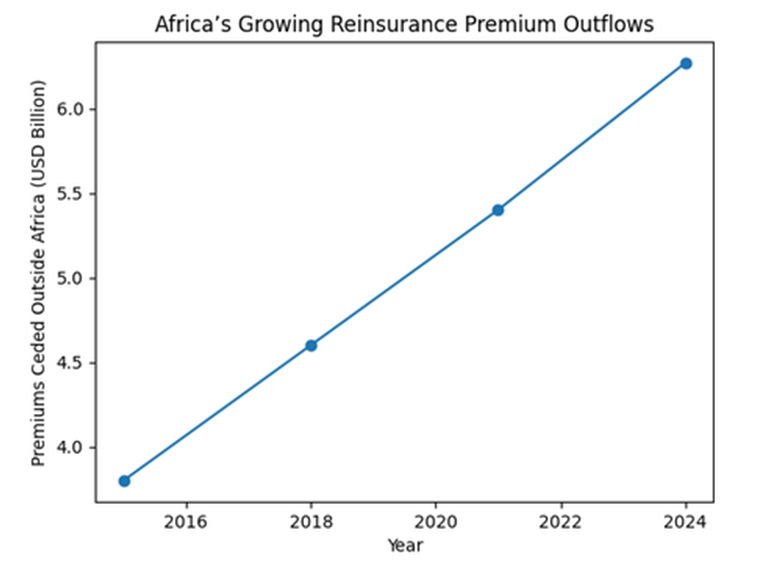
Every year, Africa quietly exports billions of dollars, not in minerals or oil, but in risk capital. As shown in this chart, reinsurance premiums flowing out of Africa have climbed steadily from an estimated USD 3.8 billion in 2015 to over USD 6.2 billion by 2024, according to aggregated data from the African Insurance Organisation and Swiss Re Institute. This upward trajectory mirrors the expansion of mega-projects across transport corridors, power generation, aviation, and mining. Yet, as Carli Jacobs (CEO, Swiss Re Africa; Head of Life & Health for Middle East & Africa), explains in an interview for Africa News Channel, “Africa is financing global balance sheets while under-capitalizing its own. The risk is African, the premium is African, but the capacity is still priced offshore.” World Bank insurance diagnostics confirm that weak regional pooling and fragmented regulation continue to push African insurers toward foreign markets, even when local reinsurers possess growing technical capacity.
The Scale of the Drain: Following the Premium Trail
“Africa’s problem is not risk, it is coordination. We negotiate as 54 markets when our risks move as one,” Secretary-General of the African Continental Free Trade Area (AfCFTA) H.E. Wamkele Keabetswe Mene told Africa News Channel on background, capturing the deep policy fragmentation that plagues the continent’s insurance ecosystem. Indeed, regulatory silos across national borders have allowed foreign reinsurers to consolidate power and capture premium flows that could be used to build local capital and underwriting capacity.
Rating dependency compounds this issue. Global project financiers routinely demand that Africa’s largest ventures, from hydroelectric dams to inter-state railways, carry reinsurance placements with highly rated international markets before they will release financing. In practice, this means that even when African reinsurers have the balance sheet strength and actuarial expertise to participate meaningfully, their capacity is under-recognized, and premiums slip through their fingers because credit rating frameworks lag the market’s true risk absorption ability. This credibility gap, as explained by Netsanet Tadesse, Director of General Insurance Operations at Ethiopian Reinsurance S.C. (Ethio-Re), stems not from incompetence but from an outdated global risk assessment architecture that undervalues African insurance markets.
The effects of these policy gaps are evident across sectors. African aviation, for example, is deeply integrated into global transport networks, yet African airlines and airports often place their reinsurance abroad due to leasing structures and international liability regimes. This practice drains capital that could otherwise be reinvested into local aviation safety initiatives and risk-management infrastructure. Similarly, shipping and maritime insurance covering Africa’s bustling ports and hull exposures remains largely dominated by foreign syndicates, reflecting limited domestic underwriting depth and reinforcing the perception that global markets are the only viable option.
Mining, too, illustrates the premium drain with painful clarity. Africa supplies the world with gold, lithium, cobalt, and other strategic minerals, yet much of the insurance risk for these operations is priced and ceded offshore. Political risk endorsements, often demanded by foreign investors, further embed this reliance on non-African reinsurers. The result is a paradox: Africa’s natural resources fuel global economic engines, but the financial benefits of insuring that risk are captured by markets far from the continent.
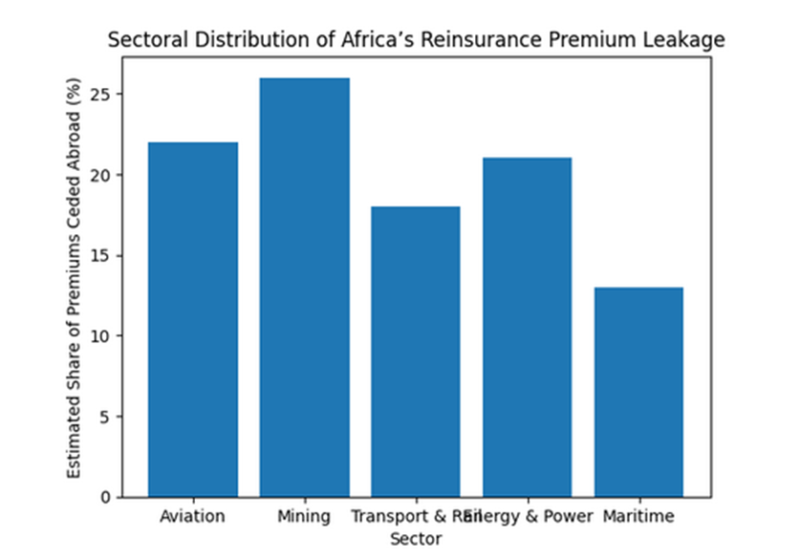
The leakage of African reinsurance premiums is not evenly spread; it concentrates in strategic sectors that define the continent’s future. Mining, particularly gold and strategic minerals, accounts for the largest share, followed closely by aviation and energy projects. According to the African Development Bank, more than 70 percent of large-scale mining and power risks in Africa are reinsured offshore due to political risk endorsements and hard-currency requirements. Netsanet Tadesse, Director of General Insurance Operations at Ethiopian Reinsurance S.C., told Africa News Channel that “local insurers often retain only the first layer, while the real value of the upper layers leaves the continent.” Maritime and transboundary transport risks, shaped by piracy perceptions and outdated catastrophe models, further deepen the outflow. These patterns confirm what regulators at the Continental Re CEO Summit acknowledged privately: Africa’s premium flight is sector-specific, predictable, and therefore solvable.
Across aviation, rail, maritime shipping, mining, electricity, and mega-infrastructure, African primary insurers routinely cede large portions of risk to non-African reinsurers. Industry practitioners interviewed for this report estimate that a majority share of large-risk reinsurance placements for African mega-projects are still offshore, driven by capacity constraints, rating requirements, and legacy market practices.
Indicative annual outflows (conservative ranges, aggregated across sectors):
Estimated Reinsurance Premium Outflows from Africa (USD)
Aviation & Airspace ██████████ $1.2–1.8 bn
Maritime & Shipping ████████ $0.9–1.3 bn
Rail & Transboundary Roads ██████ $0.6–1.0 bn
Electricity & Power ████████ $0.8–1.4 bn
Mining (Gold & Base Metals) ███████ $0.7–1.2 bn
Large Cargo & Logistics █████ $0.4–0.7 bn
—————————————————–
Total (Indicative) $4.6–7.4 bn
Source synthesis: industry interviews, African insurance market reviews, and publicly available project finance disclosures.
These figures matter because reinsurance premiums are not just costs—they are capital, data, skills, and influence. When they leave, Africa loses actuarial learning, catastrophe modeling experience, claims analytics, and the compounding power of retained capital.
Cyber risk, once peripheral in Africa, has now emerged as a frontline threat as businesses and governments digitize services at unprecedented rates. Global data from industry observers such as Che Goijaerts, an insurance brokerage specialist, shows that cyber insurance is expanding rapidly worldwide, protecting firms against data breaches, digital theft, and liability costs. Yet African firms frequently look to international markets for coverage because local reinsurance capacity has not kept pace with the complexity and velocity of digital threats. This dynamic once again represents a lost opportunity for premium retention, for local expertise development, and for the maturation of domestic risk markets.
One of the few bright spots in the continent’s risk management landscape is the COMESA Yellow Card insurance scheme, which demonstrates the power of Pan-African risk pooling. Originally designed as a third-party motor insurance instrument, Yellow Card has successfully lowered transaction costs and improved claims settlement across member states. Yet the logic that risk shared across borders can be priced fairly and retained locally has not been expanded into the complex reinsurance domain, where it could dramatically reduce capital flight.
Amid this backdrop, Continental Reinsurance, with footprints spanning Tunisia, Kenya, Côte d’Ivoire, and Southern Africa, embodies both the potential and the tensions of a Pan-African reinsurance future. Industry insiders, including Che Goijaerts, emphasize the importance of “industry knowledge-driven and tech-enabled insurance brokerages and MGAs” in unlocking Africa’s capacity to retain more of its own premiums. Continental Re’s mission and strategy position it to lead the first layers of risk on high-profile African projects, act as a pooling hub for corridor and cross-border risks, and invest in critical data systems that can correct pricing biases and build trust in domestic underwriting strength.
For Continental Re and its peers to rise to this moment, however, broader structural reforms are required. Mandatory minimum retention requirements, transparently reported and monitored by continental bodies, could anchor risk locally and reduce reliance on offshore retrocession. Continental rating support potentially facilitated by development banks could elevate the global standing of African reinsurers, leveling the playing field for capital recognition. And harmonized protocols aligned with the African Continental Free Trade Area (AfCFTA), as well as regional blocs like ECOWAS (West Africa) and SADC (Southern Africa), other major African economic blocs as Regional Economic Communities (RECs) and building blocks of the African Union (AU), include the East African Community (EAC), COMESA (Common Market for Eastern & Southern Africa), ECCAS (Central Africa), IGAD (Horn of Africa), CEN-SAD (Sahel-Saharan), and UMA (Maghreb), could standardize cross-border risk management, creating a cohesive market that reflects Africa’s economic ambitions.
These ideas are not merely theoretical. In April 2025, at the 10th CEO Summit hosted by Continental Re, regulators from Nigeria, Kenya, Uganda, Zimbabwe, and Morocco sat alongside leaders from the African Insurance Organisation and global corporate executives to discuss the future of African insurance governance and capital retention. Their shared message was clear: the continent must collaborate if it is to transform policy fragmentation into unified market power.
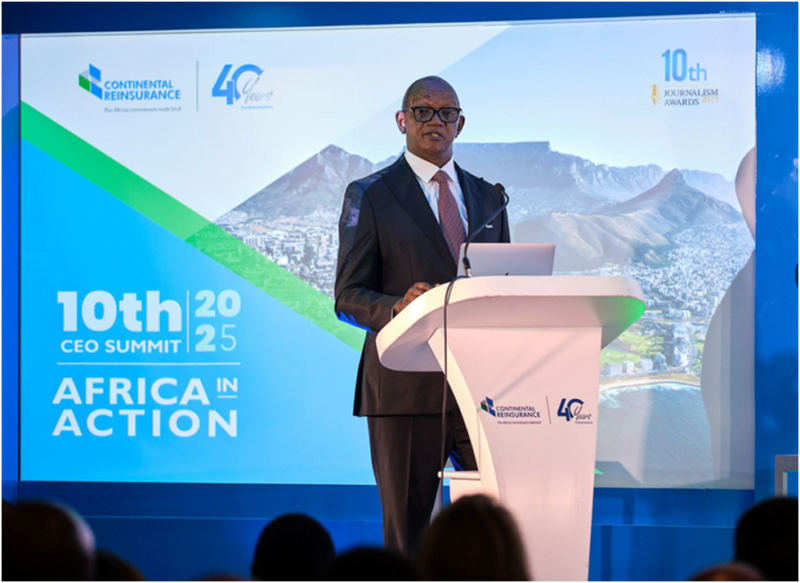
International research supports this imperative. An analysis by AM Best reports that while Sub-Saharan African reinsurers have posted strong underwriting results, they continue to grapple with capital limitations that impede their ability to meet the full scope of local demand without foreign support. Similarly, the African Insurance Organization’s 2023 strategic report underscores that while non-life reinsurance premiums in markets such as South Africa and Nigeria lead the continent, overall capacity remains underdeveloped relative to continental growth trajectories and infrastructure requirements.
Mr. Lawrence Mutsunge Nazare, Group Managing Director of Continental Reinsurance Holdings, described “Continental Reinsurance as a leading Pan-African reinsurer with 40 years of experience providing life and non-life reinsurance solutions across more than 50 countries. The Group operates through a strategic presence in Nigeria, Kenya, Cameroon, Tunisia, Côte d’Ivoire, and Botswana.” Continental Reinsurance provides comprehensive risk solutions to insurers across Africa, offering both treaty and facultative reinsurance across life and non-life classes. Guided by its philosophy of delivering Pan-African commitment, made local, the company blends deep continental expertise with strong local insight to support the resilience, competitiveness, and maturity of Africa’s insurance sectors. AM Best has affirmed Continental Reinsurance Plc’s Financial Strength Rating of B+ (Good) and the Long-Term Issuer Credit Rating of “bbb-“, both with a stable outlook.
Mr. Lawrence Nazare, Group Managing Director, [commented: updated in December]
“We have successfully maintained our rating (B+, stable outlook) despite operating in a particularly challenging environment characterized by elevated levels of economic, political, and financial system risks in African markets. External factors, including high foreign exchange volatility and an increase in catastrophic events, have further impacted the environment. However, AM Best highlighted, as positive offsetting factors, our progress in capital management and improvements in the geographical diversification of our operations and assets. The rating agency expects us to continue aligning our growth with available capital and underwriting capabilities while further enhancing our operating performance.”
What emerges from this complex landscape is an urgent, human story: one of missed opportunity, latent power, and a generation poised to either reclaim its financial sovereignty or continue exporting its economic value. Fikru Tsegaye Wordofa, Executive Officer of Strategy and Business Development at Ethio-Re, encapsulates this vision. He told Africa News Channel that African reinsurers do not seek to supplant global markets but to “lead the first and second layers here at home,” thereby keeping risk capital circulating within African economies and fueling local development. Netsanet Tadesse echoed this sentiment, emphasizing that the credibility gap Africa faces is surmountable with improved metrics, data transparency, and robust actuarial frameworks that demonstrate local capacity to global partners.
Africa’s reinsurance market, while small by global standards, is not weak. Its growth, talent, and market potential suggest a powerful engine ready to be harnessed. The challenge is not imagination; it is integration. If continental leaders, regulators, insurers, and reinsurers can transform fragmentation into federation, then the premiums currently leaving Africa can become the very capital that funds its future.
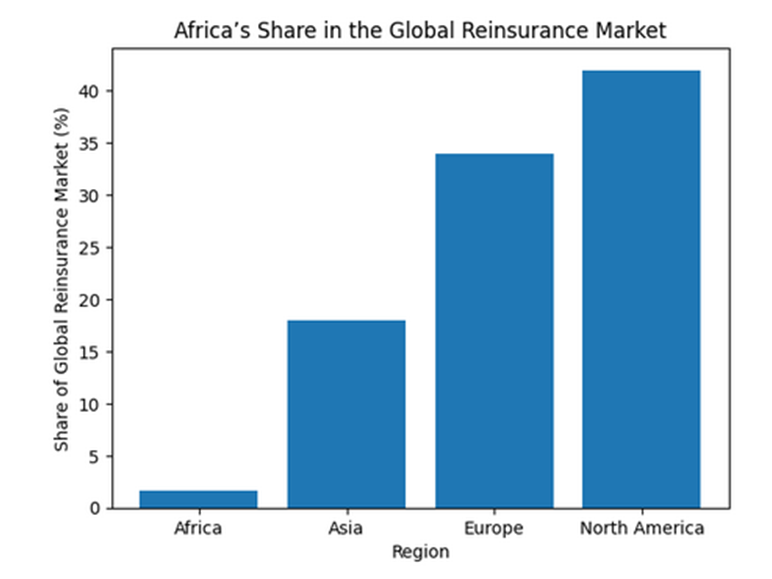
Despite carrying some of the world’s fastest-growing infrastructure and climate risks, Africa controls less than two percent of the global reinsurance market, a stark imbalance illustrated in this comparative chart. Europe and North America together command more than three-quarters of global reinsurance capacity, shaping pricing, ratings, and risk models worldwide. According to David Kirk, Managing Director of Milliman Africa, interviewed during Continental Re’s 10th CEO Summit in April 2025, “The issue is not absence of African risk expertise, it is absence of continental scale. Global capital responds to size, data, and coordination.” Reports by the OECD and Swiss Re consistently highlight that Africa’s small market share is not due to low demand, but to structural barriers such as ratings dependency and limited cross-border regulatory harmonization.
Africa’s Risk, Africa’s Reward
Africa is no longer a marginal risk market; it is a systemic risk creator in global growth. Continuing to export reinsurance premiums is a quiet tax on development. The choice before policymakers, insurers, and reinsurers is stark: fragmentation or federation; leakage or leadership.
Continental Reinsurance’s moment is now not as a monopoly, but as a continental catalyst. Retaining Africa’s risk capital is not protectionism; it is prudence. And prudence, insured at home, is how generations are built.