By Ayele Addis Ambelu Addis Ababa, September 8, 2025
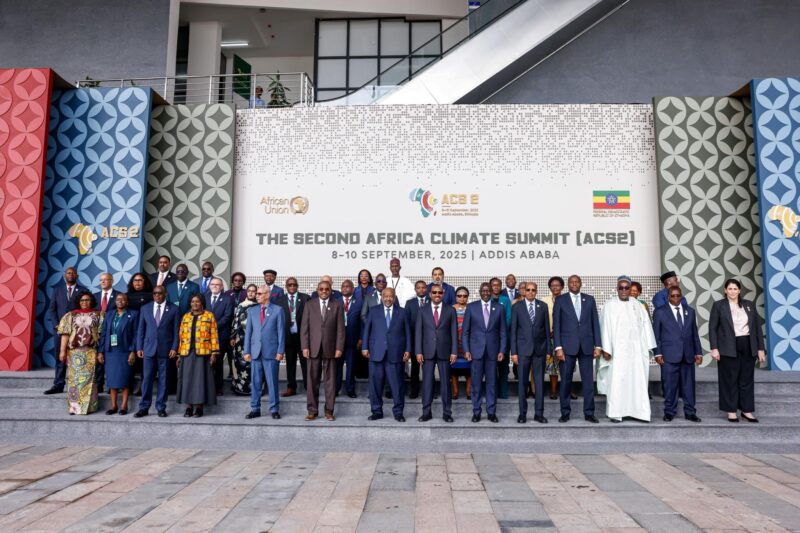
Addis Ababa today became the beating heart of Africa’s climate diplomacy as the Second Africa Climate Summit (ACS2) officially opened under the theme “Accelerating Global Climate Solutions: Financing for Africa’s Resilient and Green Development.” In a speech that was equal parts call-to-arms and visionary blueprint, Ethiopia’s Prime Minister Abiy Ahmed (PhD) declared the summit open, setting the tone for three days of high-stakes negotiations, partnerships, and declarations.
Abiy’s keynote address was anything but ceremonial. His words were charged with urgency, pride, and a refusal to cast Africa as a passive victim of global warming. “Too often, Africa’s story at climate summits begins with what we lack—lack of finance, lack of technology, lack of time,” he told the audience of presidents, diplomats, researchers, and civil society leaders. “Let us begin instead with what we have: the youngest population in the world, bursting with creativity and innovation; the fastest-growing solar belt on Earth; the planet’s last carbon vaults—in our forests, wetlands, and coasts.”
The Ethiopian leader underscored his country’s own achievements as proof of what African vision and determination can accomplish. Since the launch of the Green Legacy Initiative in 2019, Ethiopia has planted more than 48 billion seedlings—a figure the government says has helped cool degraded land, restore watersheds, and boost food production. Similarly, the soon-to-be inaugurated Grand Ethiopian Renaissance Dam (GERD), which generates over 5,000 megawatts of renewable energy, was highlighted as a continental symbol of clean power and pan-African integration.
However, the most striking proposal of the day was Abiy’s announcement of an African Climate Innovation Compact, an ambitious continent-wide partnership aimed at fostering homegrown solutions to the climate crisis. The Compact, he said, will unite Africa’s universities, startups, rural innovators, and research institutions, to produce 1,000 African-designed climate solutions by 2030. “Africa will not only meet its needs, but boost exports, powering growth beyond our borders and advancing Pan-African prosperity,” he said, framing the initiative as both a development strategy and a geopolitical repositioning.
Significantly, Abiy emphasized that this compact must be funded and owned by Africans themselves, in partnership with—but not dependent upon—the world. “We will also claim climate data sovereignty—mapping our own forests, measuring our own carbon, and pricing our own ecosystems,” he declared. “Climate data is not just science—it is the new currency of power. It is time to replace climate aid with climate investment.”
This rhetoric marks a strategic shift. While Africa contributes less than 4% of global greenhouse gas emissions, it remains one of the most climate-vulnerable regions. According to the UN Intergovernmental Panel on Climate Change (IPCC), Africa could face economic losses of up to 15% of GDP by 2050 without accelerated adaptation measures. Yet, the continent is also home to 60% of the world’s solar resources and 30% of the planet’s mineral reserves critical for green technologies. Abiy’s framing of Africa as a solution-provider rather than a charity case was met with applause inside the Addis International Convention Center.
The summit also became the stage for Ethiopia’s formal bid to host COP32 in 2027, an announcement that drew symbolic weight. By bringing the world’s most important climate gathering to Addis Ababa—the diplomatic capital of Africa and home to the African Union—Ethiopia signaled its ambition to cement its place as a leader in global climate governance. “We invite the world to Africa’s capital of diplomacy and climate ambition—to witness our solutions and to help shape the future,” Abiy said. “Let us show the world that the continent of origins will also be the continent of solutions.”
Other African leaders and AU commissioners echoed similar themes. Dr. Fitsum Assefa, Ethiopia’s Minister of Planning and Development, emphasized that the summit was not simply a forum for discussion but for delivery. “We gather not merely to discuss climate change, but to shape an African decade of delivery—a decade in which ambition becomes pipeline, and pipeline becomes investment,” she said, outlining the summit’s agenda which ranges from nature-based solutions and clean energy to climate finance and health resilience.
For analysts, ACS2 represents more than another round of climate talks. The continent attempts to redefine its narrative ahead of COP30 in Brazil, where Africa intends to arrive as a “continent of solutions” rather than a bloc of negotiators. Experts note that this rebranding aligns with Agenda 2063, the African Union’s long-term strategy for prosperity and self-reliance. Dr. Fatima Denton, Director of the UN University Institute for Natural Resources in Africa, has argued in previous research that Africa’s climate crisis must be recast as a development opportunity: “If Africa leverages its renewable energy and natural capital, it could leapfrog into a new kind of industrialization—one that avoids the carbon-heavy mistakes of the West.”
Still, challenges remain. Climate financing flows to Africa have consistently fallen short of promises. According to the Climate Policy Initiative, Africa received only about $29 billion annually between 2019 and 2020, far below the estimated $250 billion a year needed by 2030. Without structural reforms in global finance, critics fear that Africa’s bold plans may struggle to move from rhetoric to reality.
Yet, the mood in Addis was not one of despair but of determination. Youth delegates, many from climate tech startups and rural innovation hubs, embraced the Prime Minister’s message. For them, the promise of 1,000 African climate solutions was more than a political pledge—it was an invitation to lead.
As the summit continues over the next two days, the focus will shift toward finalizing the Addis Ababa Leaders’ Declaration, which is expected to serve as Africa’s unified position at global climate negotiations. But for now, Abiy Ahmed’s rallying cry lingers in the air: “We are the first African generation with the means to heal what was broken, and the last with the time to do it.”
In Addis Ababa, a city reinventing itself with green corridors and smart mobility, that declaration felt less like rhetoric—and more like history in motion.