By Sirawedeneke Zereyehuen| Addis Ababa, September 8, 2025
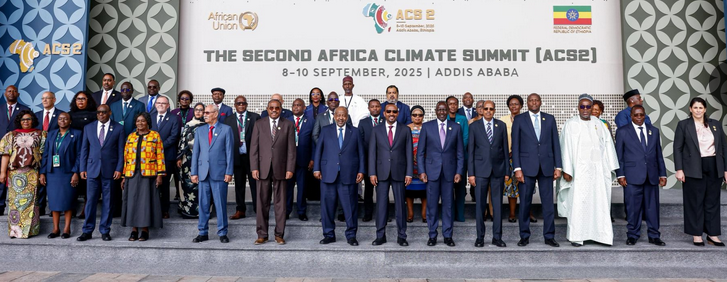
The green corridors of Addis Ababa pulsed with history today as Ethiopia’s Prime Minister Abiy Ahmed (PhD) stood before African heads of state, diplomats, and innovators to declare a new era: Africa would no longer beg for climate charity—it would demand climate investment.
Opening the Second Africa Climate Summit (ACS2), Abiy delivered a keynote that was both a manifesto and a provocation. His words carried the weight of a continent weary of broken promises yet brimming with unmined potential:
“We ask our global partners not to fund us because we are impacted, but to invest with us because we are visionary.”
In that single sentence, Abiy reframed Africa’s climate politics—from victimhood to vanguard, from aid-dependent pleas to strategic power broker in the global green economy.
🌱 Ethiopia as the Showcase of Africa’s Climate Future
The Prime Minister’s speech painted Ethiopia as a living laboratory of climate innovation:
- The Green Legacy Initiative: 48 billion seedlings planted since 2019, cooling lands and restoring soils.
- The Grand Ethiopian Renaissance Dam (GERD): a 5,000-megawatt symbol of Pan-African clean energy independence.
- Climate-smart agriculture: Programs like Yelemat Tirufat (“Bounty of the Basket”) are transforming food security and rural incomes.
- Smart, green cities: Bike lanes, electric mobility, and fossil-fuel phaseouts reshaping Ethiopia’s urban future.
Each achievement was not framed as a charity’s outcome, but as proof that African ingenuity can pioneer climate-smart prosperity.
⚡ The African Climate Innovation Compact: A Bold Gamble
The most electrifying announcement was Abiy’s proposal of the Africa Climate Innovation Compact—a sweeping vision to produce 1,000 homegrown climate solutions by 2030, spanning energy, water, agriculture, transport, and resilience.
Unlike previous top-down initiatives, this compact is designed to be African-owned, African-financed, and globally partnered.
Its radical promise: Africa will not merely adapt to climate change—it will export climate solutions.
“Climate data is not just science. It is the new currency of power,” Abiy warned, signaling a push for climate data sovereignty—the right for Africa to measure, price, and trade its own ecological assets, free from the grip of foreign institutions.
🌍 Addis Ababa vs. the World: The Bid for COP32
In perhaps the summit’s most symbolic moment, Abiy Ahmed formally presented Ethiopia’s bid to host COP32 in 2027, turning Addis Ababa into a contender for the epicenter of global climate diplomacy.
If successful, Ethiopia would not only be showcasing its climate leadership but transforming Africa from guest to host in the global climate negotiations.
🔎 Analysis: From the “Continent of Lack” to the “Continent of Solutions”
Abiy’s rhetoric flipped the script long imposed on Africa. At climate summits, African leaders are too often cast as petitioners pleading for finance. ACS2, however, projected an Africa of agency and audacity.
- By stressing Pan-African integration, Abiy positioned Africa as a unified bloc of solutions, not negotiators.
- By rejecting “charity” and embracing “investment,” he reframed Africa as a partner in global green growth.
- By linking climate innovation to security, jobs, and exports, he tied the green agenda to Africa’s geopolitical rise.
The stakes are profound: If Africa succeeds, it will be the first continent to industrialize without destroying its ecosystems. If it fails, it risks repeating cycles of dependency under the guise of green finance.
🌍 The Mood in Addis
Inside the Addis International Convention Center, the atmosphere was electric. Diplomats whispered about the GERD’s symbolism, while youth delegates buzzed over the chance to drive climate tech startups into the global market.
Outside, Addis itself told its own story: tree-lined boulevards planted under the Green Legacy Initiative, solar-powered city lights, and bustling markets where eco-friendly transport was no longer novelty but a necessity.
📌 Africa Steps Into History
As the three-day summit unfolds, Abiy Ahmed’s words will echo:
“We are the first African generation with the means to heal what was broken, and the last with the time to do it.”
From the tree seedlings of Ethiopia to the megawatts of the GERD, from climate-smart farms to futuristic African cities, ACS2 is not just another summit—it is Africa’s declaration of climate independence.
And if Addis Ababa does win its COP32 bid, the world will not just witness Africa’s solutions—it will convene at their source.
Africa, the continent of origins, may yet become the continent of solutions.