





By Ayele Addis Ambelu | Africa News Channel
A Cry in the Silence
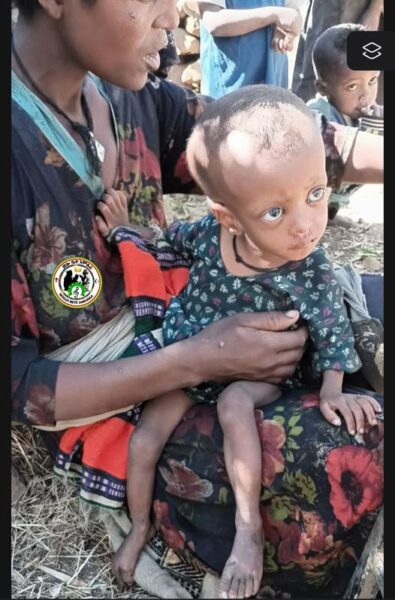
In a remote village in Ethiopia’s Afar region, three-year-old Hana lies motionless on a straw mat. Her tiny arms are stick-thin, her ribs protrude beneath fragile skin, and her breathing is shallow. Her mother, Fadumo, strokes her daughter’s forehead gently and whispers, “Eat, my child. Please eat.”
But Hana cannot eat. Severe acute malnutrition has weakened her body so profoundly that she can no longer swallow food.
“I brought her to the health post, but there was no therapeutic milk,” Fadumo explains, tears streaming down her face. “They told me to wait. But my daughter does not have time to wait.”
Hana’s story is tragically common. Across Ethiopia, millions of children are facing hunger, their lives threatened not by bullets or bombs, but by the slow, silent killer of malnutrition. Climate shocks, conflict-driven displacement, and deepening international funding shortfalls are converging into a perfect storm. The result is one of the world’s most under-reported humanitarian crises.
The Scale of the Crisis
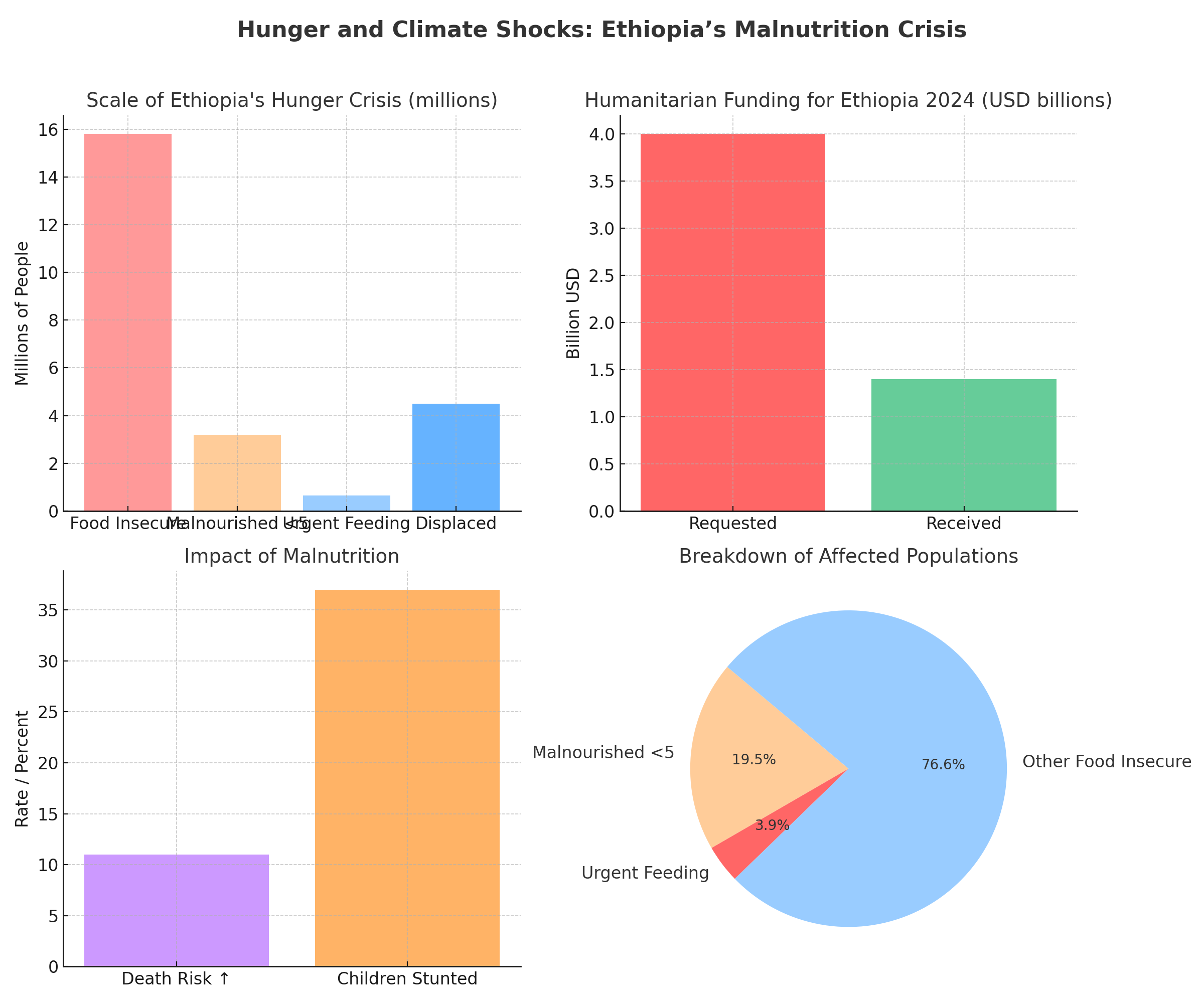
The numbers reveal a dire situation. UNICEF’s 2024 report estimates that 15.8 million people in Ethiopia face acute food insecurity, with 3.2 million children under the age of five acutely malnourished. Among them, 640,000 children urgently require therapeutic feeding just to survive. Meanwhile, over 4.5 million people have been displaced by drought and conflict, many of them children uprooted from homes, schools, and farms.
Behind each of these staggering figures is a child like Hana, whose future hangs in the balance. Hunger in Ethiopia is not abstract — it is embodied in the frail bodies of children gasping for survival.
Climate Shocks: From Drought to Floods
Ethiopia, once celebrated as the “water tower of Africa,” now struggles under the weight of climate extremes that swing violently between scorching droughts and devastating floods.
In the south and east, relentless drought has decimated crops and killed livestock, leaving pastoralist families destitute and children without food. In the north, erratic rainfall has unleashed floods, washing away farmlands, seeds, and topsoil.
“Climate change is no longer a distant threat; it is here, now,” warns Dr. Alemu Mekonnen, a climate researcher at Addis Ababa University. “Pastoralists who once thrived on livestock trade are losing entire herds. Farmers are watching crops fail season after season. Children are the first victims.”
A recent FAO climate assessment shows that Ethiopia has experienced five consecutive failed rainy seasons in the south, followed by flash floods in the highlands, a cruel cycle that erodes resilience and deepens dependence on aid.
Conflict and Displacement
The climate crisis collides with war. Ethiopia’s northern conflict, along with ongoing unrest in Oromia and Amhara, has disrupted farming cycles, destroyed health facilities, and forced millions into displacement.
In Tigray, farmlands were left fallow for years as farmers fled violence. In Amhara, fresh clashes still prevent families from planting or harvesting. Humanitarian corridors remain unstable, and aid convoys often face blockades or delays.
“Conflict strips families of everything,” explains Save the Children Ethiopia’s Country Director. “They lose their land, their homes, their savings. Displaced children often arrive at camps severely malnourished, some weighing half of what they should for their age.”
Testimonies from Families
The suffering is not captured by statistics alone but by the voices of families enduring hunger firsthand.
Alem, a 29-year-old mother of twins in Wag Hemra, Amhara, recounts: “When the fighting started, we ran. I carried one child, my husband carried the other. We left our sorghum behind. Now, my twins are thin like sticks. One cries all night from hunger. Sometimes I want to scream, but I have no voice left.”
Mohammed, a 42-year-old pastoralist father in the Somali region, once owned 200 goats. Now, he owns none. “Drought took them all,” he says bitterly. “My children drink water from a muddy pond shared with animals. They cough, they vomit, and they cry. How can a father watch his children die like this?”
In a camp for displaced people in Tigray, 11-year-old Selamawit shares her haunting dream: “I dream of bread. At night, I imagine injera on a plate. But when I wake, there is nothing. My belly hurts all the time. I want to go to school, but I cannot learn when I am hungry.”
Malnutrition: A Deadly Spiral
Malnutrition is not merely about empty stomachs. It is about weakened immune systems and heightened vulnerability. Studies show that malnourished children are 11 times more likely to die from diarrhea and that half of all under-five deaths in Ethiopia are linked to malnutrition.
The consequences are lifelong. Repeated malnutrition stunts growth, both physically and cognitively. Today, 37% of Ethiopian children are stunted, their brain development permanently impaired, their future productivity diminished.
At a stabilization center in Oromia, nurse Tigist Ayalew recalls a baby who was brought in weighing just four kilograms at 18 months old. “We fed her with ready-to-use therapeutic food. But she was too weak. She died in her mother’s arms. I still see her face at night.”
The Funding Gap
Despite the immense need, Ethiopia’s crisis is falling into the shadows of global attention. In 2024, the Humanitarian Response Plan appealed for $4 billion but received less than 35% of the required funds. The World Food Programme has already cut rations by 40%, leaving families with barely enough to survive. Several nutrition programs run by NGOs have been forced to shut down.
“The world has turned its back,” an aid worker in Afar laments. “Ukraine, Gaza, Sudan, these crises dominate headlines. Ethiopia’s children are dying in silence.”
Expert Analysis
Dr. Aida Mengistu, a nutrition specialist, stresses that the problem is structural: “Malnutrition in Ethiopia is not just about food. It is about systems. Health facilities without medicines. Schools without feeding programs. Markets disrupted by war. If we do not address the root causes, this crisis will not end.”
The UNICEF Representative in Ethiopia issues a grim warning: “Without immediate funding, hundreds of thousands of children will die. This is not an exaggeration. It is a mathematical certainty.”
From the FAO, a regional officer adds, “Climate resilience is key. Ethiopia needs irrigation, drought-resistant seeds, and support for pastoralists. Otherwise, every drought will push families deeper into hunger.”
The Human Toll
The crisis is hollowing out Ethiopia’s future. Malnourished children struggle in school, their learning impaired, their ambitions stifled. Families sell their last assets, goats, land, even cooking pots, just to buy food. Some parents, in desperation, marry off their daughters at a young age.
“I had to marry off my daughter at 13,” confesses a father in the Somali region. “I hated it. But she could eat in her husband’s house. I could not feed her here.”
This is the cruel face of hunger, where survival decisions destroy childhoods and strip away dignity.
International and National Reports
The IPC Acute Food Insecurity Report (2024) confirms that 15.8 million Ethiopians face severe food insecurity, with 3.2 million children acutely malnourished. Human Rights Watch (2023) warned that Ethiopian children face “a deadly mix of conflict, climate shocks, and neglect.” Meanwhile, OCHA (2024) describes Ethiopia as “one of the world’s largest humanitarian emergencies, but among the least funded.”
Glimmers of Resistance
Yet, amid despair, there are sparks of resilience. In Tigray, women’s cooperatives are reviving farmland using oxen loans and shared seeds. In Oromia, community health workers move from hut to hut, screening children and distributing supplements. In the Somali region, solar-powered irrigation pumps are enabling farmers to grow vegetables even during drought.
“These are small lights in the darkness,” says Plan International Ethiopia’s Director. “But they prove that with investment, recovery is possible.”
Ethiopia’s Silent Emergency
As the world’s gaze shifts elsewhere, Ethiopia’s children starve quietly. Climate shocks, armed conflict, and aid shortfalls are stripping away their chance at survival. Yet their suffering is not just an Ethiopian tragedy — it is a test of global conscience.
“Every child has the right to food,” says Fadumo, the mother of malnourished Hana. “If the world forgets us, what does that say about humanity?”
The question lingers, haunting and unresolved.
AfricaNewsChannel #EthiopiaHungerCrisis #ClimateShocks #FoodInsecurity #ChildMalnutrition #SilentEmergency #EastAfricaHumanitarianCrisis #ConflictAndClimate #NutritionCrisis #SaveEthiopianChildren #GlobalConscience #HumanitarianAction #AfricaSpeaks #VoicesOfEthiopia #FutureAtRisk








