





By ARMACA Team: A Nation Speaks After Silence
For years, the story of war in Ethiopia was told through fragments: official statements, scattered reports, and distant headlines. But when the national participatory radio program Voices: Ethiopia’s Ongoing Conflict and Civilian Protection, organized by the Amhara Region Media Association, went live, something unprecedented happened:
The narrative shifted from institutions to individuals.
This was not just a broadcast.
It was a moment when survivors spoke, listeners became witnesses, and a country heard its own pain; unfiltered.
Grounded in the Pulitzer Center-supported investigation
Falling Like Leaves: The War in Ethiopia and Its Crimes Against Civilians by Ann Neumann, the program transformed journalism into a lived experience.
Theme of the Project
Humanizing conflict through participatory storytelling
The program aimed to:
- Amplify civilian voices
- Bridge regional narratives
- Create a safe platform for national reflection
Narrative Summary of the Article
This article captures the raw voices of ordinary Ethiopians—survivors, women, youth, and displaced communities—who shared:
- Trauma and loss
- Fear and uncertainty
- Resilience and hope
It demonstrates how participatory media can:
- Reveal hidden realities
- Build empathy across divides
- Initiate healing dialogue
1. Stories Behind the Statistics
The Pulitzer investigation revealed staggering numbers:
- Up to 600,000 civilian deaths
- 5+ million displaced
But the radio program revealed what numbers cannot:
“We buried people without names,” one caller said.
“Even now, we don’t know how many we lost.”
These voices mirrored scenes described by Ann Neumann—families fleeing, communities collapsing, and civilians caught between forces.
2. Gendered Violence: The War Women Carry
A central theme that emerged also echoed in global discussions was gender-based violence.
In a related expert dialogue, speakers included:
- Tinebeb Berhane
- Vanessa Tsehaye
highlighted how sexual violence in Tigray was:
systematic, targeted, and deeply underreported
On the radio, one woman said:
“Even if the war ends, what happened to us will never end.”
This aligns with documented findings:
- Rape used as a weapon of war
- Survivors facing stigma and isolation
3. Hunger as a Weapon
Another recurring theme—both in the Pulitzer story and webinars—was famine.
Experts warned:
Starvation is not accidental—it is strategic
As discussed in international forums:
- Humanitarian aid was restricted
- Food systems were disrupted
A listener shared:
“We didn’t run from bullets—we ran from hunger.”
4. The Ongoing Crisis
Despite the Pretoria Peace Agreement, the situation remains fragile.
Listeners emphasized:
- Continued insecurity
- Displacement
- Lack of justice
“Peace was announced. But we are still suffering.”
Conclusion
This program shows that:
The war is not just history; it is a lived reality
Through radio, Ethiopia did not just listen.
It confronted itself.
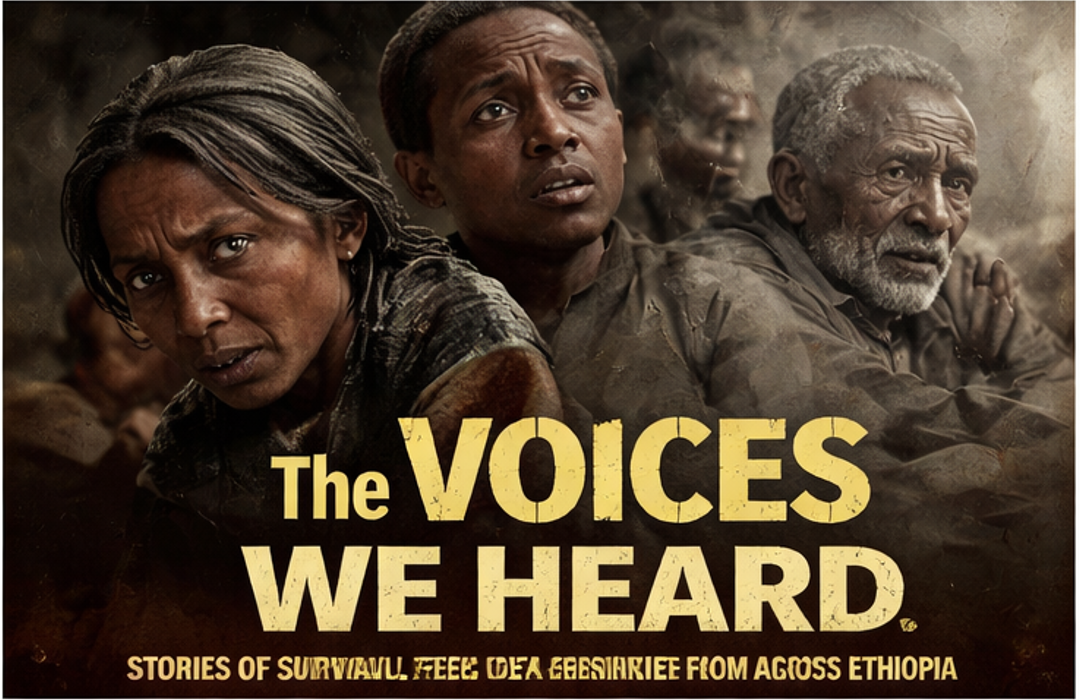
“The Voices We Heard: Stories of Survival, Fear, and Resilience from Across Ethiopia”
Introduction: When Pain Found a Microphone
They did not call themselves experts.
They did not call themselves politicians.
They are called survivors.
From the highlands of Amhara to the towns bordering Tigray, from university dormitories to displacement shelters, voices poured into the national radio program—raw, unfiltered, and often trembling.
For many, this was the first time they spoke publicly.
And what they shared was not just opinion.
It was a memory.
It was trauma.
It was true.
Chapter 1: “We Are Still Alive, But Not Living”
The first call that shook the studio came from a man who did not give his name.
There was silence before he spoke.
Then, slowly:
“We are still alive… but we are not living. Everything we had is gone.”
His words echoed a reality reflected in the reporting of Falling Like Leaves: The War in Ethiopia and Its Crimes Against Civilians by Ann Neumann:
- 385,000–600,000 civilians killed
- Over 5 million displaced
- Entire communities fractured
But statistics could not capture what came next.
The caller described:
- A home abandoned overnight
- Crops left to rot
- A family scattered across regions
“We don’t know where some of our relatives are. Maybe alive. Maybe not.”
Chapter 2: Women Who Carried the Invisible War
As the program continued, messages from women began to dominate.
Their voices were quieter, but heavier.
One listener sent a message that stopped the moderator mid-sentence:
“We survived the war, but the war did not leave us.”
Across conflict zones, sexual violence has been widely documented as a weapon of war. Reports cited in the investigation describe:
- Systematic rape
- Sexual slavery
- Long-term psychological trauma
A woman from a rural community shared:
“Even when the guns stopped, fear did not stop. We still feel unsafe.”
Another added:
“People talk about peace. But for us, peace has not arrived.”
These voices revealed something often ignored:
War continues long after the fighting ends
Chapter 3: Youth Between Anger and Uncertainty
Young people, students, unemployed graduates, and first-time voters spoke with urgency.
A university student said:
“We are the generation that grew up hearing about development. But what we see now is destruction.”
Another voice, sharper, more frustrated:
“We don’t trust what we hear anymore. Not from the media. Not from leaders. So where do we find truth?”
This loss of trust is critical.
Audience Poll Insight (During Broadcast):
- 70% said they struggle to identify reliable information about the conflict
- 65% said media coverage feels incomplete or biased
Chapter 4: The Geography of Fear
Calls came from different regions, but the emotions were strikingly similar:
- Fear
- Loss
- Uncertainty
One caller described fleeing at night:
“We walked for hours. No lights. No roads. Just fear.”
Another spoke of displacement:
“We are living in a school building. No privacy. No dignity.”
These testimonies align with documented realities:
- Schools turned into shelters
- Limited access to food and healthcare
- Interrupted education for millions
Chapter 5: When Silence Breaks
Perhaps the most powerful moment came not from what was said, but from what had never been said before.
A caller paused for nearly 10 seconds before speaking:
“I have never spoken about this. Not even to my family.”
The studio held its breath.
Then came a story of survival, hiding, escaping, and enduring.
This was the true power of the program:
It created a space where silence could finally break
Chapter 6: Resilience in the Ruins
Despite the pain, the program revealed something unexpected:
Resilience.
A farmer said:
“We lost everything. But we are starting again.”
A teacher added:
“Even in displacement, we are teaching children. They must not lose their future.”
These voices did not deny suffering.
They redefined survival.
Conclusion: A Nation Heard Itself
By the end of the broadcast, one truth was undeniable:
Ethiopia had listened to itself.
Not through filtered headlines.
Not through political statements.
But through the voices of its people.
And in those voices, there was pain.
But also something else:
The beginning of healing
“Truth Under Fire: Media, Misinformation, and the Struggle to Report War”
The ARMACA journey continues in this 2nd and 3rd articles: The War Over Truth
In modern conflict, controlling information can be as powerful as controlling territory.
In Ethiopia, the war exposed a second battlefield:
The fight over truth itself
Organized by the Amhara Region Media Association, the national radio program created a rare space where narratives could be questioned, challenged, and reconstructed.
Theme of the Project
Restoring trust in journalism and truth in conflict
Narrative Summary
This article explores:
- Information blackouts
- Media bias and fragmentation
- The dangers of misinformation
It connects radio discussions with global expert analysis and the Pulitzer investigation.
In-Depth Narrative
1. Information Blackout: Silence as Strategy
The Pulitzer story documents:
- Internet shutdowns
- Blocked access to Tigray
- Journalist expulsions
This created:
An information vacuum
2. Global Expert Perspective
In international discussions, experts like:
- Alex de Waal
- Sarah Vaughan
emphasized:
- The complexity of narratives
- The political use of information
Alex de Waal noted that:
“Control over humanitarian access and information is a central tool of war.”
3. Media Distrust
From the radio audience:
Findings:
- 70% confused by conflicting narratives
- 60% distrust media sources
One listener said:
“Truth depends on who is speaking. That is the problem.”
4. Ethical Journalism Under Pressure
Journalists faced:
- Risk of arrest
- Restricted access
- Ethical dilemmas
The story of Ann Neumann reflects these challenges directly.
5. The Role of Radio as a Trusted Medium
Unlike fragmented digital platforms, radio:
- Reached rural populations
- Created a shared understanding
- Enabled moderated dialogue
6. Peace Process and Narrative Control
Following the Pretoria Peace Agreement, discussions led by:
- Susan Stigant
- Joshua Meservey
highlighted:
- The importance of transparency
- The role of information in sustaining peace
Conclusion
Truth remains contested.
But initiatives like this radio program prove:
Dialogue can rebuild trust where information has failed
“Truth Under Fire: Media, Misinformation, and the Struggle to Report War”
Introduction: When Truth Becomes a Casualty
In war, bullets are not the only weapons.
Information is.
Narratives are.
Silence is.
The conflict in Ethiopia has not only been fought on battlefields, but it has also been fought in the media, in public discourse, and in the minds of millions trying to understand what is real.
Chapter 1: Reporting in the Dark
According to Falling Like Leaves: The War in Ethiopia and Its Crimes Against Civilians, one of the defining features of the conflict was:
A communications blackout
- Internet shutdowns
- Restricted access for journalists
- Limited humanitarian reporting
This created a dangerous vacuum.
Where there is no information, misinformation thrives.
Chapter 2: Competing Truths
During the radio program, one listener asked:
“How do we know what is true when everyone tells a different story?”
This question captures the core crisis.
Different actors presented:
- Conflicting narratives
- Competing claims of victimhood
- Selective reporting
An expert on the panel explained:
“Truth becomes fragmented. People believe what aligns with their identity, not necessarily what is verified.”
Chapter 3: The Cost of Misinformation
Key Insight from Audience Engagement:
- 70% of participants reported confusion about conflict information
- Over 60% said social media increased their anxiety
Misinformation leads to:
- Increased fear
- Heightened tensions
- Distrust in institutions
One caller said:
“Sometimes, what we see online makes the situation feel worse than reality or hides what is really happening.”
Chapter 4: Journalists Under Pressure
Reporting on conflict is never neutral.
Journalists face:
- Political pressure
- Security risks
- Ethical dilemmas
The investigation by Ann Neumann highlights:
- Deportation of journalists
- Limited access to affected areas
- Risks of reporting sensitive information
A panelist stated:
Journalists are not just observers. They are often targets.
Chapter 5: The Ethics of Telling Pain
One of the most difficult questions raised:
“How do you tell stories of suffering without exploiting them?”
This is the ethical challenge of war reporting.
Responsible journalism must:
- Protect dignity
- Avoid sensationalism
- Ensure accuracy
And yet, without telling these stories:
Suffering remains invisible
Chapter 6: Why This Radio Program Mattered
In a fragmented information environment, the radio program became:
✔ A trusted platform
✔ A space for verification
✔ A bridge between narratives
It did not claim absolute truth.
It created dialogue.
Conclusion: Defending Truth in Times of War
Truth is fragile in conflict.
But it is also essential.
Because without truth:
- There is no accountability
- No justice
- No lasting peace
And as one listener said:
“If we don’t tell our stories, others will tell them for us.”
#VoicesOfSurvivors #StoriesOfResilience #HumanStories #SurvivalStories #HopeAmidConflict #VoicesUnheard #ResilienceInCrisis #SpeakOut #CommunityVoices #HealingThroughStories #HumanityFirst @PulitzerCenter #PulitzerCenter #Ethiopia #VoicesOfEthiopia #JournalismMatters #Peacebuilding #CivicDialogue #HumanRights #ConflictReporting #AfricaMedia #StorytellingForChange #MediaForPeace








