





The battle over Africa’s global narrative is entering a new phase, and this time, African journalists are taking the lead.
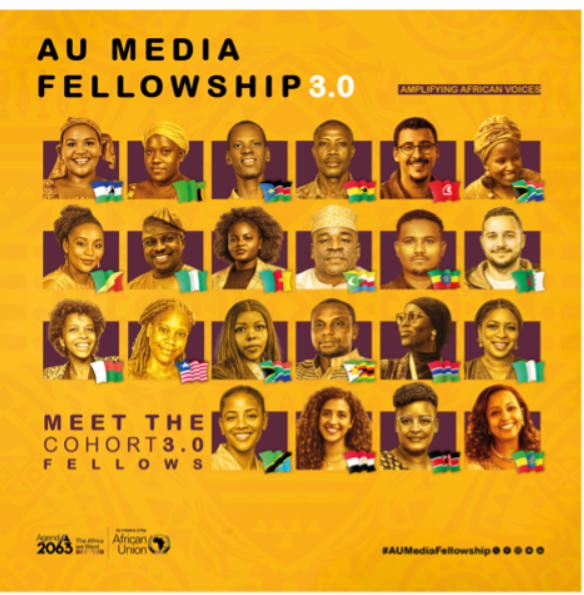
In a landmark announcement on March 6, 2026, the African Union Commission revealed the 22 journalists and storytellers selected for the third cohort of the African Union Media Fellowship Programme, an initiative designed to reshape how Africa tells its own story.
Chosen from more than 100,000 applicants across the continent, the fellows represent 18 African countries, reflecting a new generation of media professionals determined to challenge outdated narratives and amplify African perspectives.
According to the African Union, the fellowship is more than a training programme—it is a strategic effort to strengthen the role of media in advancing the continent’s long-term development vision under Agenda 2063.
A New Frontline in Africa’s Development
African media has become an increasingly powerful force in shaping public understanding of continental policies. By translating complex institutional agendas into accessible, people-centered stories, journalists play a critical role in bridging the gap between citizens and continental governance.
The new cohort of fellows will spend 16 months collaborating across borders, receiving mentorship from senior media leaders, and gaining professional training to produce solutions-driven journalism.
The programme is run through the Information and Communication Directorate of the African Union Commission, which sees storytelling as a strategic pillar for continental integration.
Wynne Musabayana, Head of the AU Communication Division, emphasized the significance of the selection.
“Selected from over 100,000 applicants, the 22 Fellows embody the bold vision and excellence of a continent shaping its own narrative.”
She added that their work is expected to strengthen public discourse, reinforce accountability, and amplify Africa’s voice globally.
The Fellows: A Pan-African Network
The selected fellows represent a diverse mix of media professionals working in digital, broadcast, and print journalism. Among them are two Ethiopian journalists, including Ayele Addis Ambelu and Tizita Girma.
The full list of fellows includes journalists from across the continent, such as:
- Abdillah Kemba (Comoros)
- Anis Seif Eddine Belmili (Algeria)
- Bongekile Filana (South Africa)
- Cynthia Areh (Nigeria)
- Elvy Gotiene (Congo)
- Emmanuel Ibukun Akindubuwa (Nigeria)
- Esther Ewune Otto (Cameroon)
- Isatou Keita (Gambia)
- Jacky Habib (Egypt)
- Justina Matandiko (Zambia)
- Lalaina Randriarimanana (Madagascar)
- Lourdes Walusala (Kenya)
- Mamer Abraham Kuot (South Sudan)
- Mapule Motsopa (Lesotho)
- Michael Dewornu (Ghana)
- Oussama Othman (Tunisia)
- Salome Gregory (Tanzania)
- Tawanda Forgive Dube (Zimbabwe)
- Tina Mehnpaine (Liberia)
- Zodidi Mhlana (South Africa)
Together, the fellows form what AU officials describe as a continental network of storytellers capable of influencing the digital information landscape.
Public Health Journalism Joins the Agenda
A notable innovation in Cohort 3.0 is the introduction of a Public Health Track, supported by the Africa Centres for Disease Control and Prevention.
Five fellows will focus specifically on reporting public health issues, a move aimed at strengthening credible, evidence-based health journalism across Africa.
Margaret Muigai Edwin, Director of Communication and Public Information at Africa CDC, highlighted the urgency of accurate health reporting.
She noted that solutions-driven journalism is crucial for building trust in institutions responsible for protecting public health across the continent.
Mentorship from Africa’s Media Leaders
Participants will receive mentorship from prominent figures in African media, including:
- Anita Eboigbe, Chief Operating Officer of Big Cabal Media
- David Mukholi, veteran journalist and national independence medal recipient
- Simmi Areff, Group Head of Audio and Video at Arena Holdings
The fellowship is also supported by international partners, including the European Union Delegation to the African Union and Deutsche Gesellschaft für Internationale Zusammenarbeit (GIZ).
Media, Technology, and Narrative Sovereignty
Beyond journalism training, the fellowship seeks to empower African storytellers to leverage digital tools and emerging technologies to reshape the continent’s global image.
Franz von Weizsaecker of GIZ emphasized that the initiative contributes to Africa’s digital transformation and narrative sovereignty, aligning with the African Union Digital Transformation Strategy 2020–2030.
By strengthening media capacity and encouraging cross-border storytelling, the programme aims to promote African-led narratives about development, governance, and innovation.
A Strategic Information Movement
Since its inception, the fellowship has grown into a network of 60 journalists and content creators working across audio-visual, print, and digital media.
At a time when misinformation and geopolitical competition over narratives about Africa are intensifying, AU officials view the programme as part of a broader strategy to ensure Africans tell their own stories.
With Cohort 3.0 now launched, the African Union hopes these journalists will not only report on Africa—but redefine how the world understands it.
AU50 #AfricanUnion #MediaFellowship #AfricaRising #AfricanJournalism #Agenda2063 #StorytellingAfrica #DigitalInnovation #PublicHealthJournalism #PanAfricanMedia #AfricanExcellence #FutureOfMedia #AyeleAddisAmbelu #AfricaNewsChannel #EMMANEWS








