





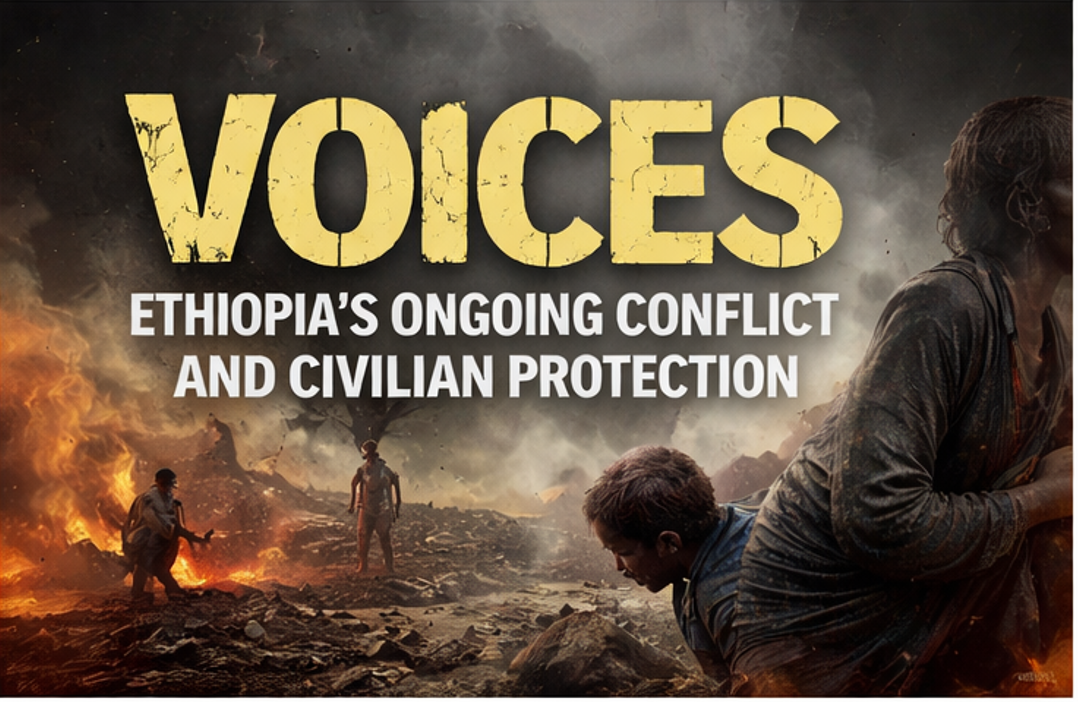
This webinar and radio-connected program is part of a national participatory media initiative led by the Amhara Region Media Association (ARMACA) in collaboration with a network of 32 community and university radio stations across Ethiopia, anchored by FM 87.9. The project draws directly from the Pulitzer Center–supported investigation “Falling Like Leaves: The War in Ethiopia and Its Crimes Against Civilians” by Ann Neumann.
Through a series of live, interactive radio broadcasts and extended digital engagement, including webinars, live and recorded radio programs, and audience-driven discussions, the program sought to transform a powerful investigative story into a living national dialogue.
This first program captures the opening broadcast, where the story was introduced not as history but as an ongoing reality. It reflects the voices of experts, survivors, and listeners across Ethiopia, revealing a country still wrestling with the consequences of war.
Theme of the Project
At its core, the project asked a difficult question:
What happens when a war officially ends; but its violence continues in silence?
The theme centers on:
- Civilian protection
- Ongoing conflict dynamics
- Media responsibility
- The power of storytelling in post-conflict societies
The Program Summary
This program documents: with a documentary film based on the Pulitzer Center–supported investigation “Falling Like Leaves: The War in Ethiopia and Its Crimes Against Civilians” by Ann Neumann.
- The framing of the Pulitzer investigation in a national radio setting
- Expert analysis linking past atrocities to current realities
- Emotional and raw audience testimonies from across Ethiopia
- The role of media amid misinformation and silence
It reveals that the war did not end; it changed form, becoming less visible, but no less devastating.
A Story That Refused to End
On paper, the war in northern Ethiopia ended in November 2022.
But on the airwaves, and in the voices of millions, it never did.
When the first broadcast of “Voices: Ethiopia’s Ongoing Conflict and Civilian Protection” went live, the studio was quiet, but the country was not. Phones lit up before the opening segment even finished. Messages flooded in. Names of towns. Names of victims. Stories long buried.
Because the truth is simple, and uncomfortable:
The war may have stopped being reported.
It never stopped being lived.
The Pulitzer Center investigation that anchored the program described a conflict that killed between 385,000 and 600,000 civilians, displaced over five million people, and weaponized hunger, rape, and silence.
But what the broadcast revealed is something even deeper:
Those numbers are not the past. They are the present.
From Investigation to National Conversation
The program began with a deliberate choice to treat the Pulitzer story not as documentation, but as unfinished evidence.
The moderator opened with a stark reflection:
“This is not just a story about what happened. This is a story about what is still happening—and what we are failing to see.”
Experts in the studio echoed this urgency.
A conflict analyst stated:
“What Ann Neumann documented was not an isolated tragedy. It was a pattern. And that pattern has not disappeared, it has spread.”
Across regions, from Amhara to Oromia to Benishangul-Gumuz, listeners confirmed what experts warned:
- Displacement continues
- Ethnic tensions persist
- Violence remains localized but frequent
- Humanitarian access is still fragile
When Silence Becomes a Weapon
One of the most powerful threads of the discussion focused on information blackout.
The original Pulitzer investigation emphasized how communication shutdowns obscured the scale of atrocities. The radio program revealed that, even now, silence remains one of the most effective weapons.
A journalist on the panel described it bluntly:
“You cannot respond to a crisis you cannot see. And you cannot see a crisis that is deliberately hidden.”
Listeners reinforced this reality.
A caller from northern Ethiopia said:
“During the war, we had no internet. No phone. Now we have a connection, but still no one is listening.”
Another added:
“It feels like the country moved on. But we are still there.”
The Human Cost Behind the Numbers
Statistics filled the studio, but it was the voices that gave them weight.
The Pulitzer investigation documented mass killings, sexual violence, and starvation used as a weapon of war. During the broadcast, these realities resurfaced, not as data, but as lived experience.
A woman from a conflict-affected area shared:
“We don’t talk about what happened to women. Not because it is rare, but because it is everywhere.”
A humanitarian expert reinforced this:
- Thousands of women experienced sexual violence
- Many cases remain unreported
- Survivors face stigma, isolation, and a lack of support
The expert paused before adding:
“The war did not end for these women. It simply became invisible.”
Echoes from the Webinar Discussions
The radio program was further strengthened by insights drawn from global webinar discussions on the Ethiopia conflict, including panels featuring humanitarian leaders, researchers, and diaspora voices.
In one discussion on gender-based violence and conflict:
A speaker emphasized:
“Sexual violence in conflict is not incidental; it is strategic. It is used to destroy communities from within.”
Another panelist added:
“When justice is delayed or denied, the violence continues in another form; through trauma, silence, and fear.”
These perspectives were woven into the broadcast, connecting Ethiopia’s experience to broader global patterns of conflict and accountability.
Starvation as a Weapon
One of the most chilling aspects of the discussion centered on hunger as a deliberate tactic of war.
The Pulitzer investigation highlighted how access to food and humanitarian aid was restricted during the conflict.
During the radio program, this issue was brought into the present.
A development expert stated:
“We are familiar with bombs and bullets. But we underestimate hunger. Starvation is quieter—but just as deadly.”
Listeners confirmed ongoing struggles:
“Food is still a problem. Not because it doesn’t exist, but because we cannot reach it.”
This echoed broader global discussions, where experts warned that:
- Blocking aid can be as destructive as direct violence
- Hunger creates long-term instability
- Children and vulnerable populations are disproportionately affected
Media Under Pressure
Another critical theme was the role of the media during and after the conflict.
The Pulitzer story itself highlighted the difficulty of reporting under restricted conditions. The radio program expanded this discussion, examining current challenges facing Ethiopian journalists.
A media expert in the studio noted:
“Journalists are caught between truth and survival. Reporting the truth can carry consequences.”
The discussion revealed:
- Limited access to conflict zones
- Political pressure and self-censorship
- Misinformation is spreading faster than verified reporting
A caller summarized the situation powerfully:
“We don’t know what to believe anymore. Every side has its own truth.”
The Audience Becomes the Story
What made the program extraordinary was not just what was discussed, but who was speaking.
The audience was not passive. They were participants, witnesses, and, in many cases, survivors.
Over the course of the broadcast:
- Hundreds of calls were received
- Messages came from across all regions
- Listeners shared personal experiences, fears, and reflections
One message stood out:
“This is the first time I feel like someone is listening to us—not speaking for us.”
This shift, from storytelling about people to storytelling with people, became one of the program’s most powerful achievements.
A Country Still Searching for Peace
Despite the peace agreement, the broadcast revealed a complex reality:
Peace exists on paper.
But on the ground, it remains fragile.
Experts highlighted:
- Continued ethnic tensions
- Unresolved territorial disputes
- Lack of accountability for past crimes
- Ongoing humanitarian challenges
A peacebuilding specialist reflected:
“Peace is not just the absence of war. It is the presence of justice. And we are not there yet.”
Closing Reflection: When Voices Refuse to Fade
As the program closed, the moderator returned to the central metaphor of the Pulitzer story:
Falling like leaves.
Lives lost.
Stories scattered.
Truths buried.
But something had changed.
Because through the radio program, those stories were no longer falling silently.
They were being heard.
And in being heard, they began to demand something more:
Recognition.
Accountability.
Action.
The final words of the broadcast captured this shift:
“We cannot bring back those who were lost. But we can decide whether their stories disappear—or whether they shape what comes next.”
“Voices That Refused Silence: Inside Ethiopia’s Most Powerful Radio Dialogue on War, Truth, and Survival”
Introduction: When the Airwaves Became a Battlefield of Truth
On a quiet evening, across cities, villages, refugee shelters, and university dormitories, millions of Ethiopians leaned closer to their radios; not for music, not for entertainment, but for something far more urgent: truth.
What unfolded was not just a broadcast.
It was a reckoning.
A national participatory radio program, Voices: Ethiopia’s Ongoing Conflict and Civilian Protection, transformed the country’s airwaves into a rare civic space where silence was broken, stories surfaced, and the human cost of war was spoken aloud.
For years, narratives of the conflict remained fragmented; shaped by fear, politics, and, at times, deliberate silence. But now, inspired by a deeply reported international investigation, the microphone was handed to the people.
And they spoke.
Chapter 1: The Story That Sparked a Nation
At the heart of the program was a powerful investigation: Falling Like Leaves: The War in Ethiopia and Its Crimes Against Civilians.
The story documented staggering realities:
- Hundreds of thousands of civilian deaths
- Entire communities displaced
- Sexual violence used as a weapon
- Information blackouts that hid suffering
But statistics alone do not move a nation.
Stories do.
Through vivid reporting, the investigation revealed something deeper—the human experience behind the numbers:
- A mother fleeing with nothing but her child
- A town emptied overnight
- Survivors carrying invisible wounds
The radio program took this reporting and asked a bold question:
What happens when a nation hears its own story, together?
Chapter 2: A Studio, A Nation, A Moment
Inside the studio, the atmosphere was tense, almost electric.
Journalists, conflict analysts, and humanitarian experts sat across from each other—not as distant commentators, but as witnesses to a shared reality.
Outside the studio, something extraordinary was happening.
Phones began ringing.
Messages flooded in.
Voices, once unheard, were now demanding space.
Chapter 3: When Listeners Became Participants
The most powerful moment of the broadcast did not come from the panel.
It came from the people.
A caller from a rural area spoke with a trembling voice:
“We are not statistics. We are people who lost everything.”
Another listener challenged the narrative:
“Why do we only hear one side of the story? Who decides what truth is?”
A young university student added:
“This program is the first time I’ve understood the war beyond social media.”
These were not just comments.
They were acts of courage.
In a context where speaking openly can be difficult, participation itself became a form of resistance.
Chapter 4: The Emotional Weight of Testimony
As the program continued, a pattern emerged.
The conversation moved beyond politics.
It became deeply personal.
Listeners described:
- Nights spent hiding in fear
- Families separated without communication
- The psychological toll of uncertainty
One message read:
“We survived, but we are not the same people anymore.”
Another said:
“Peace was announced, but inside us, the war continues.”
The studio fell silent.
Because in that moment, the truth was undeniable:
War does not end when guns fall silent.
Chapter 5: Experts Confront the Reality
The expert panel did not offer easy answers.
Instead, they confronted uncomfortable truths:
- Civilian protection remains fragile
- Accountability is still unresolved
- Media narratives are often incomplete
One expert stated:
“The greatest danger is not just violence, it is forgetting.”
Another added:
“When stories are not told, injustice becomes invisible.”
The discussion shifted from “what happened” to something more urgent:
What must happen next?
Chapter 6: The Power of Radio in a Divided Landscape
Why radio?
Because in Ethiopia, radio is not just a medium.
It is:
- Accessible in remote areas
- Trusted across generations
- Immediate and intimate
Unlike social media, which can amplify division, radio created a shared listening experience.
For two hours, millions heard the same voices, the same pain, the same questions.
And in that shared experience, something rare emerged:
A sense of collective reflection
Chapter 7: The Shift—From Listening to Understanding
By the end of the first broadcast, something had changed.
Audience feedback revealed:
- Increased understanding of the conflict
- Greater empathy for affected communities
- Stronger trust in investigative journalism
Listeners began connecting the dots:
- Between regions
- Between narratives
- Between personal and national experiences
One listener summarized it powerfully:
“Before this program, I thought the conflict was far away. Now I realize it is all of us.”
Chapter 8: Unexpected Impact—From Radio to Film
Perhaps the most remarkable outcome was not planned.
A group of young journalists, deeply moved by the program, decided to take the story further.
They asked:
What if this story could be seen, not just heard?
Using:
- Eyewitness accounts
- Radio discussions
- Field narratives
They began producing a documentary film.
This was more than a creative project.
It was a transformation:
- From audio → visual storytelling
- From discussion → documentation
- From listening → witnessing
The film preserved voices that might otherwise fade.
Chapter 9: The Risk and Responsibility of Dialogue
Not everything was easy.
The program faced real challenges:
- Managing sensitive discussions
- Preventing inflammatory language
- Ensuring safety and neutrality
Moderators played a critical role.
They guided conversations carefully, ensuring:
- Respect
- Balance
- Constructive dialogue
Because in a fragile context, words matter.
Chapter 10: A Nation Reflects
By the end of the broadcast, one thing was clear:
This was not just a radio program.
It was a national moment.
A space where:
- Pain was acknowledged
- Voices were heard
- Silence was challenged
And perhaps most importantly:
People felt less alone in their experiences
Conclusion: The Beginning, Not the End
The program ended.
But the conversation did not.
Across the country, discussions continued:
- In homes
- In universities
- In communities
The radio had done something powerful:
It reminded people that their voices matter.
And in doing so, it opened the door to something essential:
Dialogue as a pathway to healing
@PulitzerCenter #PulitzerCenter #Ethiopia #VoicesOfEthiopia #JournalismMatters #Peacebuilding #CivicDialogue #HumanRights #ConflictReporting #AfricaMedia #StorytellingForChange #MediaForPeace
#CivilianProtection #WarInEthiopia #EndViolence #ProtectCivilians #HumanitarianCrisis #ConflictVoices #NeverAgain #StopTheWar #JusticeForVictims #AccountabilityNow #EthiopiaConflict #WarStories








