How diaspora connections, online promises and transnational money networks can help fuel irregular migration from Africa and when those connections become a lifeline, not a crime
An investigative news analysis for Africa News Channel The Voice of Africans
By Ayele Addis Ambelu
Publication section: Investigations / Migration / Human Rights
The promise travels farther than the person
A young African sitting in a town far from the coast opens a smartphone and watches a video from a city thousands of kilometres away. A former neighbour appears in a photograph outside a European apartment block. A cousin in North America posts about a new job. Someone in a messaging group claims that a contact can arrange travel documents, secure employment or connect a prospective migrant with a reliable intermediary.
The images show arrival, not the journey. The apparent success is visible; the borrowing, visa refusals, dangerous crossings, exploitation and months of uncertainty may remain hidden.
For a young person facing unemployment, insecurity, family pressure or a future that seems to be shrinking, the message can feel more powerful than a government warning or a formal migration-information campaign. Someone who looks familiar has apparently made it. Someone who speaks the same language appears to know the route. Someone claims to know a person who can help.
The question is what happens next.
Does a relative in Canada explain a lawful route to family reunification? Does an established migrant in Europe help a young person find a verified employer? Does a community member in the United States contribute money for a legitimate visa application? Or does a seemingly trusted contact introduce the prospective migrant to an unlicensed broker, promise a visa that does not exist, or transfer money into a chain of intermediaries whose identities and responsibilities are deliberately obscured?
These are different transactions, with different legal and human consequences. Yet they can appear indistinguishable to a family desperate to believe that a journey will succeed.
The role of African diaspora communities in migration is therefore an important investigative question—but a more complicated one than the familiar accusation that people abroad are simply encouraging young Africans to leave home. Transnational connections can lower the cost of information, provide money for lawful travel, create employment opportunities and help migrants survive. The same social trust and communication channels can also be exploited by fraudsters, recruitment intermediaries and migrant-smuggling networks.
The evidence does not support treating African diaspora communities in Canada, the United States and Europe as a single organisation, much less as a collective criminal actor. It does, however, support investigating the ways family relationships, social networks, digital platforms and cross-border financial transactions may intersect with irregular migration.
A peer-reviewed study by migration researcher Milena Belloni examined how Eritrean refugees heading towards Europe negotiated financial support from relatives abroad. The study, titled “My Uncle Cannot Say ‘NO’ if I Reach Libya”, explored the moral and financial pressure that can arise when migrants ask relatives to finance journeys that may expose them to danger. The research does not establish that relatives abroad are responsible for smuggling. Instead, it shows why family financing can be more complicated than a simple decision to sponsor or reject a journey. Read the study in Ethnic and Racial Studies.
That distinction should guide the investigation.
The issue is not whether diaspora support exists. It does. The issue is when ordinary support becomes an incentive for a dangerous journey, when money changes hands through an opaque recruitment chain, when an intermediary knowingly facilitates unlawful entry, and when a person living abroad is deceived into financing a journey they believe to be safe or legal.
Africa News Channel’s investigation should follow these relationships across borders—not assume guilt from nationality, ethnicity, family ties or residence abroad.
A route sustained by more than geography
Migration is often presented as a story of departure and arrival: a young person leaves an African country and attempts to reach Europe or another destination. In reality, the journey can begin long before the person reaches an airport, a desert crossing or a coast.
It may begin with a conversation in a family home, a social-media post, an informal job offer, a promise of a visa or a discussion about who can contribute to travel costs. It may continue through a recruitment office, a relative, a money-transfer service, a local intermediary and a contact in a transit country.
Some journeys are lawful. Others begin lawfully but become irregular after a visa expires, a person loses employment or circumstances change. Some are organised through migrant smugglers who facilitate unauthorised entry for payment. Others involve trafficking, coercion, deception or exploitation. These categories overlap in some cases, but they are not interchangeable.
A person may travel irregularly without being trafficked. A person may be smuggled across a border and subsequently become a victim of exploitation. A trafficking victim may initially agree to travel for work, only to discover that the job, conditions or freedom promised to them do not exist.
Those distinctions matter because careless reporting can confuse victims with offenders, exaggerate the role of relatives and obscure the people who profit from deception.
The International Organization for Migration’s Displacement Tracking Matrix reported that 446,194 movements were tracked along the Eastern Route between the Horn of Africa and the Arabian Peninsula in 2024, compared with 395,000 in 2023 an increase of 13 per cent. Ethiopia accounted for 96 per cent of the movements recorded in the report, and 89 per cent of reported reasons for movement were economic. The report also recorded 558 deaths along the route in 2024, most of them caused by drowning. These are tracked movements, not a complete census of every migrant or a count of people whose journeys were financed by diaspora members. Source: IOM, Migration Along the Eastern Route – Report 58, January–December 2024.
The figures show the scale and danger of a migration corridor. They do not establish that people in Canada, America or Europe caused the increase. To make that claim, investigators would need evidence linking specific journeys to identifiable forms of overseas financing, recruitment, logistical assistance or coercion.
That evidence must be collected case by case.
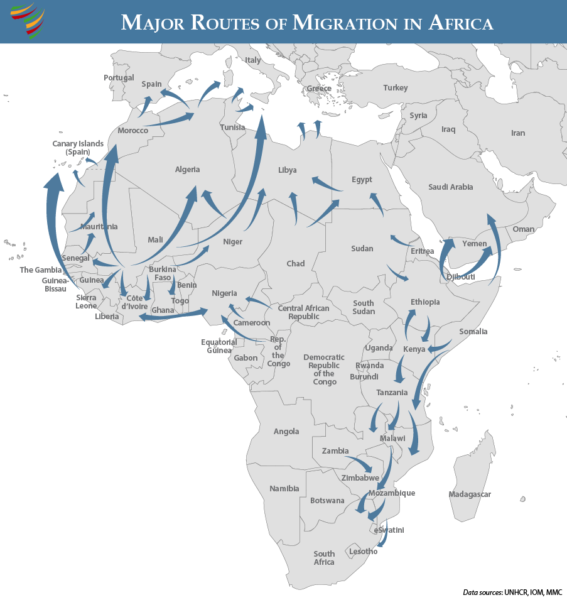
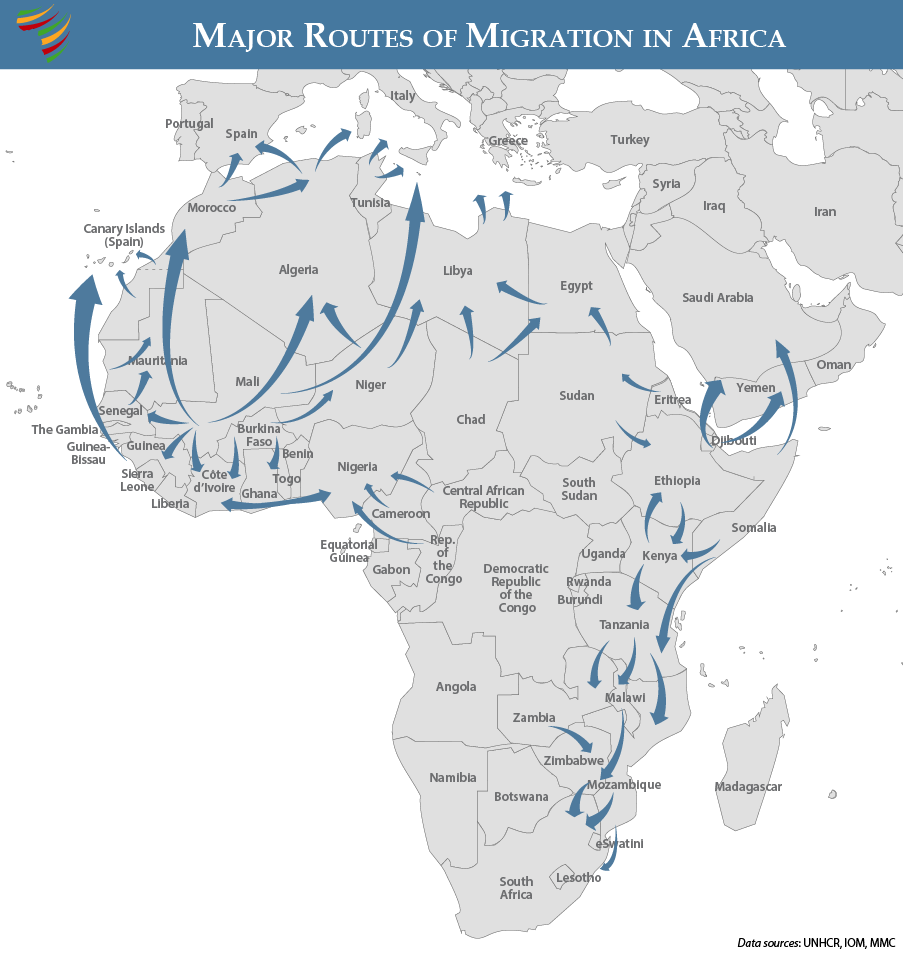
The route itself is not a single pipeline. Some people travel through Djibouti or Somalia towards Yemen and the Gulf. Others move through North Africa and attempt to reach Europe across the Mediterranean. Some travel through West Africa towards the Canary Islands. Others apply for visas, enter a destination country lawfully and later fall out of status. Still others seek asylum because they fear persecution or serious harm.
Each pathway has different rules, risks, actors and patterns of financing. A report that treats all of them as one “illegal migration network” will be dramatic but analytically weak.
The real investigation begins by identifying the people, payments and promises connecting one stage of a journey to another.
The diaspora connection: a bridge, a pressure point or a business opportunity?
African diaspora communities are diverse. They include refugees, students, professionals, entrepreneurs, care workers, long-settled families, recent arrivals and people who have lived abroad for generations. Their relationships with their countries of origin vary enormously.
Many diaspora members support relatives through remittances, school fees, medical costs, business investments and emergency assistance. They help people obtain reliable information, understand visa rules, find legitimate employment and settle after lawful migration. Community associations and hometown organisations can fund development projects, support education and maintain relationships across borders.
Research on transnational African networks has documented the importance of remittances, hometown associations and migrant connections to sending communities. Such relationships are not inherently suspicious. They are a normal feature of family life across national borders. See the Oxford Academic chapter, Sahelian Transnational Networks and Diasporas.
But networks built on trust can become vulnerable when the person asking for money is under pressure and the person providing it cannot independently verify what is happening on the ground.
A relative in Toronto may receive a message from a nephew in Addis Ababa asking for money to pay a recruitment agent. A family in Minnesota may be told that a European employer has guaranteed a work permit. A woman in London may be asked to send funds for a travel document that turns out to be counterfeit. A family in Italy may be told that a young man stranded in a transit country needs an urgent payment to secure release from a smuggler.
Some requests will be genuine. Others may be exaggerated, fraudulent or connected to a criminal operation. In still other cases, the family member abroad may know that the prospective migrant intends to travel irregularly but may not understand the danger, the legal consequences or the possibility that the money will fund exploitation.
A rigorous investigation must distinguish at least four roles.
First, the ordinary supporter. This person contributes money or advice, believing the travel is lawful or that the recipient will use the support responsibly. They may be a parent, sibling, aunt, uncle, cousin, friend or community member. Without evidence of knowing facilitation, they should not be labelled a smuggler or criminal.
Second, the person who encourages departure. This individual may tell relatives that opportunities abroad are better or that migration is worth the risk. Their influence may be important to the decision, but encouragement alone does not prove criminal involvement. Investigators must establish what was said, what was known and whether the person arranged or financed specific unlawful acts.
Third, the intermediary or broker. This person claims to arrange a job, visa, travel itinerary, accommodation or connection to someone who can move a migrant across a border. Some recruitment and immigration services are legitimate and regulated. Others may operate without authorisation, misrepresent their services or take money for documents and opportunities they cannot provide. A broker’s location in the diaspora does not by itself establish wrongdoing; the evidence lies in their conduct, representations, payments and legal obligations.
Fourth, the knowing facilitator or organiser. This is the category that demands the greatest scrutiny. A person may knowingly arrange transport, introduce a migrant to a smuggler, collect fees, coordinate payments or participate in an organised operation. Whether particular conduct constitutes an offence depends on the evidence and the applicable law. A report must not assign this label on the basis of rumour, association or a person’s diaspora identity.
The distinctions are not merely legal technicalities. They determine whether an investigation exposes a criminal business, unfairly damages a family or discourages a vulnerable person from seeking help.
The central question is not simply, “Did someone abroad send money?” It is: What was the money intended to pay for, who received it, what was promised, what did each participant know, and what happened after the payment?
When family assistance becomes pressure
Family obligations can be powerful. A person living abroad may be regarded as the relative who has “made it”—the person expected to help siblings find jobs, pay school fees or escape unemployment.
The expectation may be voluntary and affectionate. It may also become a source of pressure. Relatives at home may believe that a family member abroad can solve problems that would otherwise be overwhelming. The person abroad may feel compelled to provide help even when they are uncertain about the plan.
Belloni’s research on Eritrean refugees illustrates this difficult negotiation. Family members who finance a dangerous journey may face a moral dilemma: refuse the request and risk being blamed if the person remains trapped in hardship, or provide money and fear that the journey may end in kidnapping, exploitation or death.
This is not evidence that diaspora relatives deliberately cause irregular migration. It is evidence that family support can be shaped by obligation, expectation and limited alternatives.
A strong investigation should ask migrants and relatives separately how the decision was made. Who first suggested the journey? Who selected the route? Who estimated the cost? Was the family told that a visa or job was guaranteed? Did the person abroad believe that the money would pay for a legal application, or did they know that it would fund a clandestine crossing? Were they shown a contract, a receipt or a genuine job offer? Could they verify the information independently?
These questions can reveal whether the overseas relative was a decision-maker, a reluctant financier, a victim of deception or an active participant in a scheme.
They can also reveal an uncomfortable reality: the person with money is not always the person with control. A migrant may pressure relatives to pay because they have already invested in a journey. A broker may contact the family directly and claim that a payment is urgently needed. A person in transit may ask for money under threat. The relative abroad may transfer funds not because they approve of the arrangement but because they fear for someone’s safety.
In such cases, the transaction may sustain a dangerous system without making the person who paid a willing criminal participant.
The investigation should therefore reconstruct the chain of decision-making rather than treat all payments as proof of collusion.
The social-media showroom: success without the cost
The digital presentation of migration has changed the way some prospective migrants learn about life abroad. A phone can display employment announcements, travel advertisements, videos of people arriving in Europe, accounts of successful asylum applications, photographs of new homes and claims about how easily someone can cross a border.
Digital platforms can also provide legitimate information. Governments publish visa requirements. Universities advertise scholarships. Employers recruit internationally. Migrants share practical advice about housing, work and settlement. Community organisations explain rights and warn against fraud.
The same platforms can be used to mislead.
A post may present an exceptional outcome as an ordinary one. A person who reached a destination may describe a dangerous journey as easy. An account may use photographs of a successful migrant to advertise an unrelated service. A fake recruiter may impersonate a legitimate company. A broker may circulate videos of people who arrived safely while concealing the people who were robbed, detained, abandoned or killed.
The United Nations Office on Drugs and Crime has described how migrant-smuggling networks can use social networks and messaging applications to advertise services, recruit collaborators and circulate videos intended to persuade prospective clients that a journey has succeeded. Its 2025 working-group document discusses the role of digital communications in extending the reach of smuggling operations and attracting potential customers.
That evidence establishes a broader criminal pattern. It does not prove that every African-language migration group, diaspora page or person sharing an overseas success story is involved in smuggling.
The investigative challenge is to identify the point at which ordinary storytelling becomes deceptive marketing.
A newsroom could begin with a sample of public posts that explicitly offer migration-related services. The team would record the date, platform, advertised service, claimed destination, price, promised outcome and contact method. It would preserve the material securely, verify whether the advertised employer or agency exists, and compare any claims about visas or work permits with official requirements.
Researchers should not attempt to gain access to private groups through deception, publish personal information without a compelling public-interest justification or expose vulnerable people to retaliation. A public post is a lead, not proof of a crime.
The most revealing question may be whether a service provider makes claims that no legitimate adviser can guarantee. Does the advertisement promise a visa before reviewing the applicant’s circumstances? Does it claim that a work permit is certain if a large payment is made? Does it instruct applicants to lie on official forms? Does it offer fabricated employment records or documents? Does it refuse to identify the employer, licensing status or refund policy?
Those are testable questions. They are stronger than a general allegation that “social media is causing illegal migration.”
The investigation should also examine how success is measured. A person may reach a destination country but face debt, exploitation or the inability to work legally. A video of arrival does not reveal whether the person is safe, whether the journey was lawful or whether the person is being pressured to recruit others.
A successful arrival can become a sales tool even when the underlying service is dangerous. That possibility deserves scrutiny, especially when the person appearing in the video is asked to persuade relatives or acquaintances to pay for the same route.
The broker’s business model: selling certainty where none exists
The language of recruitment can make an uncertain journey appear like a standard commercial transaction.
An intermediary may claim to have contacts in a consulate, a company, an airline, a recruitment agency or an immigration office. They may present a logo, a business card, a contract, a payment receipt or a photograph with someone who appears influential. They may say that an application is “almost approved,” that a job is reserved, or that a special route is available to people who pay quickly.
Some services may be genuine. Others may be misleading or fraudulent. The difference can be difficult for a family to establish when the intermediary is recommended by someone they trust.
The United States Department of State’s 2024 Trafficking in Persons Report on Ethiopia described the use of trusted community members known as manamasas to recruit and groom vulnerable youth on behalf of trafficking syndicates. The report said such intermediaries may exaggerate the benefits of working abroad and noted that traffickers use technology, including false social-media accounts depicting successful migration, to recruit people. It also identified poverty, scarce economic opportunities and family encouragement as factors associated with vulnerable migration.
The report is a basis for investigating recruitment practices, not for assuming that all community intermediaries or all people encouraging overseas employment are traffickers. A local recruiter may be properly licensed; a family friend may be giving genuine advice; and a migrant may independently choose to travel. Investigators must identify the specific conduct and evidence.
For Africa News Channel, the most useful approach is to reconstruct a recruitment transaction from beginning to end.
A prospective migrant first hears about an opportunity. An intermediary claims to know an employer. The family receives a quotation. A payment is made. The applicant receives documents. The promised departure date passes. The intermediary asks for more money, blames a delay or stops responding. The family discovers that the employer does not exist, the visa is false, or the job terms are different from what was promised.
That sequence is a reporting hypothesis, not a claim that every case follows the same pattern. To establish it, journalists need the messages, payment records, documents and testimony of people directly involved.
Where a broker claims to have arranged legal employment, investigators should check the employer’s existence, the recruitment agency’s registration, the relevant licence requirements and the authenticity of the work authorisation. Where a broker claims to have arranged entry through an irregular route, journalists should investigate the actual service offered and avoid publishing operational details that could facilitate further unlawful crossings.
The newsroom should also examine whether the broker’s contacts abroad are real decision-makers or merely names used to build credibility. A person may invoke a relative in Canada or a friend in Italy to make a local operation appear international. Another may claim to represent a diaspora organisation without its knowledge or approval.
The crucial evidence is not the foreign location of a contact. It is whether the person made a false representation, knowingly arranged unlawful activity, took money through deception or participated in exploitation.
Following the money across borders
Money can connect people who never meet. It can also provide one of the strongest ways to test a migration story.
A family may pay a local agent. The agent may ask for a deposit to reserve a place in a recruitment programme. A second payment may be requested for documentation. A third may allegedly cover travel, accommodation or an overseas contact. In some cases, funds may be sent through ordinary financial institutions. In others, people may use cash, informal transfer arrangements or several intermediaries.
The existence of a transfer does not establish criminality. Remittances support millions of ordinary family transactions, and informal financial practices may have lawful uses. A journalist should not imply that a particular payment service or community is criminal simply because it appears in a story.
The investigation should instead ask whether the payment matches the service described. Was a written agreement provided? Was the recipient identified? Did the amount change after the original promise? Was the payer told that money would be sent to a government office, employer or airline? Can that claim be verified? Did the recipient provide a receipt or a valid reference number? Was the payment refunded when the promised service failed?
The Government of Canada’s 2025 assessment of money-laundering and terrorist-financing risks discusses the financial risks associated with human smuggling. It notes that smuggled people can become vulnerable to exploitation after entering a country irregularly, and it highlights the importance of investigating financial flows connected to smuggling operations. The assessment also discusses the use of informal value-transfer systems in moving proceeds across jurisdictions.
This does not establish that African diaspora remittances are generally linked to smuggling. The report concerns financial crime risks and should not be misrepresented as evidence against diaspora communities.
The newsroom must avoid a common investigative error: treating correlation as proof. A person sends money to a relative who later travels irregularly. That fact alone does not establish that the sender intended to finance an unlawful crossing. A transfer to a recruiter may be a legitimate fee, a fraudulent payment or part of a criminal operation. Its meaning depends on the surrounding evidence.
The most important financial questions are therefore specific:
- Who initiated the payment?
- Who ultimately received it?
- What service was promised in exchange?
- What documents or receipts support the transaction?
- Was the sender told that the money would finance a lawful application, a journey without authorisation, or an unspecified “connection”?
- Did the recipient knowingly misrepresent the service?
- Did the payment support a larger chain of recruitment or transport?
- What happened when the service failed?
Answering these questions may require cooperation from affected families, lawful access to records, financial experts and relevant authorities. Journalists should not obtain private banking information unlawfully or publish account details that could expose sources to fraud.
A well-documented payment trail can distinguish an ordinary act of support from a recruitment scam or knowing facilitation. Without that trail, the story risks turning suspicion into accusation.
Canada: a destination, a family network and a fraud-prevention challenge
Canada’s African communities include people who arrived through family sponsorship, refugee protection, study, employment and other lawful pathways. They also include people who have experienced exploitation, uncertain status or difficult journeys. Their experiences cannot be reduced to one migration narrative.
For some families in Africa, a relative in Canada represents stability and opportunity. That relative may be asked to explain the immigration system, contribute to application fees or help a family member navigate a complicated process. Such assistance can be legitimate and valuable.
But the same expectations can create an opening for fraudulent advisers. A prospective migrant may believe that a person who has lived in Canada understands every visa category or has influence over immigration officials. A broker may exploit that belief by claiming to possess special access or guaranteed results.
Canada’s immigration system is governed by formal eligibility requirements. No private individual can legitimately guarantee that an immigration application will be approved simply because they know someone in the country. A person offering paid immigration or citizenship advice must comply with applicable rules governing authorised representatives. Applicants should verify the identity and credentials of anyone claiming to provide professional advice.
In June 2025, Immigration, Refugees and Citizenship Canada reported increased scrutiny of visa integrity and fraud, including a rise in visitor-visa refusals for misrepresentation in 2024 compared with 2023. Those figures concern Canada’s administrative response to fraud and visa integrity; they do not show that African diaspora communities were responsible for the cases.
For the investigation, Canada should be examined as one of several locations where migration-related promises may be made, not as evidence that diaspora communities in the country are a collective source of irregular migration.
Journalists should test claims that someone in Canada arranged a job, guaranteed a visa, collected a fee or introduced an applicant to an intermediary. They should ask whether the person actually provided immigration advice, whether they were authorised to do so if required, whether the applicant received accurate information and whether the money was used for the stated purpose.
The investigation should also look at the other side of the relationship. Did the relative in Canada feel obliged to pay? Were they told that the applicant would be stranded if they refused? Did they know the route was irregular? Were they themselves deceived by a recruiter in the country of origin?
A diaspora member who sends money under pressure or false pretences may be a witness or victim, not an organiser.
Canadian authorities’ work on financial crime and smuggling can provide context, but a story about African migration must not conflate all smuggling cases with the activities of African communities. The journalist should identify the actual nationality, conduct and evidentiary basis of each case before drawing conclusions.
The broader question is whether legitimate family networks are being used as a bridge by unlicensed brokers and criminal intermediaries and what information would help families recognise the difference.
The United States: opportunity, uncertainty and the danger of guaranteed outcomes
The United States is another major destination for African students, professionals, workers, refugees, family members and entrepreneurs. African communities there maintain transnational relationships that support families, education, business and cultural life.
These relationships may also influence migration decisions. A relative may advise someone about study options, provide accommodation or contribute to travel expenses. A person already living in the United States may share information about work and daily life that is difficult to obtain from official sources alone.
Such assistance should not be confused with unlawful facilitation.
The investigative concern arises when an intermediary turns a real connection into a false guarantee. A recruiter might claim that a relative’s status makes a visa certain, that a company can provide a job without the required process, or that an applicant should conceal relevant facts. Another might collect fees for documents that cannot be verified.
The journalist must establish what was promised and by whom. Was the person offering advice a family member or a paid agent? Was the service described as legal immigration assistance, employment recruitment or a way to cross a border without authorisation? Did the person receive money? Did they know the claim was false? Was there a direct connection between the promise and the eventual journey?
A person’s presence in the United States does not automatically make them a source of influence over immigration decisions. Nor does the fact that a migrant has a relative in America prove that the relative organised their travel.
The story should also consider the pressure experienced by people abroad. Families may assume that anyone who has settled in the United States can afford to finance a journey. But migrants may be supporting children, paying rent, managing debt or navigating their own legal and employment difficulties. Some may fear that refusing a request will be interpreted as abandonment.
A responsible investigation should give diaspora interviewees a chance to explain those pressures rather than treating them solely as possible facilitators.
The question for US-based reporting is whether particular people or organisations have knowingly misrepresented immigration or employment opportunities, collected money through deception or coordinated unlawful entry. That requires records, corroborated testimony and a fair opportunity to respond.
Where a case involves allegations of fraud, journalists should distinguish a failed application from deliberate deception. Visa refusal does not by itself prove fraud; irregular status does not by itself prove smuggling; and a family member’s financial contribution does not by itself prove criminal intent.
Those distinctions are essential to an investigation that aims to expose wrongdoing rather than stigmatise migrants.
Europe: the destination image and the reality of the route
Europe is not one immigration system. Countries have different visa rules, employment requirements, asylum procedures and family-reunification policies. A person may travel lawfully to one country, seek protection in another or attempt to cross a border without the required authorisation. The reasons, legal status and risks differ.
For many young Africans, the idea of Europe is shaped by family accounts, social media, entertainment, community networks and the visible achievements of migrants who have established themselves abroad. A relative may describe stable employment, access to education or the ability to send money home. Those accounts may be entirely genuine.
But the visible outcome can conceal the uncertainty that preceded it. People may not discuss visa refusals, periods without work, exploitative employers, debts or the danger of a journey. A broker may select only the most persuasive images to market an expensive service.
This problem is not unique to African migration, nor does it prove that migrants abroad are deliberately misleading relatives. It raises a question about how information is selected, amplified and monetised.
Based on findings from IOM, UNHCR and UNICEF, found that more than two-thirds of children arriving in Europe through Mediterranean and Balkan routes in 2025 were unaccompanied or separated from their guardians. The report also documented violence and exploitation experienced by young migrants interviewed along several routes. The figures show serious protection concerns; they do not establish that diaspora communities caused those journeys.
The European Commission has also described migrant smuggling as a profitable business in which criminal networks use land, sea and air routes and increasingly exploit digital technologies. Its November 2025 overview estimated annual turnover of more than €5 billion for migrant-smuggling activity. That is an estimate for the broader smuggling business, not a measurement of money transferred by African diaspora members.
These sources support a serious investigation into organised smuggling and digital recruitment. They do not justify a headline claiming that Africans in Europe are collectively financing unlawful crossings.
A more precise investigation would identify the links between particular overseas contacts and particular journeys. Did a diaspora contact recommend a broker? Did they know the person was arranging an irregular crossing? Did they send money directly to a smuggling organiser? Did they receive a commission? Did they encourage a migrant to recruit others? Or did they simply help someone who had already decided to leave?
A report that answers these questions can expose facilitation where evidence supports it. A report that skips them risks confusing social connection with criminal organisation.
The Eastern Route: the human cost behind the numbers
The Eastern Route linking the Horn of Africa to Yemen and the Gulf offers a stark example of the dangers that can accompany migration through irregular channels.
IOM’s 2024 monitoring report recorded 446,194 movements along the route. It reported that departures from Ethiopia increased by 27 per cent from 2023 to 2024, reaching 234,015 tracked exits. Movements by women and girls increased substantially, and women and girls accounted for almost one-third of movements recorded during the year. The report also described captivity, extortion, abuse, gender-based violence and deaths along the route.
These figures point to a migration system under severe pressure. They do not tell us how many people received money from relatives in Canada, the United States or Europe, how many used brokers recommended by diaspora contacts, or how many were independently deceived by local intermediaries.
Those questions require additional research.
An investigative team could interview migrants who returned from Yemen, relatives who financed their journeys, community leaders who counselled families and service providers who assisted people in distress. With informed consent and careful protection, journalists could reconstruct how a decision was made and how a route was arranged.
The investigation should ask whether the migrant was promised employment, whether the promised job existed, whether the total cost changed, and whether anyone used threats to demand more money. It should establish whether overseas relatives knew the real route and whether the payments were intended for legal travel or for an intermediary.
The story should also recognise the limits of retrospective testimony. A person who has survived a traumatic journey may not remember every date or payment precisely. A family member may know only what they were told. A broker may deny responsibility. The newsroom should seek corroboration through messages, receipts, travel records and other evidence where lawful and safe.
The objective is not to identify a diaspora scapegoat. It is to establish whether a transnational network helped recruit, finance, transport, deceive or exploit a person and to identify which actors had knowledge and control.
When smuggling becomes trafficking
One of the most consequential errors in migration reporting is treating migrant smuggling and human trafficking as synonyms.
Smuggling generally involves facilitating a person’s unauthorised entry into a country for financial or material benefit. Trafficking involves acts such as recruitment, transportation or harbouring through specified means, for the purpose of exploitation; the legal definitions and requirements depend on the applicable framework and circumstances. Trafficking does not necessarily require an international border crossing.
A person may agree to pay a smuggler to cross a border and later be kidnapped or exploited. A person may agree to travel for work and discover that the job is fictitious or that their freedom is controlled. A recruiter may initially present an opportunity as lawful employment, while the actual arrangement involves deception and exploitation.
This is why investigators must ask what happened before, during and after the journey. Was the person free to leave? Were they threatened? Were their documents withheld? Did they incur a debt that they could not realistically repay? Were they forced to work? Were they deceived about the nature of the job or the conditions of travel?
The United Nations Office on Drugs and Crime’s 2024 Global Report on Trafficking in Persons examines trafficking patterns and forms of exploitation across regions. It is a useful source for understanding how deceptive recruitment and organised criminal activity can intersect. It should not be cited as proof that any particular diaspora community is involved in trafficking.
For a story focused on African diaspora networks, the distinction is especially important. A relative who pays a smuggler’s fee may be knowingly facilitating irregular movement, may be acting under pressure or may have been deceived about the nature of the service. A person who recruits someone for a fake job and then subjects them to exploitation may be involved in trafficking. The legal assessment depends on evidence, not on whether the person lives abroad.
The investigation should follow the chain of conduct. Who recruited the migrant? Who made the promises? Who collected the money? Who controlled the travel arrangements? Who benefited from the person’s labour or vulnerability? Who threatened the migrant or demanded further payment? Who knew what was happening?
Those questions are more likely to identify the responsible actors than a broad accusation against a diaspora community.
The invisible cost: debt, shame and silence
The financial cost of migration is often described as a number: the amount paid for a visa, an agency, transport, accommodation or a journey. But families may experience the cost as a long-term obligation.
A household may sell livestock, borrow from relatives, take a loan or use savings intended for education or medical care. A relative abroad may contribute money they cannot easily replace. A migrant may arrive at a destination with debt and feel compelled to accept unsafe work because returning home would mean admitting that the journey failed.
Debt can also discourage reporting. A family that borrowed heavily may fear public embarrassment. A migrant who discovers that a job is false may be reluctant to tell relatives that their savings have been lost. A person who has travelled irregularly may fear legal consequences or stigma. Someone who was deceived may worry that authorities will treat them as a willing participant rather than a victim.
These pressures can protect a fraudulent intermediary from scrutiny.
A journalist investigating a suspected recruitment scheme should not assume that silence means consent or that a person’s reluctance to speak proves a claim is false. Sources may be frightened, ashamed or concerned about relatives still in transit. They may also have reasons to exaggerate or misremember events. The correct response is careful interviewing and corroboration.
The newsroom should avoid publishing identifying details that could expose a migrant or their family to retaliation. If a source is still dependent on a broker for transport, accommodation or contact with relatives, disclosure may increase their danger. A pseudonym may be appropriate, but the newsroom should explain to readers why anonymity was granted without revealing details that defeat the protection.
The investigation should also examine the impact on diaspora households. Does a person abroad feel obliged to pay repeated fees? Has the family been told that someone will be harmed if money is not sent? Has the diaspora member borrowed funds or faced threats? Has the person been falsely accused of sponsoring a journey they did not organise?
Such accounts can complicate the popular narrative, but they can also reveal how the same network of trust may be exploited at both ends.
The role of legitimate recruitment and the danger of false promises
International recruitment is not inherently unlawful. People move for work, education, family and protection through established legal processes. Recruitment agencies, employers and immigration advisers may provide legitimate services, subject to applicable rules.
The problem is deceptive or abusive practice: false job offers, misleading claims about wages or legal status, fabricated documents, undisclosed fees, coercion, debt exploitation or promises that no intermediary can guarantee.
The International Labour Organization’s general principles and operational guidelines on fair recruitment provide a framework for examining recruitment practices and the protection of workers. They emphasise the importance of fair recruitment and addressing abusive practices.
An Africa News Channel investigation should compare the claims made by recruiters with the documents and legal requirements that govern the advertised opportunity. If a recruiter says that a worker has a job, the employer should be contacted independently. If a person says a visa is guaranteed, the relevant official requirements should be checked. If the broker claims to be licensed, that status should be verified with the appropriate regulator.
The newsroom should also investigate the role of informal recommendations. Did a prospective migrant select the agency through an advertisement, or did a friend in the diaspora recommend it? Did the overseas contact have direct knowledge of the employer, or were they repeating a claim from another person? Did the recommender receive money? Was the recommender told that the opportunity was legitimate?
A recommendation is not proof of wrongdoing. But if a person repeatedly directs applicants to a broker, collects fees or knowingly promotes false promises, those actions may be relevant to the investigation.
The journalist must establish the facts before using terms such as “trafficker,” “smuggler” or “fraudster.” Where evidence is incomplete, the article should describe the documented conduct and state what remains unverified.
What would prove that a diaspora contact helped fuel a journey?
The central claim requires more than a story about a migrant who has a relative abroad. Investigators need evidence of a meaningful connection between the contact and the journey.
The strongest evidence may include contemporaneous messages in which a person discusses a specific route, payment or broker; financial records showing a transfer tied to an identified service; documents that reveal a false job or visa promise; testimony from multiple independent witnesses; or evidence that the same intermediary arranged similar transactions for several people.
Even then, context matters. A message saying “I will send money for your travel” does not prove the sender knew that the recipient intended to cross a border unlawfully. A payment to a recruitment agency does not prove the agency was fraudulent. A person who introduces a relative to a broker may have believed the broker was legitimate.
The newsroom must determine whether the evidence supports one of several distinct conclusions:
- Support without knowledge of irregularity: A relative contributed to travel costs believing the journey was lawful.
- Advice or encouragement: A contact promoted migration or described opportunities abroad, without arranging unlawful entry.
- Negligent or reckless recommendation: A person recommended an intermediary without adequate verification, but evidence of deliberate criminal conduct is absent.
- Deceptive recruitment or fraud: A person knowingly made false claims or took money through deception.
- Knowing facilitation of irregular entry: Evidence indicates that a person knowingly helped arrange or finance unlawful border crossing.
- Participation in exploitation or trafficking: Evidence indicates that a person took part in recruitment or movement for exploitation, or knowingly helped maintain coercive conditions.
These are investigative categories, not a substitute for legal advice or a determination of criminal liability. The exact legal elements vary by jurisdiction, and only competent authorities or courts can make formal findings.
The categories also prevent the investigation from collapsing all forms of involvement into one accusation. A person can influence a decision without organising a journey. A person can finance a journey without knowing that a broker is deceptive. A person can be a victim of a scam and still unintentionally pass misinformation to others.
If the evidence shows knowing involvement, the article should say so precisely, explain the basis and include the accused person’s response. If the evidence does not establish that knowledge, the article must not imply it.
A cross-border chain of accountability
Migration-related transactions can cross several legal jurisdictions. A recruiter may operate in Ethiopia, a relative may live in Canada, a broker may be based in a Gulf country, and the intended destination may be in Europe. The people involved may communicate through encrypted messaging applications and use intermediaries to make payments.
This complexity can make an investigation difficult, but it does not justify speculation. The newsroom should map the chain of actors and identify what is known about each one.
A useful starting point is a transaction timeline: the first contact, the promise made, the fee requested, the payment date, the documents supplied, the travel date, the point at which the promise failed and any later demands for money. Each event should be linked to a source or document. Gaps should be marked as gaps rather than filled with assumptions.
The newsroom should distinguish first-hand evidence from hearsay. A migrant who personally handed money to a recruiter has direct knowledge of that transaction. A relative who heard about the payment from another family member has second-hand information. Both may be useful, but they are not equivalent.
Independent verification is especially important when a story could harm a person’s reputation or expose them to criminal allegations. A journalist should contact the person accused, explain the substance of the allegation and allow reasonable time for a response. If they decline to comment, the article can state that they were contacted and did not respond, provided that is accurate.
The investigation should also avoid implying that a person committed a crime merely because they have been questioned, investigated or accused. The status of any official investigation must be confirmed with the relevant authority, and the article should distinguish an allegation from a charge, a conviction or a final judicial finding.
A transnational investigation may require collaboration with journalists in Canada, the United States, Europe and countries of origin. Such cooperation can help verify records and understand local law. But source protection must remain central: sharing a source’s identity across newsrooms should require a clear purpose and appropriate consent or safeguarding measures.
What governments and communities should do
A response focused only on border enforcement may miss the earlier stages at which people encounter false promises. By the time a migrant reaches a dangerous crossing, the family may already have paid a substantial sum, sold assets or borrowed money.
Prevention should therefore include reliable information about lawful migration pathways, recruitment standards, visa requirements and the warning signs of fraud. Information must be accessible in languages people understand and should reach communities through trusted channels, including schools, local media, diaspora organisations and community groups.
Governments in countries of origin should make it easier to verify recruitment agencies and report suspected abuse. Where licensing systems exist, the public should be able to check an agency’s status and understand which fees are lawful. Authorities should investigate credible complaints, publish warnings about known scams and provide safe ways for victims to seek help.
Destination countries should ensure that migrants can find accurate information about immigration rules and authorised advice. Enforcement efforts should distinguish people who are vulnerable to exploitation from those who knowingly organise criminal activity. Where someone has been deceived, the ability to report the deception without unnecessary fear is important to identifying the people responsible.
Diaspora organisations can contribute by sharing verified information, warning against guaranteed visa promises, supporting people who return after a failed journey and connecting families with legitimate services. They can also make clear that no community leader or successful migrant has special authority over a visa decision simply because of their connections.
Journalists have a role of their own. They should investigate the financial incentives behind recruitment promises, explain the differences between smuggling and trafficking, avoid sensational claims unsupported by evidence and provide readers with practical ways to verify opportunities.
The objective should not be to stop every form of migration. People have legitimate reasons to move, and safe, lawful mobility can benefit migrants and their families. The objective is to reduce deception, coercion, exploitation and preventable deaths while holding responsible actors accountable.