
News Analysis | Technology, Language and Digital Inclusion
By Ayele Addis Ambelu (ayeleradio@gmail.com)
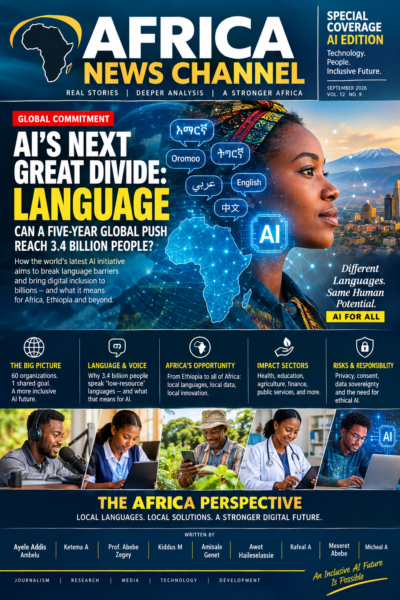
Artificial intelligence is expanding at extraordinary speed but for billions of people, the AI revolution is still happening in a language they do not speak.
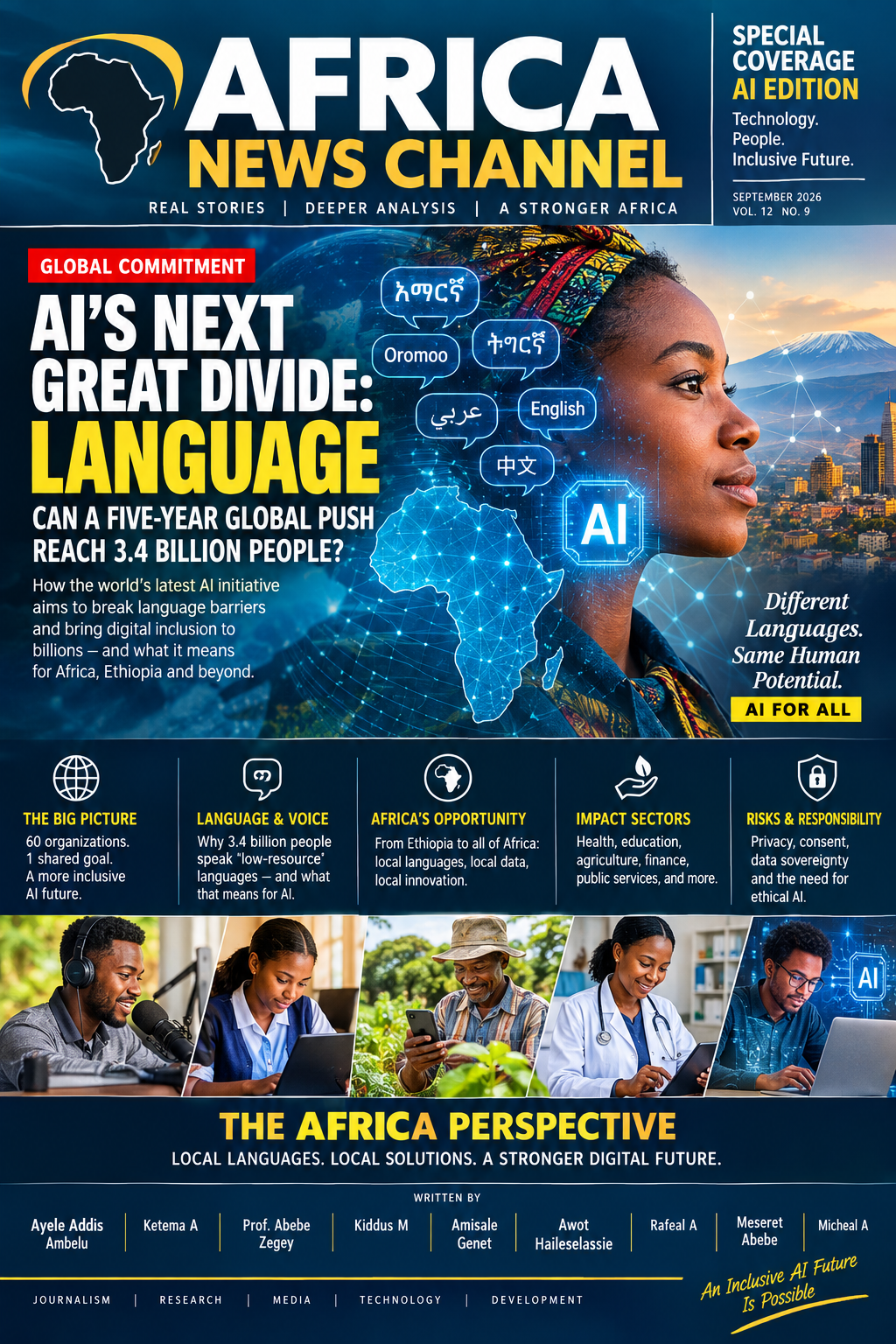
That could begin to change under a new five-year global commitment announced on September 21, 2026, bringing together 60 organizations from the technology, research, government, philanthropy and civil-society sectors with an ambitious target: to help an estimated 3.4 billion people use AI in their own languages and voices.
The initiative brings together major technology companies and AI organizations, including Google, Microsoft, Amazon, Anthropic and NVIDIA, alongside philanthropic, research and development institutions. Its African dimension is particularly significant, with organizations including Ethiopia AI Institute, Masakhane, Data Science Nigeria, Digital Green, Rwanda AI Scaling Hub, Viamo and Senegal’s Ministry of Telecommunications and Digital Affairs among the signatories.
The announcement addresses a problem that has received far less attention than the race to build increasingly powerful AI models: Who gets to participate in the AI revolution and in which language?
The hidden language barrier behind the AI revolution
The world is home to roughly 7,000 languages, yet only a small proportion are considered sufficiently well-resourced for strong AI performance.
That creates a profound digital inequality.
For speakers of languages that are poorly represented in AI training data, the problem is not simply that a chatbot may fail to translate a sentence. AI systems can struggle to understand dialects, slang, idioms, cultural references and speech patterns. Voice-based systems can perform particularly poorly where languages have limited speech datasets.
The consequences can extend far beyond inconvenience.
An AI system that misunderstands a question about education may provide an irrelevant answer. A system used for agricultural information may fail to recognize a locally used term. A health-information system that does not understand how people describe symptoms in their own language could create much more serious problems.
In other words, language is becoming an infrastructure issue for the AI age.
The emerging question is therefore no longer simply whether people have access to the internet or smartphones. It is whether the technologies running on those devices can actually understand them.
For Africa, the stakes are enormous
Africa may be one of the most important testing grounds for whether this initiative can succeed.
The continent has enormous linguistic diversity, with thousands of languages spoken across its countries and communities. Yet many African languages remain poorly represented in digital datasets, language technologies and AI benchmarks.
This creates what could become a new form of digital exclusion: people may have smartphones, broadband and access to AI applications while still being unable to use those systems effectively in their everyday language.
For Ethiopia, the issue is particularly consequential.
The country is linguistically diverse, with major languages including Amharic, Afaan Oromo, Somali, Tigrinya, Afar and others serving millions of speakers. The presence of the Ethiopia AI Institute (EAII) among the initial signatories places Ethiopia within a global coalition attempting to address precisely this language-access challenge.
But membership in the coalition is only the beginning.
The critical question will be whether African languages move from being discussed as “low-resource languages” to becoming properly resourced languages of AI.
That requires more than translating existing English-language systems.
Translation alone will not solve the problem
One of the most important aspects of the commitment is its recognition that language inclusion goes beyond text translation.
An AI system needs to understand how people actually communicate.
That includes speech, dialect, local terminology, cultural context, idioms and variations in everyday expression. For many communities, voice could be particularly important because speech interfaces may be more accessible than typing.
This makes local participation essential.
If language datasets are created without meaningful involvement from the communities that speak those languages, the resulting systems may reproduce inaccuracies or misunderstandings.
The commitment therefore identifies privacy, consent and data sovereignty as part of its responsible-development principles.
That is an important issue for Africa, where questions surrounding who owns local language data, who controls it and who benefits commercially from it are likely to become increasingly significant.
The four pillars and the real test ahead
The coalition says its work will focus on four broad areas.
First is the creation of an open language layer, including shared and safely managed language data infrastructure.
Second is measurement—developing assessments and benchmarks capable of showing whether AI performance is genuinely improving across underrepresented languages.
Third is turning language resources into usable AI tools and models, rather than leaving datasets sitting in research repositories.
Fourth is safe deployment, with attention to privacy, consent and data sovereignty.
These four areas point toward an important reality: the language gap cannot be solved simply by releasing another AI model.
It requires an ecosystem.
Researchers need datasets. Developers need models. Communities need to participate. Governments need appropriate policy frameworks. Universities need language technology research. Civil-society organizations need mechanisms to scrutinize how data is collected and used.
And, critically, speakers themselves need a voice in determining what successful AI representation looks like.
The 3.4 billion target is enormous but measurement will matter
The headline number 3.4 billion people is powerful.
But the real test will not be how many people can technically open an AI application.
The more important question is: How well does AI actually work for them?
If an AI system can generate a few sentences in a particular language but cannot reliably understand regional vocabulary, spoken language or culturally specific expressions, claiming meaningful language access could be misleading.
That makes the coalition’s proposed benchmarking effort particularly important.
Progress should ultimately be measurable through questions such as:
Can people communicate naturally with AI?
Can voice systems accurately recognize different speakers and dialects?
Can AI provide useful information in local languages?
Can communities correct errors and improve datasets?
Are language resources genuinely accessible to local researchers and developers?
Who owns the resulting data?
And who benefits economically from the technologies built from it?
These questions could determine whether the initiative becomes a genuine digital-inclusion effort or simply another global technology pledge.
Africa must move from being a language-data source to a technology partner
For African countries, the opportunity extends beyond simply gaining access to AI products developed elsewhere.
There is a possibility to build local expertise, datasets, research institutions and AI companies around African languages.
Organizations such as Masakhane and other African language-technology initiatives have already demonstrated that local researchers can play a central role in developing language technologies.
The new global commitment could accelerate that work if resources reach African researchers and communities rather than remaining concentrated among large technology companies and institutions in the world’s wealthiest countries.
This is where the commitment’s emphasis on an open language layer could become significant.
If language resources are genuinely open, safely governed and accessible to researchers and developers, African innovators could potentially build applications tailored to local needs in education, agriculture, health, financial services, public administration and journalism.
But openness alone will not guarantee equality. Funding, technical capacity, computing resources, governance and local ownership will determine who can actually use those resources.
The journalism implications are equally significant
For journalists, the language question could reshape how information moves across Africa.
AI capable of understanding local languages could support transcription, translation, research, fact-checking, accessibility and multilingual content production.
It could help connect reporting produced in one Ethiopian language with audiences speaking another. It could make public-interest information more accessible to communities that have historically received less digital content.
But journalism also faces risks.
Poorly trained language models can mistranslate statements, misunderstand political terminology, reproduce stereotypes or generate convincing but inaccurate information.
For newsrooms, therefore, language AI should not simply be viewed as a productivity tool. Accuracy, verification and editorial accountability will remain essential.
The better the language technology becomes, the greater the potential benefits and the greater the consequences when it gets something wrong.
A five-year promise now enters the implementation phase
The September 21 announcement represents an important shift in the global AI conversation.
For years, much of the AI race has focused on larger models, faster chips and increasingly sophisticated applications. The new commitment puts another question at the center of the discussion:
Can AI understand the people who are currently being left behind?
The coalition’s five-year ambition is substantial. Sixty organizations have initially signed on, with the statement inviting additional participants to contribute expertise and resources. The detailed governance structure and workstreams are expected to be developed collaboratively over the coming year.
That means the announcement is not the end of the story. It is the beginning of a difficult implementation process.
For the world’s billions of speakers of underrepresented languages, the outcome will ultimately be measured not by the number of organizations on a signatory list, but by whether AI can genuinely listen, understand and respond in the languages they use every day.
The next AI divide may not be between those who have AI and those who do not. It may be between those whose languages AI understands and those whose languages remain invisible to the machines.
And the five years ahead will determine how much of that divide can actually be closed.