





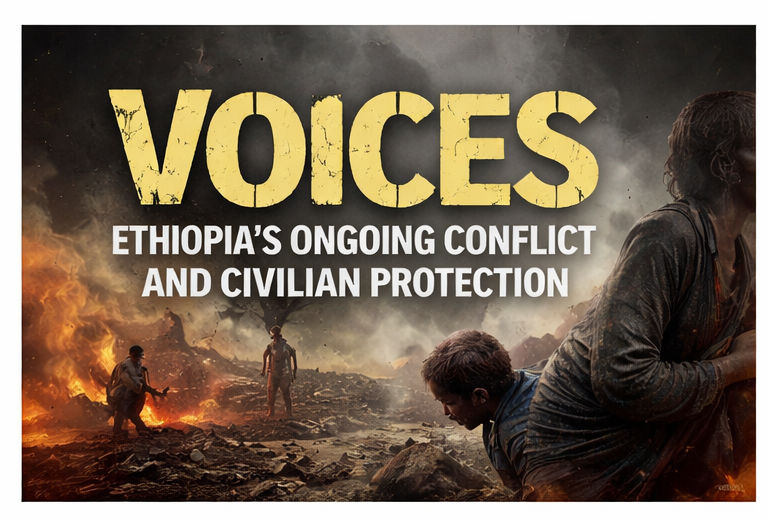
BY ARMACA: When a Story Refused to Stay on the Page
It began with a story, one that carried the weight of grief, silence, and unanswered questions. A story written by Ann Neumann and supported by the Pulitzer Center: “Falling Like Leaves: The War in Ethiopia and Its Crimes Against Civilians.”
But this was not just a story to be read.
It became a story that had to be heard.
Across Ethiopia, where conflict had fractured communities and silence had settled over painful truths, a bold idea emerged:
What if journalism could move beyond the page—and into the voices of the people?
What followed was not just a radio program.
It was a national awakening.
Chapter One: Turning Journalism into a National Conversation
Inside a modest studio at Addis Ababa, a team from the Amhara Region Media and Art Charitable Association (ARMACA) prepared to attempt something unprecedented.
Not a broadcast.
Not a debate.
But a living dialogue.
The concept was radical in its simplicity:
- Take one deeply reported investigation
- Open it to the public
- Let the nation respond
Three live broadcasts.
Two hours each.
Millions listening.
But no one anticipated what would happen next.
Chapter Two: The First Broadcast — Breaking the Silence
The microphone opened.
A voice introduced the story.
Not with politics.
Not with blame.
But with people.
Descriptions of civilians. Families. Displacement. Loss.
The words of Ann Neumann echoed through the airwaves—stories of Lalibela, of fear, of survival.
And then, something shifted.
The phones began to ring.
At first, slowly.
Then relentlessly.
From cities. From rural towns. From places rarely heard in the national media.
One caller said:
“We thought we were alone. Now I hear the same story from others.”
Another voice, trembling:
“This is the first time I’ve heard the truth spoken like this.”
The program had done something extraordinary.
It had broken silence.
Chapter Three: When Listeners Became Witnesses
By the second broadcast, the program was no longer controlled by the studio.
It was being shaped by the people.
Listeners were no longer just reacting.
They were testifying.
Stories came in waves:
- Displacement across regions
- Fear that never left even after ceasefires
- Families separated
- Communities struggling to rebuild
A young caller said:
“The war may have stopped, but the fear didn’t.”
Another added:
“We survived—but no one asked us what that means.”
The studio changed.
The experts spoke less.
The people spoke more.
And for the first time, a national platform reflected something deeper than headlines:
➡ Shared human experience
Chapter Four: Truth Under Pressure
But truth is never simple.
As discussions deepened, so did tensions.
Questions emerged:
- Who is responsible?
- Why are civilians always the victims?
- Can media be trusted?
The program confronted one of the most difficult realities:
➡ War does not produce one truth—it produces many competing truths.
Experts spoke about:
- Information blackouts
- Misinformation
- The danger of narrative control
One media analyst warned:
“When truth disappears, conflict grows.”
Listeners responded:
“Sometimes silence is more dangerous than lies.”
The program was no longer just about conflict.
It was about truth itself.
Chapter Five: A Nation Listening to Itself
By the third broadcast, something remarkable had happened.
Ethiopia was no longer just listening to a program.
➡ It was listening to itself.
Voices from different regions—who had never heard each other before—were suddenly connected.
A caller from one region said:
“I didn’t know others were suffering like us.”
Another responded:
“Now we know. And that changes everything.”
This was the turning point.
The program had moved beyond awareness.
It had created:
- Recognition
- Empathy
- Shared understanding
Chapter Six: The Moment That Changed Everything
And then, something no one planned.
Something no proposal predicted.
A group of young journalists—listening, documenting, absorbing—decided:
“This story cannot stay on radio.”
They began collecting:
- Eyewitness testimonies
- Audio recordings
- Emotional moments from the broadcasts
They transformed sound into vision.
Stories into scenes.
Voices into images.
And from that moment, the project evolved into something entirely new:
➡ A documentary film movement
Chapter Seven: From Airwaves to Screens
The documentary was not just an output.
It was a transformation.
Radio had sparked:
- Dialogue
- Reflection
- Emotional release
The documentary captured:
- Faces behind voices
- Silence between words
- The depth of lived experience
It became a new storytelling model:
➡ Radio → Dialogue → Documentary
A young journalist involved in the film said:
“We didn’t just report the story. We lived it with the people.”
Chapter Eight: Beyond Broadcast — A Movement Emerges
What started as a 3-week program expanded into:
- National conversations
- Online engagement
- Academic discussions
- Webinar reflections
Experts from global institutions joined conversations on:
- Humanitarian crises
- Gender-based violence
- Peacebuilding
The discussions connected local realities in Ethiopia with global insights.
One speaker noted:
“The Ethiopian experience reflects a global truth—civilians always pay the highest price in war.”
Chapter Nine: The Data Behind the Emotion
Behind the powerful stories were powerful numbers:
- 5.3+ million people reached
- 4,650+ active participants
- 420+ live calls
- 3,000+ social media engagements
But the most important number?
➡ One nation engaged in dialogue
Chapter Ten: What Changed
Before the program:
- People listened
- People felt isolated
- People held fragmented views
After the program:
- People spoke
- People connected
- People understood
One listener said:
“This program didn’t just inform us—it connected us.”
Chapter Eleven: The Power of Listening
Perhaps the greatest achievement was not what was said.
But what was heard.
For the first time:
- Survivors were listened to
- Communities were acknowledged
- Silence was challenged
And in that process, something rare happened:
➡ Media became a space for healing
Conclusion: A Story Still Being Written
The war may have changed form.
The violence may have shifted.
But the questions remain.
And so do the voices.
This project proved something profound:
A story is never just a story.
When given space, it becomes:
- A conversation
- A connection
- A catalyst
From the reporting of Ann Neumann to the platform created by the Pulitzer Center, and the voices amplified by ARMACA—
This journey showed that even in the aftermath of conflict:
➡ People are ready to speak.
➡ People are ready to listen.
➡ And when they do—change begins.
Final Line
This was not just a radio program.
It was the moment a nation chose to hear itself.








