A Story Begins with a Warning
In a quiet training hall in Addis Ababa, a story that began thousands of kilometers away slowly unfolded into something far more powerful than a workshop. It started with a single investigative report by the Pulitzer Center: Climate Change Is Driving Millions to the Precipice of a Raging Food Catastrophe, a deeply reported warning that climate change was no longer a future threat, but a present catastrophe reshaping lives across Africa.
But what happened next in Ethiopia was something extraordinary. That story did not remain a document. It became a movement.
The Gathering: Voices from Across Ethiopia
They came from cities and towns, across the country not just as participants, but as witnesses to a reality they had lived.
Among them were journalists like Getnet Demelie, Gion Fentahun, and Mulugeta Hunachew, whose daily work already placed them at the frontline of public narratives. Alongside them sat legal professionals like Getachew Wonde and Simegnew Mequanint, community leaders such as Mesfin Adimas, and youth representatives including Girum Misali and Abayenhe Getu.
Women’s voices carried equal weight Firehiwot Mustofa, Birtie Mezgebu, Selam Desalegn, and Yewerkeweha Haile bringing perspectives shaped by lived realities of vulnerability and resilience.
Academics like Dr. Asegidew, policymakers such as Prof. Areya, and media leaders, including Addis and Solomon added intellectual and institutional depth.
Sixty participants. Sixty perspectives. One shared realization:
The crisis described in the Pulitzer story was already unfolding around them.
The Moment of Realization
As facilitators guided participants through the investigation, the room shifted from passive listening to deep reflection.
The Pulitzer report described how repeated drought destroys livelihoods, how livestock deaths trigger immediate hunger, and how fragile systems collapse under pressure. These were not abstract findings.
Participants from Bahir Dar spoke of declining harvests.
Voices from Injibara described water scarcity.
Community representatives from Debre Markos spoke of migration and instability.
Then came the comparative lens.
The Somalia investigation Prolonged Drought Brings Famine, Death, and Fear in Somalia—revealed famine as a regional reality.
The Kenya report Hospital Ward of Starving Children: Kenya Has Seen a Surge in Cases This Year showed the human cost in hospital wards filled with malnourished children.
Suddenly, Ethiopia was not an isolated case.
It was part of a continental pattern.
From Understanding to Urgency
What made this workshop different was not the information—it was the transformation.
Participants were not asked to summarize the story.
They were challenged to respond to it.
Inside breakout groups, ideas began to take shape. Journalists debated narrative framing. Youth participants explored visual storytelling. Community leaders discussed how to communicate crisis without fear.
The question shifted from:
“What is happening?”
to
“What must we do?”
The Birth of a Movement: Digital Storytelling Takes Over
When the workshop ended, the real work began.
Across Ethiopia, participants and extended youth networks began producing short videos, visual narratives, digital testimonies. What emerged was not a contest, but a nationwide storytelling wave.
Among dozens of submissions, three voices rose above all others.
The Faces of Impact
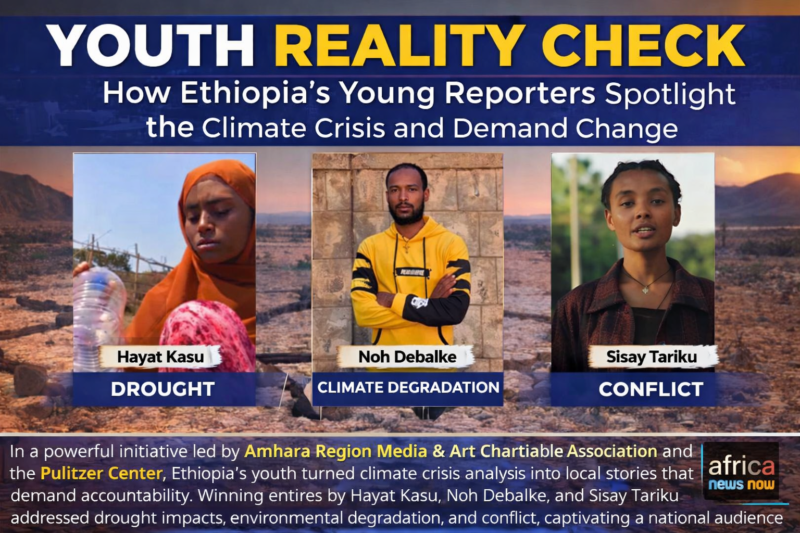
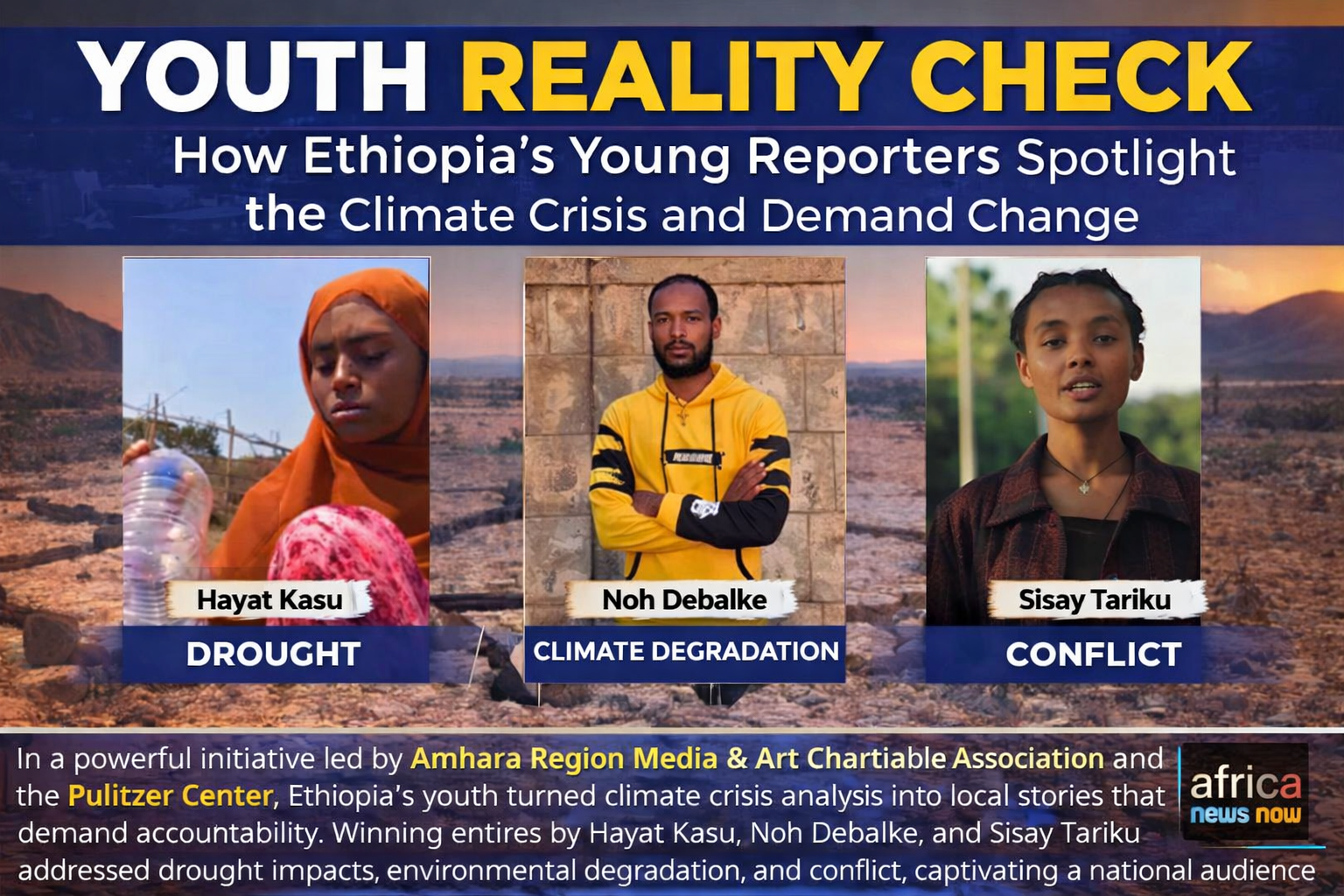
Hayat Kasu, the grand winner, did not speak loudly. Her video did something more powerful it showed silence. A woman sitting with a bottle of water. Dry land. Waiting. Her story captured drought not as an event, but as a slow erasure of life. It reflected the Pulitzer finding that when rains fail repeatedly, communities lose not just crops, but their future.
Noh Debalke, the second-place winner, chose metaphor. He described climate change as a wound—something that deepens over time. His narrative aligned with the investigative insight that each failed season compounds the next, leaving communities weaker and more vulnerable.
Sisay Tariku, third place, took a different direction. He told a story of peace under pressure. His work revealed how scarcity fuels tension, how instability grows, and how civilians are caught in between. His storytelling expanded the Pulitzer narrative into the realm of conflict and protection.
Together, these three voices told a complete story:
environment, suffering, and survival.
A Nation Responds
What followed was beyond expectation.
The project reached more than 400,000 people, with over 6,000 active engagements. But the numbers only tell part of the story.
Comments flooded in from young people across Ethiopia:
They spoke about drought in their villages.
They questioned why food insecurity persists.
They demanded accountability.
The audience was no longer consuming content.
They were participating in a conversation.
More Than a Workshop: A System of Change
The success of the project lies not only in its outputs but in its structure.
It connected:
- Investigative journalism
- Youth creativity
- Digital platforms
- Community voices
It transformed:
- Participants into storytellers
- Stories into awareness
- Awareness into dialogue
And most importantly, it localized a global crisis.
The Evidence of Impact
Participants reported a deeper understanding of:
- Climate systems
- Food insecurity
- The role of media
Many are committed to continuing storytelling efforts. Others initiated discussions within their communities.
The Pulitzer story provided the foundation.
But the participants built the structure.
Challenges That Strengthened the Journey
The journey was not without difficulty.
Limited internet access restricted some participants.
The complexity of the investigative material required simplification.
Not all had the technical tools for content creation.
Yet these challenges led to innovation:
- Peer learning groups emerged
- Simpler storytelling formats were adopted
- Collaboration increased
A New Narrative for Africa
What happened in this project is a model for something larger.
It shows that:
- African youth are not passive recipients of global narratives
- They are creators, interpreters, and amplifiers
It proves that investigative journalism can go beyond publication—
it can become participation.
Conclusion: When Stories Become Power
This was never just a workshop.
It was a turning point.
A global investigation entered a room in Addis Ababa.
It left as 50+ stories, thousands of voices, and a national conversation.
And in that transformation lies its greatest achievement:
The crisis was reported.
The people responded.
And together, they created change.